
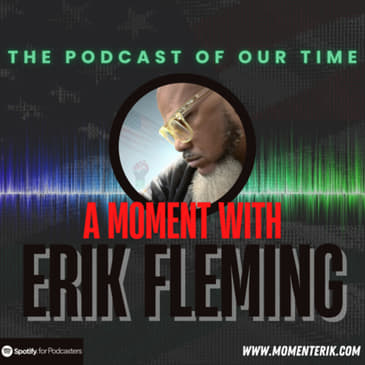
[00:00:00] Welcome. I'm Eric Fleming, host of A Moment with Eric Fleming, the podcast of our time.
[00:00:07] I want to personally thank you for listening to the podcast. If you like what you're hearing,
[00:00:11] then I need you to do a few things. First, I need subscribers. I'm on Patreon at patreon.com
[00:00:17] slash A Moment, Eric Fleming.
[00:01:40] And today is another great episode.
[00:01:43] I am really, really again, I'm really, really blessed to have quality guests come on this a New York judge set a trial date for March 25 and rejected Trump's request to dismiss the case. Alexei Navalny, a prominent Russian opposition figure, died in a penal colony, drawing international attention and critical statements from U.S. leaders like Vice President Kamala Harris, who met with Navalny's wife at the Munich Security Conference.
[00:04:02] its border security efforts.
[00:04:06] Special counsel David Weiss has indicted Alexander Smirnoff, a former FBI informant
[00:04:10] for lying about Hunter Biden's business dealings
[00:04:13] with Burisma Holdings.
[00:04:16] An independent commission in New York
[00:04:17] has approved a new congressional map,
[00:04:20] which experts say provides a slight advantage to Democrats.
[00:05:22] I'm not the best news presenter.
[00:05:25] That's why I wanted Grace to do it. But as we stated, Grace is recovering.
[00:05:29] And I ask you to continue to
[00:05:33] send your thoughts and prayers to her
[00:05:36] as she's recovering.
[00:05:37] And trust me, I will be glad when she comes back.
[00:05:42] But we're gonna, as nonprofit after school program in Queens, New York. The New York Association of Black Journalists awarded her first place
[00:08:11] All right, Christina. How you doing, sister?
[00:08:14] You're doing good.
[00:08:15] I'm doing well.
[00:08:16] Thank you so much for having me.
[00:08:18] I'm excited to discuss all these things with you.
[00:08:21] Well, I'm honored.
[00:08:22] First of all, that you had the time to do you think? I'm stuck on the part about when we turn away from policies that, um, you know, that affect the community. And it's true because, you know, you can take laws that are written that's been written decades ago and apply it for
[00:09:40] every case. Or you can look at the individual that's involved in said case
[00:09:45] and look at the statute and say, does this even apply in today's standards black folks, we're amplifying the voices of black folks, we are giving platforms for scholars and experts and grassroots organizations that give the needs for black folks, you know, ways to help them. We're giving them those platforms and we're going to the rural areas. We're talking to folks who are involved in environmental issues, politics, criminal justice,
[00:11:01] obviously, politics and health, and we're our name, but they just think we're a suburb of Chicago. And one of my close friends is from Hammond.
[00:12:20] So all those cities are right there together.
[00:12:23] And yeah, that's really, really needed
[00:13:22] there was going to be a quote thrown at me, it would have been that one, right? Because I do wear a black black journalist matter t-shirt that was actually
[00:13:27] given out. I'm actually was a part of the fundraising efforts within the
[00:13:30] National Association of Black Journalists Convention in Vegas two years ago.
[00:13:35] They saw they sold that shirt and I purchased it because it matters. We
[00:13:39] matter to be in those newsrooms and going to NABJ almost every year since I
[00:13:45] joined since 2009, I think, and been a part of the local and national until I got to ABC News. So we're talking over 10 years in the industry at that time before I saw another black woman in the newsroom with me or even another black woman on the same team or black man on the same team with me. It took that long before I saw that. And even seeing that one other in the room look around,
[00:15:00] it's still just us.
[00:15:02] And I just never understood why it was that.
[00:15:06] I feel it might, newspapers, whatever. But it wasn't a long stint in, you know, it was kind of some different dynamics going on. So I don't really brag about that. But you know, I was a part of the community because I worked for both black newspapers in Jackson.
[00:16:21] So I always want, when I can get African American journalists
[00:17:23] opportunity to be seen with the editors inside those newsrooms and seeing how a newspaper gets developed. And we're talking about a time that was before digital, so literally
[00:17:28] printing out pages, handing them out, like, really. And while I was there, I became a
[00:17:34] general news assignment reporter, aka a permalancer, a permanent freelancer, no benefits, getting
[00:17:40] paid terrible wages. But nonetheless, I did that connection of how I could complete those cases I covered in the street in the courtroom and take
[00:19:02] the case to show the readers how that arrest that happened years ago ended.
[00:20:03] because it's showing how the system can be used in the negative and the positive,
[00:20:05] but also exposing and explaining those elements
[00:20:08] to the reader is where I feel I'm needed in this industry.
[00:20:13] And this is true, you are needed,
[00:20:18] not just in this industry, but in society as a whole.
[00:20:21] Truth telling is a commodity at this time.
[00:21:21] and how it ended up.
[00:21:26] Yeah, so Brittany was 22 weeks pregnant when she was experiencing discomfort,
[00:21:29] went to her doctor,
[00:21:30] and was told that this pregnancy is not going to last.
[00:21:33] You're gonna end up having a miscarriage.
[00:21:34] There were conversations in between all that
[00:21:37] where she was being sent home,
[00:21:39] she was waiting too long.
[00:21:40] And unbeknownst to her,
[00:21:42] her questions of what she should do
[00:21:44] and how she should go about, you know,
[00:21:47] seeing through the miscarriage, end up sitting there until a resolution happens or bail is reduced and they're able to pay it. And so Brittany was able to be out and as her attorney fought the case and it came back a few months later that they did not they declined a grand jury declined to indict her which was great news for everyone because if they
[00:23:02] if the grand jury had decided to indict Brittany for abusing a corpse not only and other women who've been in her shoes and yeah she's going to possibly become an advocate herself which most people who have experienced the system do become advocates. Yeah and and this is another this is an example of why it's important to have us because you were if you weren't the first you were one of a what I've picked up from it and then let you deal into it. But this was a young lady who was killed by Los Angeles County Deputy Sheriff and she was her child. I think her child is like what?
[00:25:40] Nine years old and and the officer killed her in front of her child.
[00:25:48] Tell the story. They, the body cameras video shows the woman kicking at the door, which could be seen as a violation of some type of police procedure. Um, Nalani then opens the door, but in that time, nobody's announcing themselves. Police, like anything, right? Like, so it doesn't even give Nalani an opportunity to put the knife down, to then, you know,
[00:27:02] address the people who are kicking at her door. She gets shot. She's dead. The daughter was in the kitchen at the time, but still could see and hear her. Her mother dead in the living room and the gentleman that she wanted out of the house is screaming. Why did you shoot her? And so her family attorney and everybody who has been very much involved in this. A lot of investigations are happening.
[00:28:20] Black Lives Matter grassroots is on top of
[00:28:23] this as well to lend support to the family.
[00:28:26] And this officer who she was in, As you know, the rules and policies of most police departments, the officers removed from duty pending investigation. So he's still getting paid his salary, which we found on the internet was close to over $200,000 he's been making. And he hasn't really been on the job that long. Okay. But he hasn't been on it. Go ahead. I wasn't sure if this was his case, but I believe he is also training other officers
[00:29:44] on how to.
[00:29:45] Yes, it is.
[00:29:46] He's also a field training officer. So we literally had to separate one agency from another just so that agency was under confinement. I mean, you know, it just I don't understand that logic, but that's but I wanted her name and I wanted that case to get highlighted. Now this one, a friend of mine, Carlos Moore is the attorney and the young man's name is
[00:31:03] Quintavius Eason.
[00:31:07] Now he's aing, an officer passed by and seeing what was going on, stopped,
[00:32:21] and told him that that wasn't what he was supposed to be
[00:32:23] doing, it was wrong,
[00:32:24] but then proceeded to go find his mom, scene and for a 10 year old to be back there, not handcuffed. All right. So I guess the police felt that, oh, well, we didn't handcuff him with something to highlight. They never thought about the separation anxiety that could come from this child. They didn't think about the mom being take, have her child taken from her. She has no recourse in that gamble and so Carlos Moore filed the appeal to throw the case out and a few months after that about earlier this month February 5th they dismissed the case. So thankfully Latanya did what I
[00:35:01] hope more parents are able to do if they have legal representation to stand up
[00:35:06] for the children if they're behind the system especially in juvenile court so But that's just insane that they would go to that length. Because if that was me and had done it, it had been like, it's a misdemeanor charge. So for them to even go through the motions of that for a child, that's usually when that officer's like, hey, you ain't supposed to be doing that,
[00:36:21] where your mom at?
[00:36:22] You know, go ahead and talk to the bomb and say,
[00:36:24] look, you know your child was out here peeing, right?
[00:36:26] Let's not do that, okay? officer who could not independently think and had to call for backup has been fired. So you don't have to worry about him being an officer in that jurisdiction. What we may have to be concerned about is him going to another jurisdiction and doing the same thing. Right and we kind of joke about it in a sense, so Darien Harris had been released from, after being wrongfully convicted for 12 years for a crime he did not commit, that was relying on a sole witness that happened to have the vision of like,
[00:39:02] the blindness of the blind, like could not see anything
[00:39:06] and had documents to show it in federal court has gone, she was the first black woman to serve in that office. And she also had shook up the office by having their conviction review integrity unit launched, which has been revamped to a conviction review unit, which has overturned several wrongful convictions in that office, which is the second largest office in the country. So a second trial. So the story had to be reformatted, obviously, but it was good news and Darian is home. I believe he got married and all this other stuff is just happening for him right now, which is the positive thing that, um, we like to see in the when there's an exoneration
[00:41:40] and I'm sure he'll get resource and I'm sure he'll file a lawsuit and those
[00:41:44] are other, um, actionable So yeah. And so, I mean, I, I, you know, and you have to forgive us, ladies and gentlemen, because the unfortunate thing is there's just so many of these tragedies and it's like,
[00:43:01] and you trying to remember, huh? Did I get highlighting the good and the bad of it. So for people to be black DA there. And I'm going to be publishing a story next week about that. So I look forward to everybody reading that. All right, ladies and gentlemen, Christina Correga. Please follow her on Capital B. And please follow Capital B. Because like I said, truth telling
[00:45:44] is the commodity in this day and age.
[00:45:47] All right, Ms. Kyle was a member of several space flight teams at NASA's Jet Propulsion Laboratory, where she managed resources for projects like Magellan,
[00:47:02] Genesis, and Mars Pathfinder.
[00:47:04] Sharon also sits on several boards,
[00:47:06] including the board of directors of the ACLU, Some people, you know, you're trying to pull for a particular issue or whatever the case may be, but there's some people you just want to have a conversation with. And you're one of those folks because you've been doing this for a long time and you and your husband. And so, you know, I just I'm really honored to be
[00:48:22] able to spend some time with you and us as a collective. So the division that exists disempowers us. So, you know, and part of, I guess,
[00:49:44] what you do is based off of, distinction that we're talking about white evangelical Christians who provide complete loyalty. I think that they are the single demographic that has pledged fealty to Donald Trump. For me, what it means to be a Christian is to live a Christ-like life. And I do believe
[00:51:02] that if Jesus Christ was walking with us today, he would be out there marching against Donald Trump. I already had children. He already has had a child. I have grown children. And we wanted to embark on a project that sort of could be our child. And we were trying to think of something to do and we had similar or really pretty much identical political leanings.
[00:52:22] So we volunteered for a local democratic club initially, Barack Obama was not supported. They had planned to place Hillary in from the start, but Barack was too successful and he won them over. Well, and I can attest to that because I was a Democratic nominee for US Senate in Mississippi during that time. And the reason why they wanted
[00:53:43] me to run in Mississippi was because we had a chance to win because Barack Obama was doing so well. So I definitely relate to the conflict that you were, because I had to deal with it as a candidate.
[00:55:01] There was a lot of tension within the Democratic Party. of what I would call a progressive. I think that they're liberals. And liberals just kind of want policies to be nicer and kinder. They don't necessarily want for there to be a real revolution, which is what I want. And I'm not talking about a violent revolution, but I don't believe that we can get the kind of government
[00:56:23] that we want unless we have a dramatic change
[00:56:26] and we can't have that by being liberals.
[00:56:28] So no, I don't agree. governors and you know Kevin McCarthy is from California. Uh you know what I'm saying? Dan is a all these people. So it's like I've always viewed California as a swing state. We've just as Democrats, we've just been lucky to get those electoral votes every election but it's it's not easy and
[00:57:41] considering how many people and all of our tags and we have over 40,000 articles covering a good 1,000 categories.
[00:59:06] It's very difficult.
[00:59:07] We publish every day. Because underneath that, the undergirding issue that is at the root cause that causes the problems that we're having with not having affordable housing, mass incarceration is another big issue. And it is impacting our universities about 10 years ago.
[01:00:21] When you looked at the budget for California for its UC system, yeah, go ahead. In line, in line, that's the matter. Right, so in Los Angeles, when I moved to Los Angeles, I'm originally from New York City. When I moved to Los Angeles, the downtown area of Los Angeles was sort of a neglected area.
[01:01:40] And over the past, though, 15, 20 years,
[01:01:43] it started out maybe 25 years ago.
[01:01:46] There was a county redevelopment agency
[01:01:48] that was pouring money. live in my own home, but I think that the average rental rate for a two-bedroom might be something close to $3,000 a month. My goodness. And I'm not talking luxury. I'm not talking luxury. I'm talking average, $3,000 a month. I think it's very hard to find anything less than $2,000 a month in the city of Los Angeles. So people are just one paycheck away from losing their housing.
[01:03:06] And I got on a track. to unhoused people's encampments and just knock down their tents, take all their belongings, trash them, just throw their personal belongings away, which the ACLU was successful in getting, I guess initially gaining an injunction, and then they won the case where they found it
[01:04:21] was a violation of the Fourth over this company called WikiLeaks and he was able software application or a platform that would receive information to WikiLeaks. And Julian Assange, working as a journalist, published that information on WikiLeaks.
[01:08:22] If Julian, as a result of that,
[01:08:25] WikiLeaks had up until that point existed, And it's especially important for me as the publisher of an independent publication called the LA Progressive. So he is being, he is accused of violating the Espionage Act. That has never happened with a journalist. Journalists have the freedom and the right to report the laws of the United States. He's been to the United States once and I think, I mean for a very limited time, he may have had a layover. But the fact is he did not get this information from any unusual way.
[01:11:01] He got it from a whistleblower and he published you pointed that out. The other person was Mary Ann Williamson. You're one of the few platforms that really, really talked to her. I tried to get her on before she dropped out this time,
[01:12:20] but that really have kind of talked to her
[01:12:25] about what her vision is She was really interested in politics. She was concerned about the direction that the nation was going. She had a huge following. She at that time had several New York Times bestsellers. And she thought that she could possibly take her celebrity, for lack of a better word, and get the group of people that followed her
[01:13:40] to become more engaged civically.
[01:13:42] Because most of the people that followed Mary Ann
[01:13:46] were not civically engaged.
[01:13:48] And she wanted willing to do it. And for the most part, her position on the environment, on healthcare, on education, on immigration, she was the first candidate to talk about
[01:15:01] the need for reparations.
[01:15:03] I don't know if you remember,
[01:15:05] when she had an opportunity to be on the debating stage,
[01:15:08] she brought up reparations. was a long shot chance, but you know, I really felt this time around was going to be really a struggle because everybody was, everybody's just kind of focused in on saving democracy, right? But you know, so I didn't think she was going to get any traction this time, but
[01:16:21] you know, I think four years from now, she might need to look at it again. But you say, whoo hoo? Or did you know, what was your reaction when when she pulled that out and started talking about it and how realistic are her chances in this Senate race? Yeah, I so in California, the two top winners in the primary go on to the general election.
[01:17:42] So the three people, Katie Porter, Adam shift's quite possible that $50 an hour. You know, yo wasn't a kid. And um I ca
[01:19:02] didn't work it, he was going to select someone else and that someone else may have chosen to run in November. And she knew that she was not going to run in November. So I'm happy that she
[01:20:20] accepted the offer. I'm glad that she turned what's going to happen in the four years from now. It looks like that's what he's doing. He's never said that to me, but it looks like that's what he's doing. But I think like I said, she's also from California and from San Francisco. So how would that match up, you think? So what Gavin has advantages that Kamala Harris did not have.
[01:23:02] Gavin walks through this world paying a heavy price. Just a woman period, not just a black woman, a woman period. So he has more freedom than she does. And we as the citizens can benefit from that freedom.
[01:24:24] So I don't know if that answers your question,
[01:24:27] but I'm again, being a realist. I would say I would give her a B plus and it would be because of how she's addressing the number one problem I think the number one problem in Los Angeles which is the huge unhoused population. She's stepped in day one trying to make a dent in the problem and she is making a people run for their lives. We know about Tulsa, Oklahoma. But that happened all over the United States. And a book that they should read is written by a man named Elliot Jaspen.
[01:27:00] And the name of the book is Buried in the Bitter Waters, the Hidden History of Racial
[01:27:06] Cleansing in America. All right, if people want to get in touch with you and get hooked up with LA progressive and all that, how can they do that? Go to LA progressive.com and subscribe. It's free or you could donate. That would be nice. But we publish every day the digital publication and it's all progressive politics 24 seven.
[01:28:23] Well Sharon Kyle, I appreciate the time that you did give me. into the digital age. As national campaign manager for Howard Dean's presidential campaign, Trippie's vision of using the internet to connect directly with the campaign supporters changed the way all campaigns will be waged going forward. The Atlantic magazine says Trippie's influence on Democratic Party politics has been profound and lasting. Trippie currently serves as groundbreaking media strategies that helped elect Ro Khanna, Mark Tocono, Seth Moulton, and Kwaize Nfume, among others. He was also the media consultant and senior strategist behind Governor, California Governor Jerry Brown's historic Come From Behind Victory in 2010,
[01:31:01] despite being outspent four to one.
[01:31:05] In addition to his political work, politics forever, a key figure in several presidential campaigns. Trippie has served as a political commentator and analyst for MSNBC, NBC, CBS, Fox, and CNN. Ladies and gentlemen, it's my honor and distinct privilege to have as a guest on quote is, I learned something important about politics Kennedy style. The cause was everything. Win or lose, spend yourself completely. Leave nothing on the table it everything, or that's how democracy, you know, that's how it dies. So, you know, I've, I don't know, it's always been what motivated me that that that is Kennedy style politics. That's, and I learned it working for
[01:35:00] Kennedy Gosh, when I was 19, 20, 21 years old, a big bus around in the sky, I wouldn't be really flying. And about the same time, there was a woman by the name of Aiola Williams, trying to be the first African-American to run for city council in the city of San Jose. And the entire punditry was saying she couldn't
[01:36:23] possibly win because San Jose was only 3% black, and therefore the incumbent she was running against I couldn't drive across the country fast enough. And then I never did go back and finish my degree in aeronautical engineering, which is something my father's passed away was not really happy about. I understand. Um, having run two U S Senate campaigns in the South during the Trump era,
[01:37:43] what do you see as the major challenges for Democratic candidates in that region done were focused on other places. But after a few weeks, I mean Doug Jones was an incredible candidate. He attracted, pits them against each other, and in that polarized environment, the South becomes very, very tough. I mean, so we won in 2017, this is a year after Trump was, you know, won in yeah, we may not all get our way, but we can work together. We can at least negotiate and compromise with each other because you can't compromise with the polarized Republican Party. So, but I also think, yeah, the part of the problem is
[01:41:40] money has become everything in politics
[01:41:44] and we've got to find ways to invest
[01:42:47] and they were like my staff because of lack of money. And it's just really, really important.
[01:42:50] I remember that because Vivian figures was running in Alabama
[01:42:57] at the same time.
[01:42:58] And the Alabama folks had come over to meet with me,
[01:43:01] and I was like going, but you've got a candidate.
[01:43:03] And they were like, well, she can't win.
[01:43:05] I said, well, if she can't win, I can't win.
[01:43:07] See, we're all in this thing together. Wisconsin, Arizona, Pennsylvania, Georgia, you know, the usual suspects. And of course, the Republican Party will be thinking the same thing. They got to win those places. So both parties will spend a ton of money and invest big time in those states. And the Democrats,
[01:44:21] we can't keep doing that. I mean, it's whittling down, whittling down. We have to expand,
[01:45:26] to build a, you know, work in a governor's race or a house race in Iowa, there's a consequence to saying, no, we're not going to play there this year. And there's no,
[01:45:33] this is the first time that I can remember in my, you know, all the times I've done
[01:45:37] work in presidential elections where we didn't really do much to build the
[01:45:41] volunteer base and strengthen the party in Iowa, and that said earlier, I was an aeronautical engineering major. I actually had an understanding of technology. Also, San Jose State Silicon Valley. I was immersed in that. The thing that always drove me crazy about television, which was the big thing, everybody
[01:47:05] was big TV commercials. to respond and we get to at least know who liked what we said, now we can start calling them back and talking or whatever, right? So that was 92. And by the way, that was the height of technology back then. I mean, the toolkit that we had built in the Dean campaign, add in some new stuff, sprinkle in some new stuff that didn't even exist when we were running with Howard Dean. And without all that, I don't think he defeats Hillary Clinton.
[01:49:41] The establishment was with Hillary. And that was, hey, this internet stuff that those guys all started is really cool. You can raise money by sending emails to people. Whereas the Republican Party, who gets all this big billionaire money, realized, hey, that stuff's really cool, and we could actually engage directly with people, which is what
[01:51:04] I was trying Dean blog. Twitter had become Donald Trump's personal blog, personal way to engage.
[01:52:24] He was doing the same thing. democracy, we're going to have a community where we can all engage together. I never saw this side of it coming, a demagogue, a dictator wannabe who so got that direct ability of the internet to connect with people and used it in the way he did. It's almost that sometimes exactly right. I'd say it's the same thing as abandoning Democratic candidates in the South. It's another thing where they got what was really important. And that's why you have Breitbart and Alex Jones and all these zillions of these different
[01:55:00] kind of channels that the right-wing nuts can all tune into and pick up. It's not just Fox.
[01:56:07] what happened with Obama with his birth certificate. Trump starts saying, hey, and the online stuff on the right starts saying he wasn't born here. We all roll our eyes. We all roll our eyes and say,
[01:56:13] hey, oh God, no one's going to believe that. A couple years of that with no response. And guess
[01:56:18] what? You got to show them your birth certificate. And even then they say, oh, it's fake. It's a
[01:56:23] forgery because they've got that network. They can spread media, we never built it. We're just starting now. In a lot of ways, things like the Lincoln Project, Midas Touch, the Bulwark, and other
[01:57:40] sites I'm just rambling on, are kind of like, phony bots. For them, this is second nature. They went right to work on how to build it. Luckily for us, I think we're coming online. I think
[01:59:04] the Biden campaign is getting better. But man, we've got a lot of ground to make up,