
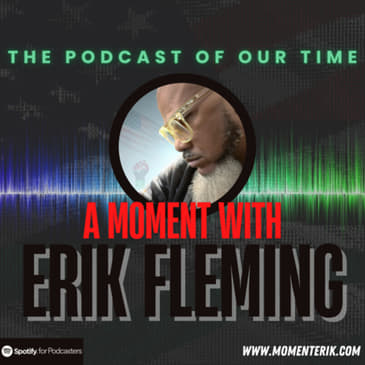
[00:00:00] Welcome. I'm Eric Fleming, host of A Moment With Eric Fleming, the podcast of
[00:00:05] our time. I want to personally thank you for listening to the podcast. If you like
[00:00:10] what you're hearing, then I need you to do a few things. First, I need subscribers.
[00:00:15] I'm on Patreon at patreon.com slash a moment with Eric Fleming. Your
[00:00:20] subscription allows an independent podcaster like me the freedom to speak Hello and welcome to another moment with Eric Fleming. I am your host, Eric Fleming.
[00:01:41] And these are some interesting times that we are living in, right? Mmm, God, nah, I messed up. I was trying to recognize The people Who are on my patreon page, yes, it has started ladies and gentlemen, it started
[00:03:04] People y'all are starting to sign up which is good. I need more of y'all to keep doing it. I
[00:04:06] with Eric Fleming. And now it is time for a moment of news.
[00:04:19] Donald Trump won both the South Carolina and Michigan Republican primaries against Nikki Haley,
[00:05:40] extending his lead for the 2024 presidentialth insurrection. A US service member who set himself on Independent School District did not violate the state's Crown Act when it punished
[00:07:00] a black student, Darryl George,
[00:07:02] for his dreadlocks hairstyle.
[00:07:04] Democratic candidate Marianne Williamson re-entered person of East Asian heritage to be elected SGA president in the school's history. Ashley is a national youth advisor and a paid freelance writer at YR Media, formerly Youth Radio, providing ideas and insights that will strengthen, teach YR programming, and co-create programming.
[00:08:21] She also serves as the state director, Georgia chapter of Voters of Tomorrow, coordinating Ladies and gentlemen, it is my distinct honor and privilege to have as a guest on this podcast, the student body president at Oglethorpe University, Ashley Ewald.
[00:09:46] All right, so normally when I start an interview, I usually give a quote. And that quote is something either that person has said, has written, or relates my future as a child. But then in my teenager years and something that I decided to change, because I started being inspired by my teachers, smart friends and so, and so therefore luckily I was able to have that kind of switch and realization that like,
[00:12:21] as I was pursuing my goals and something that and accomplishing them one after one with the So how does it feel to be student body president? Yeah, this is a great question. I get asked that a lot. So it feels very empowering because of the impact that our Student Government Association, our board has done for this school. So school, creating a new tradition, hosting dining hall initiatives to improve the cafeteria foods, being able to represent our athletics department and getting people to our games, working with other organizations that are here to help us boost school spirit. It feels great.
[00:16:04] It has been a cool moment. Oh my gosh. I love it because I do like public speaking, you know?
[00:16:11] Speaking of which, tomorrow on February 17th, I'm going to be speaking to the freshmen that got to, like, that are invited to the scholarship weekend. So I'll be speaking to an entire gym full of
[00:16:19] students, potential students who might commit to Overdoor that were invited to the scholarship I asked a lot. So, um, in fifth grade and stuff, so I became more interested in my history class, especially going to museums and stuff like that. Then in middle school, my social studies teacher would host debates, and she said I was a good, like, good speaker, so I was able to convey my
[00:17:41] speaking well and stuff like that, to the point where I could convince the class that, uh,
[00:18:46] Georgia State Capitol. And so I became a page for the Georgia State Capitol and was able to see how the State House representatives and state senators, you
[00:18:51] know, conduct their sessions and have their morning coffee while talking to
[00:18:56] their colleagues. It was very interesting and that's how I knew who I wanted to be
[00:18:59] in politics, you know, because I knew that a lot of the things I went through, being,
[00:19:03] you know, medically cleft lip affected, you know, born into a horrible system I guess yeah, and You mentioned and I've seen some pictures of you with Stacey Abrams and other Politicians here in Georgia, so I know once you got that fever you you got it and You've been even working real hard
[00:20:24] So, let me ask you some political questions
[00:21:40] What do you feel? young people who are literally Generation Z are very passionate about. The oldest Generation Z is 27 years old. And so what I'm trying to say is that like all of us young people from 15 to 27, we are so passionate about gun violence, addressing, hey, look at all these things that are happening, this misuse of guns, right?
[00:21:43] And like all these things that to Gen Z, you know, whether you like him or not, you know, that's not my opinion. That's not my, that is not my business. Sorry, let me say that. That is not my business, whether you like Biden or not. But his actions have shown that he actually cares
[00:23:03] about what Gen Z has to say, right?
[00:23:05] He just created a Tik and, you know, supporting other candidates who, you know, want to propose raising the minimum age from 18 to 25 to vote. a lot of people parroted that. What has been the, is that a topic of discussion in a lot of the forums or a lot of the places you've gone and what kind of response has people given about a potential that they might raise the age?
[00:25:42] Yeah, so the likelihood of that happening is very minimal not that he doesn't want Gen Z to vote. Well, he wants Gen Z to vote for Republican, not Democrats. So I think that for him, I think his way of thinking is that, Oh, I want to silence these voters. I think really it's about how he's afraid that Gen Z is just so progressive and something that, that they won't elect him and thus he wants to increase that
[00:27:04] voter age to 25 years old where your brain is again, fully developed.
[00:28:04] to vote because they know that Gen Z, they're not going to win the Gen Z vote, you know. It just furthers our claim basically. When people like Vivek, even if he does or actually
[00:28:10] doesn't believe what he's saying, you know, But for my fun stuff I do, I love listening to music and working out. I like to read and I like to watch boring animation, but I also like to take naps. Like if I have free time and I was productive that day, I will take a nap and I will wake up and probably work out right after, but I will literally take a nap because it's so relaxing.
[00:29:41] You just cuddle up on your bed with a blanket
[00:29:43] and just pass out.
[00:29:45] Yeah, yeah, that's cool. that go to class and then just do normal college stuff you know I was I've been told years later that you know a lot of people didn't talk to me because they like well you you always seem like you were distant you know what I'm saying you were always kind of out of you know like nobody could really approach you and you know but the people that really And it's just like an entire vault, like the cafeteria's entire vault of knowledge. You never know what you're gonna learn that day. You know, it's cool. Yeah, and you had mentioned something about me in the legislature. One of the coolest things about that position was,
[00:32:22] you know, a lot of my ideas came from just listening to average people.
[00:32:25] You know, it didn't Georgia. I really want to be elected into Congress so I can actually, so you can always help people regardless if you're elected or not. But for me, I can take the heat, you know, especially for Congress, I can take the heat. I've been doing work since I was 14. I've been on the news since I was 14.
[00:33:40] Nine years from now,
[00:33:40] I want people to be able to look me up
[00:33:42] when I'm hopefully running for office,
[00:33:44] me able to see all the things I've done since I was 14.
[00:33:46] You have a paper trail. 2000s built home that has high ceilings and has those stairs that go like a Z shape like a Z. Like when you walk in, you'll see the stairs have that top stairs and then you see the stairs going down. Right. It looks like one of those Alpharetta 2000s homes that are traditionally new built and
[00:35:03] they have a nice stone outside there.
[00:35:05] And I want a German Shepherd. for you and I really hope that you achieve everything that you want to achieve I think that it's important for us to have a an idea of what we want to do and there was an old DJ Casey Kasem used to say reach for the stars you ocean and there was a bird and the bird was flying, right? And the ocean was going to come and like literally wash away the petro. That petro still flew and survived. And Wold Talk Show. I created that in my high school year, my high school senior year during the pandemic, in order to, whatever, you know, and hopefully just reach out to me and you'll see all my socials. I only have LinkedIn, Instagram, I do have VSCO and I do have a YouTube channel for my podcast, but you could just DM me and I hope to look forward to connecting with y'all. Thank you guys so much. All right, guys. In 2009, he co-founded the community organizing NGO Serbia on the move and has participated in many grassroots campaigns, anti-corruption, health justice, civil
[00:41:40] rights, and democratization.
[00:41:44] Today, he is involved in the at Georgetown University School of Foreign Service, Ethics and International Affairs,
[00:43:01] and becoming a Democratic leader.
[00:43:04] His pedagogy is focused on fantastic yeah you Eric I'm doing well I'm glad to have you on like I you know you're one of those people that they may have written or something that relates to the work that they're doing. So your quote is really, really short. It says, the courage to change things is within.
[00:45:42] What does that quote mean to you? Yeah.
[00:45:44] Thank you.
[00:45:45] Yeah, that's a...
[00:45:46] Let me remind myself what I meant by it. enable you to become that person. So that's what it means for me that it's this process of self-discovery and understanding of who you are, who you could become, having courage to face the challenges you need and must face to become that person and
[00:47:01] enabling others to do the same.
[00:47:05] So what drove you to become an activist? happening when my cousins from Bosnia became refugees. They came to Belgrade and I was confused, what are they doing here? And then I learned that our family house in Bosnia was destroyed and that's literally the house where my mother was born because my grandmother never made it to the hospital. And that's the house where I stayed during the summer.
[00:48:20] I was spent a month or two in Bosnia,
[00:48:22] a month or two in Croatia and back to Serbia.
[00:48:25] I felt the connection the time, but I remember when I was 14, I was in my high school. I saw this flyer on wrong, but I didn't know what to do about it. But then someone gave me some tools. I told them, well, this is what you could do. So they enabled me to act upon the injustices I saw around myself. And I'm like, wait, well, that's that's amazing happened in my country. They were leveraging national and religious diversity against each other. So yeah, that's how I started this. Yeah. That's my journey. So what- From the beginning of it.
[00:52:20] Yeah, so this led you to ChangeLab Global.
[00:53:25] That moment was sparked in so many ways by what was happening at the time here in the United States.
[00:53:28] In 2007, two friends of mine went to be volunteers
[00:53:34] for Obama campaign because, wow,
[00:53:36] there's something cool happening in the United States.
[00:53:39] They fundraised, they came here, United States.
[00:53:41] They volunteered, they came back,
[00:53:44] and they said, hey know, bigger view. And let's let's let's do politics on European level pillar is ChangeLab, which is, all right, I got lucky to get exposed to these amazing frameworks of community organizing and many others, because I also ended up going to Kennedy School,
[00:56:21] Harvard Kennedy School, was very lucky to be able to get it
[00:56:25] and all of that.
[00:57:22] It's very practical and useful. It comes from both theory and practice.
[00:57:24] It's not a pie in the sky.
[00:57:26] It's something that is very practical and effective.
[00:57:30] And on the other side, deliver trainings pro bono
[00:57:34] to those who can't afford it, but really need it.
[00:57:37] Like different activists, different organizations
[00:57:41] that could benefit from that.
[00:57:43] So that's the aim of the ChangeLab,
[00:57:45] to make leadership development accessible to millions, safety. Both of them could be future doctors, scientists, presidents, right? Just think about it. Right. Anywhere in the world. They can be anything. And then the question becomes, well,
[00:59:01] how do we enable them to become the best versions of you. That's a that's a big one, right? I encourage everyone to think about what are the 10 questions that you're right now trying to answer in your life. That's what I put on my LinkedIn. It's a really powerful exercise. It enabled me to understand better
[01:00:23] myself and what am I doing and kind of reconnect or clarify my purpose. All right. What does and amazing and then I'm like well how come our society doesn't reflect all the conversations about the values look at the company's they all have values I'm sorry to say that that's all crap hmm why because values don't exist in vacuum in the real life outside of the comfort of this conversation or we are you know
[01:01:43] warm and well-fed and you know we're fine outside of this light I reacted way better than I expected. So both happened to everyone listening to this. So what I'm saying is that we have to teach people how to learn about themselves in action so that they uncover the gap between a aspired and enacted values.
[01:03:00] Because think about a situation where
[01:03:03] you're walking down the street
[01:03:04] and there's a man harassing a woman violently. with your kids, you don't want them to see you being maybe caught up in some violence. So that's an example, very kind of plastic, simple example of what happens in the reality. So what happens in reality, you realize to honor one value, you might have to sacrifice the other value that you deeply care about. Sometimes that's personal safety,
[01:04:21] sometimes that's comfort.
[01:04:24] But there is sacrifice associated The challenge in politics is that we have wrong people running for office and running for wrong reasons. We need to enable people to... if you want to get power, if you want to get power and authority, you better know why. I have students who are very ambitious and they'll tell me, oh, I want to run,
[01:05:41] I want to be this and like, you know, dream big and I love, yeah, you got to dream big.
[01:05:44] It's really important. Then ask them, do you know why you want to do that?
[01:06:43] that I coach or train about what I do, what they wanna do in life,
[01:06:44] and it's easy to anchor your goal
[01:06:47] in some kind of a position.
[01:06:48] I wanna become a president or director, CEO,
[01:06:51] and I ask them why.
[01:06:52] And sometimes they have good answers,
[01:06:54] like, well, because I wanna change this.
[01:06:56] As well, is that the only way to change that?
[01:06:58] Are you just fixated on that position
[01:07:00] because there's power with it?
[01:07:02] And then they start thinking, huh,
[01:07:03] yeah, change comes in so many different flavors.
[01:07:06] We've seen that.
[01:07:07] Change in this country came from, paying thousands of dollars going to Georgetown to get in your classes. I'm like, oh, man, it's like these few minutes I've got with Nicola is awesome. It's you know, this is only audio. So but you can hear the passion. You can hear the thought. And and and like I said, I feel like I'm cheating.
[01:08:20] It's like I'm getting something for free and my audience gets up for free.
[01:08:23] These kids are paying big money for nonetheless.
[01:08:26] But seriously, though, whose whole ambition in life was just to have power. So that's interesting because actually in a few hours I'm going to have a meeting with one Russian activist, very connected to this world and work with Navalny to learn more about it.
[01:09:43] Because I have my opinions, but you really got to go
[01:09:45] and talk to people who are Russians and to understand that. post rest in peace or something I posted his quote for one of his articles about how Russia could look like right because my way of honoring death is by continuing the idea that's that's ultimate sacrifice he has the family it's very sad I can't you know can't imagine how they feel in the way also
[01:11:00] they probably kind of knew and for some level that this is coming but what I'm
[01:11:03] saying to my Russian friends everyone in the world fighting for democracy is that of attention because of media because of their work and so forth. They are important. But I would also say the depth of democracy depends on people. My grandmother used to tell me. It can be taken so many different ways. She's done.
[01:12:20] Well, you know, democracy can also mean that three thieves and two
[01:12:23] junkies out vote three PhDs.
[01:13:26] the times, 21st century, we live in the times of many changes, technological changes, social change, globalization, right? And people are not perceived afraid of change. People are
[01:13:34] afraid of loss that change might bring. So all of these changes people are perceived,
[01:13:39] well, I'm going to lose a job. Some people lost jobs. And I, you know, what's going to
[01:13:43] happen to me? There's a lot of anxiety. That's the effect of authoritarian, that's appeal of authoritarian offer. Authoritarian comes in and says, hey, look at all this stuff around you.
[01:15:02] So much challenges and uncertainty.
[01:15:04] And by the way, I'll add a bit more.
[01:15:06] What about these immigrants?
[01:15:08] What about this? to activate talents of others. Otherwise you're lying to yourself and others. So that's what it takes. You gotta do the grassroots work. You gotta enable your, in this country particularly, because I've seen it, I live in Ohio, I've seen what a really bad education looks like. I've seen how on one side this country is very rich,
[01:16:21] but I've seen poverty that I haven't seen in my country
[01:16:23] that's much poorer.
[01:16:25] You're at the same time, we are here,
[01:16:27] first world country, like developed, That's harming our democracy. It's not just, we can talk about its ethical challenge as well, because ethically we shouldn't have that. We can talk about economically, but democracy suffers because the inequality, because we are unable to educate people
[01:17:42] and develop agency and not create masses of people
[01:18:41] and all of the listeners. You can go and create a democratic space wherever you go.
[01:18:46] To your family, to the next meeting
[01:18:48] after you're listening to this,
[01:18:51] to your school group, and how do you do it?
[01:18:56] Don't try it.
[01:18:57] Someone said, I think Adam Grant maybe said that,
[01:18:59] or maybe he quoted someone else.
[01:19:01] He said, don't try to be the smartest person in the room.
[01:19:03] That's okay, sometimes I understand you have to do that.
[01:19:06] Try to make the room smarter.
[01:20:05] that were supporters of Navalny are going to feel inspired
[01:20:10] with you and others like you that are going to give them the motivation to keep going.
[01:20:12] They inspire me, I gotta tell you.
[01:20:14] They inspire me really more than I inspire them,
[01:20:15] I gotta tell you.
[01:20:16] Oh yeah, that's usually how it works, right?
[01:20:20] So how can people get in touch with you?
[01:20:22] How can people reach out to listen to you and to meet you. Same here. Yeah, and so my rule is now that you've been a guest,
[01:21:41] you have an open invitation to come back.
[01:21:43] So please feel free to come back United States Capitol Police during one of the most tumultuous periods in this country's history. During her time there, she oversaw the identification and vetting of nearly 20,000 threats against members of Congress, most of which were made by U.S. citizens who adhered to extremist ideologies. She on. And I really am interested in your book, Domestic Darkness. You're going to be the second person that has written a book that in the interview is I throw a quote at them. And that quote either is something to do with something they may have said, something they've written or something that relates to the topic that we're getting ready to discuss. All right. So how did you get to be in that position for Assistant Director of Intelligence? Well, most of my career, I was working with the Department of Homeland Security and I started at the office in Boston with US Citizenship and Immigration Services, which is a component of DHS.
[01:27:00] I eventually made my way down to DC.
[01:27:04] And what people don't necessarily realize
[01:27:06] is that USCIS is self-funded. So in chapter two of the book, you kind of go into detail about how you warn the Capitol Police leadership about the insurrection, stating quote, Congress itself is the target on the sixth.
[01:28:27] Why do you think, and reason why I mean, reading it from the book, it was pretty clear, right, in basic language, this is going to happen. Why do you think they didn't heed the warning?
[01:29:44] Well, I mean, I think the commonalities there little bit before I get back to January 6th, cause I wanna kind of walk through that a little bit. But there was a, when I was reading and going over
[01:31:01] what I was gonna ask you,
[01:31:05] again, there's a current correlation going on. because I use that analogy with Fannie Willis, kind of talk to me about you being in the position you were in and dealing with the issues that you were dealing with, how easy it is to build trust with somebody,
[01:32:20] and then it goes a little further than just trust.
[01:32:25] Cause I think that's the similarity to pry information out of me or that he was sharing the information inappropriately. So there's that. So whether he used me or not, I don't know. My mom read the book too. She's like, yeah, he used you. Well, thanks mom. And it kind of makes me crazy too because then you think like, well, what did I miss and how did I not know?
[01:33:41] And like, was I being manipulated?
[01:33:43] So that's frustrating and disappointing. name, especially for those Western fans, right? But Shane, you know, the minute you found out he was arrested, the first person you went to was like the FBI, right? It was just like, Hey, I think we need to talk. Not too many people do that. So I, I think you're, I think you're okay. As far as judgment
[01:35:03] goes, but yeah, I'm gonna go to work. And I was like, okay, I'm gonna go to work. And I was like, okay, I'm gonna go to work. And I was like, okay, I'm gonna go to work. And I was like, okay, I'm gonna go to work. And I was like, okay, I'm gonna go to work. And I was like, okay, I'm gonna go to work. And I was like, okay, I'm gonna go to work. And I was like, okay, I'm gonna go to work.
[01:36:21] And I was like, okay, I'm gonna go to work.
[01:36:23] And I was like, okay, I'm gonna go to work.
[01:36:25] And I was like, okay, I'm gonna go to work.
[01:36:27] And I was like, okay, really started to go downhill. That was the upper part of the hill at that point. Yeah, that was just after coffee at this particular point. Yeah, exactly, exactly. And then, you know, we were watching, there were two rallies on January 6th. There was the one with the president at the ellipse,
[01:37:41] which is right next to the White House.
[01:37:42] And then next to the ellipse,
[01:37:44] there's another area in DC called Freedom Plaza.
[01:37:47] And so there was only about 65% of the officers on duty. They didn't call in, the Capitol Police did not call in other departments to help. I mean, DC Police were there because that's their jurisdiction too. Park Police were there, Supreme Court Police, but still like not nearly enough to hold back the crowds.
[01:39:03] And they only had bike rack around the Capitol to hold back's problematic. And so eventually other law enforcement agencies showed up, the National Guard showed up, and people made their way out. I left the office probably around 11 o'clock that night. And I know I spent some time sending more emails and doing some more work once I got home.
[01:40:21] And I also started working very, very early
[01:40:24] the next morning, so I didn't get a whole lot
[01:40:25] of sleep that night.
[01:40:27] But it was like, closed circuit TV kind of monitoring. Yeah, it was cameras and also I was listening to the police radio in real time to hear what was going on.
[01:41:40] Yeah, which I'm sure was not pleasant.
[01:41:45] No. the Office of Inspector General had several reports, the Senate had a report, the Government Accountability Office had several reports. None of them really got to the core of what I think caused January 6th, which were cultural issues within the Capitol Police. So issues dealing with communication, with trust, with the way employees are treated and valued. None of those recommendations
[01:43:03] dealt with that. They were all very concrete And to have help, the Capitol Police had to have asked for help, and they did not until it was already a riot. And so they should have requested help beforehand, regardless of whether or not the National Guard was going to be allowed. It's D.C. There's many, many, many officers in jurisdictions surrounding us that could have helped and
[01:44:24] that did come to our aid when we neededers, they are more militia type group and concerned about like government overreach. Proud Boys were kind of in their own category at the time, although they're leaning towards being more racially motivated today.
[01:45:43] But they did all come together for a common cause
[01:45:47] and a common purpose on January 6th, members of Congress, most of which were made by US citizens. In light of your answer and these particular groups we highlighted, why do you think that domestic terrorism has been on the rise? I think part of it has to do with, a large part of it has to do with the fact that there are
[01:47:01] individuals in elected book and and
[01:48:20] having said that, are there any lessons. I mean, with all those threats that you just mentioned, most of those were posted on social media.
[01:49:42] And a lot of times when I was investigating those threats,
[01:49:45] I would go to the social media platform to see the threat
[01:49:48] and it had already been pulled down, what is going on and but you know from a law enforcement standpoint it's really really a herculean job you know which goes back to why it was so important for folks to pay attention to what you were saying
[01:51:00] because the only way that you can effectively
[01:51:03] enforce the law is that you utilize your tools You know, it's just absolutely amazing how human beings are. It just really is. You got people that are doing their job but then you got folks that are like, yeah, not so much. And the consequences of all that. So please y'all get this book. I take it you're no longer with the Capitol Police.
[01:52:22] What are you doing now?
[01:52:23] And how can people get in touch with you
[01:52:26] and support what you're doing and all that stuff? conspiracy theory land, don't get the book. But if you want facts, get domestic darkness. And where can people get the book? Anywhere you buy a book. Okay, all right. All right guys. Well, Julie, thank you for coming on the podcast. I appreciate it. me inspiring. It's like because you're doing something good. And when people do good, it rubs off. Goodness is contagious. And I know it's hard to going to the polls if there's primaries going on in your state. If you've already voted, great. If you have not, go vote. But in this political world we live in, despite what we see, goodness is gonna prevail. And you and I are gonna make sure
[01:56:24] that happens. So.