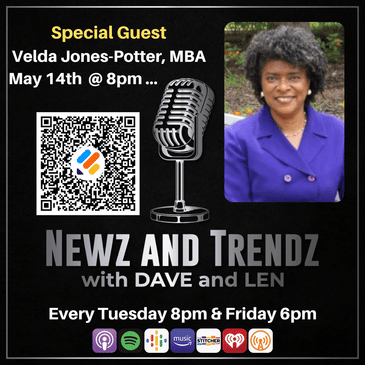
Newz and Trendz with Dave and Len: Talking all things Black News: Culture, Sports, Entertainment, and Current Events ✊🏾
Dave and Len (and Velda) speaking about:
* Interview: Velda Jones-Potter (Candidate for Mayor of Wilmington, Delaware) 302-545-4031 | VeldaforMayor.com
* To Protect Black Women and Save America From Itself, Elect Black Women
* Virginia school board votes to restore names of Confederate leaders to schools
* Wilmington Carnival Cancelled After Deadly Shooting at Concord Mall
* Dave's Corner: Things That Make You Go Hmmm...
DOWNLOAD OUR APP - Newz & Trendz:
https://www.jotform.com/app/213249001139143
Follow Us on All Podcast Platforms!
Facebook: https://www.facebook.com/newzandtrendz
Instagram: https://www.instagram.com/newzandtrendzpodcast/
[00:00:14] All right, y'all get ready for another edition of Newz and Trendz with your host Dave and Len.
[00:00:32] Welcome, welcome, welcome to Newz and Trendz with Dave and Len. I am one of your hosts Mr. David Coker, promoter, event planner, man about town, one of the goodest guys you ever meet.
[00:00:47] And you know, just hanging out here with my partner Mr. Leonard Young. What's going on sir?
[00:00:53] Hey Dave, everything is good. This is Leonard Young, CEO of DelawareBlack.com, national black guy, black media specialist and all around good guy. How's it going, Dave?
[00:01:04] Man, I can't call it. You know, here we are another week, you know, at the beginning of another week and man why do you keep bringing rain though? I don't understand that. Why do you keep bringing the rain?
[00:01:18] I don't know. I do not know. I want to say in the, I feel like in the last six weeks it has rained more than about 75, you know, at least some drops every day, you know, three out of every four days. So I'm guessing we're, I'm guessing we'll have a great summer. Hopefully it's not super humid.
[00:01:36] Yeah, well let's hope so. I mean, you know, because, you know, because it's supposed to be cloudy basically all week from what they said.
[00:01:44] Yeah, I know it's supposed to rain all day tomorrow, Thursday morning, Friday's supposed to be okay. Saturday rain. So I mean, I guess we're getting April showers and May showers.
[00:01:59] There you go. There you go. Well, we got to get all the rain out of the way because, you know, we can't have it raining that weekend coming up on June 8th, right?
[00:02:10] That is correct. Yeah. So yeah. Now for those of you guys that are under the, under a rock or whatever the case may be, Leonard, why don't you tell them that this is your place that we're talking about?
[00:02:26] Dave, you're such a great spokesman.
[00:02:29] Okay. All right. You want me to tell them? Okay. Anyway.
[00:02:32] No, no, I mean, don't worry. I'll go ahead. Go ahead.
[00:02:35] Yeah, because I just want to make sure you have your information right. So last year, my wife and I bought a campground in Delaware, lower Delaware.
[00:02:45] And it is the, it is, it continues to be the oldest black owned campground and RV park in the United States. It was founded in the mid 1990s.
[00:02:58] And the prior owner, Norman Dempster pretty much built the grant, the campground from the ground up. And most people be familiar with the location of the gun and ride club, which is sits on the campground.
[00:03:13] So this is a G and R campground saying for gun and rod and song, gun and rod road in Houston, Delaware, Houston. If you look at it, it looks like Houston, but it's actually Houston.
[00:03:25] And it is around where Harrington, Delaware. So I'm June 8 Sam B entertainment Wilmington gentleman of distinction led by Sam Bailey is having a black music fest Delaware.
[00:03:41] So if you put black music, fast Delaware into Google, you can get all the information. I think it's a $40 per person. No ticket sold at the door. Be wild be be wild.
[00:03:52] Bring your tents lawn chairs, enjoy some good music.
[00:03:57] Right.
[00:03:58] And you get to hear what best gets old will be performing going to have DJs from the area from downstate upstate or from the state of New York.
[00:04:10] Upstate or very own DJ Tim Dog will also be participating as well.
[00:04:16] They're going to have food trucks all you know, so it's just going to be it's going to be a good time.
[00:04:23] So for anyone who's listening or who hadn't heard yet, this is a good chance to, you know, have a day that you know at a place that's for us.
[00:04:36] Right, you know, catering to us catering to us. There you go.
[00:04:41] I mean, you know, we don't get that too often and you know, and and this is a great opportunity to come down and check something unique, fun, and is hopefully an annual event there every year.
[00:04:55] So yeah, definitely. Hopefully.
[00:04:58] So we, we hope to see you guys down there. And you know, for those of you that know Sam Bailey, you can go to any of his pages and Facebook, you know, Instagram, whatever, and you'll be able to find the tickets and everything or, you know, and his information to get in touch with him.
[00:05:17] Okay, so.
[00:05:18] So, all right. So, you know, we got one black cultural event out the way.
[00:05:29] So today, we have, because we want to go in and get into this right quick, you know, the day we have a very, very unique and wonderful guests with us today.
[00:05:43] And I can, you know, I'm kind of giddy over here because I've known it just about all my life.
[00:05:50] Hold on Dave, Dave, how long has that been?
[00:05:53] Well, wait, hold on. She's older than me.
[00:06:00] But but anyway, once you introduce who we have on today.
[00:06:04] Sure. Today, our guest is Belta Jones Potter, and she has a history of first in science business and government in Delaware, the first state in 2017.
[00:06:17] She was inaugurated as Wilmington City Treasurer, and she was the first woman and first African American to ever hold that office.
[00:06:27] In this position, Belta secured over 20 million in savings for women and taxpayers and was a strong voice for fair housing, education, training, jobs and economic opportunity for all people.
[00:06:42] In 2009, Belta became the first African American in Delaware history to hold statewide elective office when appointed when appointed state treasurer by then Governor Jack Markel.
[00:06:57] As state treasurer, she steered Delaware through his worst financial crisis since the Great Depression and is lauded for nationally recognized financial education and empowerment initiative launched during her tenure.
[00:07:10] Prior to serving as Delaware's CFO, Belta founded a financial services and consulting company and was managing partner with a social impact venture capital firm that invested in women and minority led technology companies and increased access to capital for underrepresented groups.
[00:07:29] She began her professional career as an engineer and previously held executive positions with DuPont, MB&A, which is now Bank of America.
[00:07:41] Today, Belta is a candidate for mayor of Wilmington and poised to make history once again as the first woman to lead Delaware's largest city.
[00:07:54] So without further ado, Belta, I would like to welcome you to News and Trends with Dave and Lynn.
[00:08:01] Hello. Thank you so much. I'm excited to be here.
[00:08:05] Good. Good. Thank you for coming along with us.
[00:08:08] So I do also want to mention because I think this is a phenomenal accomplishment.
[00:08:13] So part of the bio, Belta earned a BS of civil engineering from the University of Delaware, becoming the first African woman in the history of the institution to earn an engineering degree.
[00:08:26] So I just want to say I was an engineering major at the number one HBCU in the nation for a university.
[00:08:34] And when I say I struggled through mechanical engineering, so, you know, and, you know, it's funny because everybody at our school engineering, they were always at the engineering school, you know, they were just always doing stuff.
[00:08:49] So I recognize what an accomplishment it is because I always and Belta, maybe you're the same.
[00:08:58] We were working on problems that were so long, you couldn't explain it to anybody outside of engineering.
[00:09:07] Did you kind of have the same situation where like, you know, you can't go home and it's not like you're a teacher and you talk about the students.
[00:09:14] Right. No, absolutely. I mean, in some ways it was almost like, okay, you're kind of living in a different world because as you say, the problems were just so lengthy.
[00:09:28] They had a lot of components to them and just nobody at home was going to hang in there long enough to follow through with me.
[00:09:39] Well, I always say they wouldn't understand and they definitely don't care. Right.
[00:09:44] But again, we do want to welcome you to the show and I'm just gonna jump right into it. So first, you know, I want to congratulate you on your candidacy for mayor Wilmington because I think Wilmington is a great city.
[00:09:59] And, you know, I think it has a lot of potential. What and, you know, of course the current mayor is not running again.
[00:10:09] What are some of your ideas to, you know, bring to the city or changes that you think would be beneficial to?
[00:10:18] And I'm just going to say most residents because, you know, you can't please everybody. But, you know, what are some things that people could look forward to you implementing as mayor?
[00:10:26] Okay. Yeah, great. Thank you. First of all, both of you for having me on. I'm just really ecstatic to be here.
[00:10:35] I agree with you. Wilmington has tremendous potential. You know, we're more like a small town than a city.
[00:10:44] And there's so much charm here. The individual neighborhoods, I think, are just the hidden gems of this city.
[00:10:54] They each have their own unique, I don't know, not culture but character. And each one has a way of offering to the city its history, its contribution to what really is the city.
[00:11:24] And I think that Wilmington has in the past and I believe can in the future make Wilmington a real vibrant, very special place to live and work and play.
[00:11:36] What I'm looking forward to doing are, first and foremost, addressing some of the things that have been challenging for the city.
[00:11:47] I like to kind of present those in three pieces. A safe, a smart, and an empowered city is what I'm hoping to set us on a good path for. And in some cases get us there in short order.
[00:12:06] And the safe piece is really, I think, more about addressing some of the underlying root cause issues that people are struggling with here that are leading to the crime within our city.
[00:12:22] Not just focusing on the back end policing, but starting with honestly some of the social elements of the city. We have a huge homeless population.
[00:12:36] The affordability of housing has really become a problem here in the city.
[00:12:42] And we have a lot of people who've been through the criminal justice system and are trying to find their way back.
[00:12:51] And we're not offering enough assistance and services to people, so we're paying the price for that on the back end instead of helping that process along more on the front end.
[00:13:06] I believe clean neighborhoods is like basic and fundamental.
[00:13:13] So one example of something that I'm looking forward to doing is bringing to our neighborhoods, particularly those that need it most, clean and safe teams.
[00:13:24] We have a downtown vision in our downtown, very visible, very helpful to people who are just downtown and trying to get around.
[00:13:37] They're available to walk you to your car at night if you feel a little bit uncomfortable about that.
[00:13:44] I think if we had that kind of presence in some of the communities that are having the most challenges that would go a long way to work, reviving those neighborhoods.
[00:13:58] We've got to do a better job of making jobs available to local people.
[00:14:05] There's been a lot of construction and building and real estate development in the last eight, ten years.
[00:14:14] And even with that, the participation has not been equitable in terms of just giving people access.
[00:14:23] People who have small contractors, they have small construction companies and they just have not been given equal opportunity to work on these projects.
[00:14:34] We've got to give some apprenticeship training that can lead people into that and support those small businesses.
[00:14:43] And then we've got a real education challenge here in this city, in the state honestly, but even worse in the city where our third graders are not performing just as an example.
[00:14:56] Our third graders on the testing are performing really at a five percent level.
[00:15:05] When it comes to reading,
[00:15:07] Now, when you say five percent, can you kind of break that down?
[00:15:12] I mean, it sounds low, but I'm not exactly sure what it means.
[00:15:16] Well, probably what you're thinking it means is that the third graders are performing at a five percent level.
[00:15:26] So, if you look at the study, it shows that an assessment of all of the third graders across our state who are reading at grade level, at third grade level, across the state,
[00:15:38] is 42 percent. Within our city, it's five percent.
[00:15:44] Wow.
[00:15:45] It's unacceptable.
[00:15:47] And so, you know, we've got to give people the opportunity to do that.
[00:15:53] And I think that's a really good point.
[00:15:55] We know what that inability to read is.
[00:16:00] It's unacceptable.
[00:16:02] Across the state is 42 percent.
[00:16:05] Within our city, it's five percent.
[00:16:09] Wow.
[00:16:10] It's unacceptable.
[00:16:13] And so, you know, we wonder what, well, we shouldn't wonder what's going to happen.
[00:16:19] Six, seven, eight years.
[00:16:22] And so, we have to figure out what that inability to do a basic reading leads to.
[00:16:30] So, we've got to really demand the state whose jurisdiction that falls under, that that be addressed on behalf of the children of this city.
[00:16:42] Peace is empowered. And that's one that, you know, not a lot of people, you know, who are stepping forward to be in public service is going to tout and encourage people around.
[00:17:00] But I am.
[00:17:02] Because I believe that's the key to us breaking this cycle of decline within our city is empowering those people who live here.
[00:17:15] Right.
[00:17:16] And that's the stage in the process of how we're governed and holding our leaders accountable and speaking up for what's needed in the community and all across the city.
[00:17:31] So, those are the things that I'm really focusing on as I plan and look ahead to being mayor of the city.
[00:17:44] It's funny. One of the things that you mentioned was the more opportunities for apprenticeship.
[00:17:50] And last week, I went to the United Way had like a minority business event where there were a lot of vendors, there were some government and I guess large company that we're looking to hire, you know, supplier diversity and.
[00:18:10] And there was a construction company there, you know, a larger one named one that we're recognized with that we're familiar with.
[00:18:18] And they said that they have trouble finding good workers to, you know, trades people to work on their projects. They said, so you know it's just funny that you mentioned apprenticeship because I mean I definitely would be, you know, I think it would be good if people knew that.
[00:18:36] And unfortunately I didn't even learn till late but electricians make a lot of money. Plumbers make a lot of money, carpenters make a lot you know these trades and I don't know where we came up with the notions that these were not, you know, low paying jobs, minimum wage.
[00:18:55] But they are making a lot of money so I mean I definitely think that would be, you know, something great for the city of Wilmington.
[00:19:05] The I guess the question is how, like, how do we make that happen because so I know of course as they go to tech schools.
[00:19:13] You know they kind of have an option. Do you see trying to implement some programs that may.
[00:19:19] And, and I guess I was kind of thinking about, you know, a lot of these you two are looking for summer jobs. You know how can they be, you know, even if it's like a junior apprentice to somebody who is, you know, just to kind of get them familiar with, with doing it because I mean I think that's a real skill.
[00:19:38] Yeah, absolutely. We've got to introduce those trades as options for young people early. Right.
[00:19:50] So that it's not considered, you know, going to college and that academic route is the only option.
[00:20:00] And it isn't, and it shouldn't be.
[00:20:03] And so we've got to introduce young people to it really early. We used to have wood shop and yet we did.
[00:20:13] I had this goals.
[00:20:15] And so you know you got to see an experience some of that like right in high school.
[00:20:22] And frankly I would love to see that come back. Right.
[00:20:27] And, and but until that itself happens, then yes, programs that we can bring into the elementary schools.
[00:20:39] It just introducing the notion and the idea of trade so that it's, it's on the minds of young people.
[00:20:48] And certainly some of the after school and summer experiences need to move beyond office work, which is typically what, you know, people are brought into and need to need to connect them up with people who have are part of the skilled trades.
[00:21:03] I also believe that it's, it's on the minds of young people.
[00:21:11] I also believe we need to hold up and show them the kind of wages that they earn.
[00:21:21] That was one of the things that I did with the financial literacy program that I, you know, that I ran and introduced young people to was I, we connected it with the kinds of financial literacy programs that we have.
[00:21:36] And I think that was, I, we connected it with the kinds of work and jobs and careers that they might choose and help them see the connection between investing in themselves to learn that skill to if it's college to go to college.
[00:21:59] And I think that's where that career choice is.
[00:22:01] They're investing in that and the return that they're going to get in terms of how much they would earn, how that translate into what they can afford in terms of an apartment or a house and a car, all the things that they want.
[00:22:16] But they need help seeing how to get there.
[00:22:21] Right.
[00:22:22] And I absolutely know that people don't know how well electricians and plumbers and carpenters, how well they're paid.
[00:22:35] And frankly, always in demand. Yeah, yeah. Well you know it's funny anytime I talk to Dave, I'm like, Dave, do you know a, you know, Dave knows just about everybody.
[00:22:47] Like Dave, you know a plumber. Do you know electricians? Because if you just call one of those tradesmen out the, well, I was about to say the phone book.
[00:22:56] But you know, if you call one of those tradesmen just, you know, offer online $50 an hour, $75 an hour, you know, $200 minimum.
[00:23:08] I mean, they definitely get their money. So I mean, I definitely, and if I was in another life, I may be some type of tradesperson as well. You know, you just never know.
[00:23:21] Now, I guess my next question. So, and to be honest, I'm not as familiar with the Wilmington politics as I feel like I used to be.
[00:23:29] But you know, of course we always hear about, you know, Wilmington dumping a lot of money into the downtown, then into the riverfront.
[00:23:39] I feel like what I've seen lately kind of that North Market Street corridor. Are there any areas of town that maybe are on your radar to, and I won't say fast track, but are there any areas of town that you're thinking, okay, this is an area that if we kind of put some more money, some more development, renovation that this could be, you know, another, I guess, you know, we talked about power.
[00:24:07] I guess, you know, we talked about pockets of the city that almost like Trolley Square. Like, that's an area people love to go to. Do you have any thoughts of any of those locations?
[00:24:18] Yeah, well, certainly those areas where we're seeing high crime rates are places that need some tender love and care. And so we're seeing a fair amount on the sort of the East Northeast side of our city and on the West side of our city.
[00:24:41] And so I definitely envision a real focus on those areas. I believe we also have an opportunity to create a very strong arts and culture economy here.
[00:25:04] You know, and both of you do very well how rich the history on the East side of our city is in music. And I don't think, well, not just music, music, law, education.
[00:25:24] I mean, we have some stellar people who came before us who lived in those in that community. And I believe there's an opportunity for us to really, there's some investment going on there, but to really revive the arts and cultural aspects.
[00:25:49] I mean, I envision walking tours where you can walk and you can listen. Yeah. And so, and I know likewise the West side, we have a very large Hispanic population there.
[00:26:08] And that community celebrates its heritage. They do in some really great ways. I'd love to see that evolve into something that's just rich with heritage right there on the West side of the city that, you know, you can see the history of the city.
[00:26:38] You can see it by the buildings that are there and all of that. So those are a couple of areas that I really see opportunities. The North, the Market Street corridor, that business corridor along Market Street from the Brandywine up to like 30th, 31st and Market.
[00:27:05] I really believe if, if when we nurture the small businesses there and we revive that area, imagine what that's going to do on both sides of Market Street.
[00:27:19] It's going to begin to bring back, bring life back to the residential areas on either side of Market Street. So those are things that I'm excited about doing.
[00:27:36] Good.
[00:27:38] And you know, it's funny because you mentioned and that was gonna be my next question talking about the arts and culture.
[00:27:45] Because you know I always hear people talk man well, first of all, you know, I think we all know there are many talented people in the art scene here here in Wilmington of course the state of Delaware as well.
[00:28:00] And I won't say I don't feel like they get enough credit, but I feel like they don't have enough opportunities to kind of represent themselves and you know maybe part of it is how schools are just starting to kind of cut out, you know, art, and, you know, those type of disciplines,
[00:28:19] And I'm going to say that and maybe I'm speaking for Dave too but you know I think Wilmington has some great festivals.
[00:28:28] How you know of course, Clifford Brown Music Festival I mean that you know that's a no brainer. But then they also have some other great festival that kind of feature, you know, local artists and you know what are you excited about, you know, kind of maybe bringing more art and culture to the city.
[00:28:48] Absolutely.
[00:28:52] You know personally I love music.
[00:28:57] I just love music. Yeah, she was at a party and all weekend.
[00:29:04] I don't understand how I don't understand how people can hear music almost any kind. Yeah, and, and like just sit there, not, you know that rhythm just gets in you and just right.
[00:29:17] Personally, I love it. On the one hand, but then I just, I know so many people, young people and people who've been at it for a while all across the spectrum, who are talented.
[00:29:37] And, and we, as a city. Certainly, maybe a tad better as a state but I don't know that to be the case either but certainly as a city.
[00:29:49] We have not.
[00:29:52] We've not opened the door for that here.
[00:29:58] And I'm not sure why not, other than the leaders who've been in place.
[00:30:08] Have just made placed obstacles in the way.
[00:30:17] And, and I, I just believe it's time to, to pull those away to, to, to let this potential we have in the arts and and in music and in culture.
[00:30:35] Let that organically do what it does. And I think if we had done that some years ago, I honestly believe we we here would already be a destination point right for arts and culture in the region.
[00:30:53] Because look at where we're located. I mean, we always tell where Delaware is located you know two hours from New York. Yeah, less than an hour from Philadelphia you had DC to the south of us.
[00:31:05] Maryland. I mean we are in such a central place that there'd be no, no, no barrier to people coming here for our festivals and other entertainment that if we organically allow it to do what it does.
[00:31:25] I just believe we'll, we'll see the benefits.
[00:31:29] Yeah, you know I definitely agree one. And I've heard it a lot. And then I heard it recently as well.
[00:31:35] A lot of artists are saying that venues and Delaware make it hard for them to, you know, do shows or have live events for, you know, kind of, you know, kind of like to be honest just like we said there a lot of gatekeeper.
[00:31:54] You know, so then it's kind of like okay well if they're not able to perform in their home city which they want to, then they're forced to go to Philadelphia Jersey New York DC Baltimore. Yep.
[00:32:06] I was gonna I was gonna say that that. And what happens is what you just said, are people who have these talents are forced to go elsewhere.
[00:32:19] I mean, I've seen it and experienced it close up close and personal I'll say. And we don't want that.
[00:32:27] No, no, no.
[00:32:28] No, we don't want that talent to stay here. And we want the economy to be built around that right here.
[00:32:37] And, and I, we are long overdue for it. We were poised for it years back.
[00:32:46] But the gatekeeping and hurdles prevented it.
[00:32:52] And I think we, I know we have another shot at it now. Right. And it's really something that I'm committed to nurture and really help make sure our the city policies and practices and procedures permitting and all the stuff that government does that, you know, puts up roadblocks.
[00:33:17] Sure, are, are reviewed and transformed so that we're enabling it instead of making it more difficult. And I certainly intend to be an advocate with, with the venues that need to accommodate and welcome.
[00:33:38] So I intend as mayor to, to be an advocate with them. Okay, well, I definitely heard the name was on those venues.
[00:33:46] So I'm going to write them down on a piece of paper.
[00:33:52] Alright, so I know that and one of the, I was also going to ask about kind of like the violence and crime but I'm going to save that for either Dave or for the one of the stories we may be talking about.
[00:34:03] But my last question.
[00:34:06] And I'm actually going to bundle three things into this question.
[00:34:10] So one.
[00:34:13] And to be honest, being mayor of Wilmington sounds like a great thing.
[00:34:19] But I'm sure it comes with pressure stress like I'm just trying to think how do I wake up every day and see my name in the news.
[00:34:27] You know see my name in the newspaper or, you know, somebody did this or somebody saying that.
[00:34:34] How, how do you handle that pressure and a lot of times I always think when I sign up for a big project.
[00:34:42] Five minutes before the project or presentation I'll be like man, why did I sign up for this like, why did I put myself in this undue pressure that I didn't you know I could have just sat back.
[00:34:52] But you know what is it, I guess, in you that, you know, just, I don't know if it's confidence I don't know if it's just, you know, like purpose driven.
[00:35:03] You know, mission. But, you know, kind of like how do you handle that stress and then my, my second part of that is, and how do you, and I, I'll kind of kind of compare to Obama, where, you know, of course you are an African American woman.
[00:35:20] And sometimes people may think, okay she's the black mayor, you know she's not doing this for black people but of course you are the mayor of the city of Wilmington, which happens to be predominantly black, but you're the mayor for everybody so you know how do you handle that additional pressure.
[00:35:40] So I kind of leave that however you want to.
[00:35:44] Okay.
[00:35:46] Well to that first one.
[00:35:50] It's, it is. It's a lot to step into public service and in any public role so
[00:36:05] And, and a city that has the kind of challenges that we have can be especially challenging. So sometimes I wonder okay did I bump my head here.
[00:36:20] It is really purpose driven, I have to honestly say, because I never envisioned myself here.
[00:36:31] I'm you know I'm an engineer, I'm a finance person and but a former mayor, Jim Sills.
[00:36:43] While I was still in the private sector at DuPont career going very well.
[00:36:49] Reached out to me and asked if I would come and help kind of get things on track with the finance finances for the city.
[00:36:59] And
[00:37:02] The city had had like four straight years of deficits and just wasn't in a good place.
[00:37:08] I wasn't looking for a career change, but I knew what this city had done and the people of this city, the village of Riverside and East Lawn and you know the places where I grew up.
[00:37:23] What did in the schools did for me so I really felt a responsibility to do what I could.
[00:37:31] And so DuPont loaned me I went on a loaned executive kind of arrangement. I could be worked with the city for like 18 months.
[00:37:40] And that was a life changing experience for me.
[00:37:44] We were successful in turning the corner.
[00:37:48] The city by the end of the 18 months that I was there ended up with a $1.5 million surplus.
[00:37:56] Police officers were able to be hired on contracts with union workers and city employees were able to be filled so people were able in feeding their family and doing all those things that that allows to do.
[00:38:13] So if that was the that was the change in me that I saw how much you could make a difference.
[00:38:24] If you want care about people and want to see others do better and lift them up.
[00:38:31] And if you're prepared to bring you know some experience best practices, you know just good work to it.
[00:38:42] And and so that that then set me on this path and I've had some tough times in here with like you say your name in the newspaper.
[00:38:55] All sorts of things and I believe that's all been preparing me and readying me for this.
[00:39:03] And like I said, I never expected to be doing it. But for me, it's it's an assignment. It's a purpose driven assignment for now.
[00:39:12] And that's that urgency of of this window of time that we have to really kind of much like that 18 months to turn that corner.
[00:39:25] It's this time now for us to turn the corner around so many things that are have gotten off track.
[00:39:34] And I don't I'm not a savior or anything like that, but a catalyst and a vehicle, I think, right?
[00:39:44] To help bring all people of this city together, because you're right. You know, I'll be a mayor for this entire city.
[00:39:54] But I also come with a somewhat with a very unique background from any any other leaders who led this city in in my upbringing and my background in my
[00:40:08] the shared experience that I have with some of the people who are experiencing the most challenge.
[00:40:15] So I believe being able to kind of to know and and understand the spectrum of perspectives of people across the city, I think is I believe it's going to be helpful.
[00:40:32] Gotcha. Okay, thank you. Okay. All right. Well, I guess I get there some questions now. Are you doing, sir?
[00:40:42] Well, hold on. I got one more. Oh, yeah. Okay. Anyway. All right.
[00:40:49] Yep. And this can just be a yes, no question. After becoming the first African American and female of I'm sorry, mayor of the city of Wilmington.
[00:41:01] Do you have would you have any plans to go any higher? You can just say yes or no.
[00:41:06] No.
[00:41:13] All right, Dave. I'm done. I saw you.
[00:41:16] Well, Leonard, there's a lot of good questions and so forth, but I just have a few. I'm not going to
[00:41:25] I'm sure we can get into some other things with some of the other things we're going to talk about. But
[00:41:34] I was just listening to what you were just saying, and I've been fortunate enough to have a bird's eye view to your career.
[00:41:44] You know, and in knowing everything that you've accomplished and knowing the things that you've done.
[00:41:52] You know, this challenge of being able to come and be the leader of Wilmington.
[00:42:00] I know that's got to have it comes with big implications as far as that's concerned.
[00:42:07] We're looking at Philadelphia. What's going on with Mayor Sherrell Parker up there?
[00:42:13] And I remember when she got elected, the first thing that came out of her mouth. You remember this Leonard?
[00:42:19] Delaware, I got my eye on you. You're next.
[00:42:23] You remember that, Velda?
[00:42:25] Yes, I do.
[00:42:27] Yeah. So that rang out. It made it was a big statement.
[00:42:33] And it really made a lot of sense because we know even though Philadelphia is a lot bigger than Wilmington is, but we know
[00:42:40] Philadelphia and Wilmington always had their parallels and so forth.
[00:42:44] And normally what's going on up there, we kind of pay the attention to down here.
[00:42:49] So when that happened up there, what did you think to yourself? Tell me what you were thinking.
[00:42:56] You know, I was like, wow.
[00:43:00] I mean, wow. I watched Mayor Sherrell Parker, you know, through the campaign and I really saw her really get her stride down the stretch.
[00:43:15] And she was so authentic. That was what was so striking.
[00:43:19] That's the key. She is authentic. That's what I like about it.
[00:43:22] So authentic and she so far has been true to what she said she was going to do.
[00:43:30] And that aspect of her is so much is very much like me.
[00:43:36] And I think that's why I said wow.
[00:43:40] And because we don't typically have that among people who are moving into, I'll say for other people, political roles.
[00:43:50] For me, it's a service. But typically people in those roles are more counting the votes from the standpoint of what do I need to say to get elected as opposed to what do I really believe?
[00:44:06] And what do I really intend to do?
[00:44:10] And if that's what people believe is needed and they want in their leader, then they will vote for me.
[00:44:20] It's just a different way of looking at it as opposed to, you know, like vote seeking and therefore I'll shade and I'll shift what I say for that purpose.
[00:44:30] It's about what do I really believe? What am I really in truth and transparency intending to deliver and do?
[00:44:46] And that's what I'm saying. And that's what she did.
[00:44:49] And that's what was so refreshing and so far to me amazing because she's been out there.
[00:44:59] She was in Kensington doing like a clean up.
[00:45:06] I know, I saw that. I saw that. Because that's one of the roughest areas.
[00:45:12] And she went there and she said on the front end that she was going to be doing that.
[00:45:17] So I'm very inspired by what I have what I saw in her and what I what I am seeing still have been in communication with her.
[00:45:32] And and honestly, I am looking forward to what I think also we have not done enough of.
[00:45:41] And that's collaborating along this coast.
[00:45:44] I agree with that one. Yeah.
[00:45:46] Collaborating along this coast. You know, we got this beautiful waterway here.
[00:45:51] We got the railway that runs like straight up from here to and through Philadelphia.
[00:45:58] And yet and you know, as you noted, David, we are a sister city in that we're like, you know, the smaller.
[00:46:08] Right. And so we smaller version of Philadelphia.
[00:46:11] Really? Yeah. And we take our lead.
[00:46:13] But we haven't like partnered and collaborated in the way that I'm honestly looking forward to.
[00:46:20] So between Wilmington, Chester, Philadelphia, I think we have a golden opportunity to really and I'm talking about things that can stimulate growth and economy and an economy because we have.
[00:46:41] Assets that I really believe will allow us to do that.
[00:46:46] Yeah. All right. Okay.
[00:46:49] I want to go back to something you kind of touched on. You were talking about the schooling and the third grade reading and third grade levels.
[00:46:59] You know, and I think back to back during the 70s when they decided to, you know, close a lot of our schools.
[00:47:15] This always hits home with me when I think about it, you know.
[00:47:19] And because they thought that busting the inner city students out to other schools would help with the reading problems and the imbalance as far as the education was concerned and so forth and so forth.
[00:47:36] And they managed to close all the city high schools.
[00:47:42] Matter of fact, we still don't have a city high school that I mean, I think where they said for years, we're probably the only state that doesn't have a inner city high school.
[00:47:56] You know, and it's really a shame that that happened.
[00:48:00] But they said this was supposed to be all for the good.
[00:48:06] Well, I haven't seen anything happen that really has said this has been a successful venture into creating the type of education system that we were supposed to have when this was thought up.
[00:48:26] What do you think about all this happened since that happened?
[00:48:31] I believe it's the worst thing that could have happened to our children and to our neighborhoods.
[00:48:42] I believe when we lost our local learning institutions, we lost such a I mean, we lost so much. We lost a sense of community.
[00:48:55] Right? Because people, you know, children are going here and there and everywhere.
[00:49:00] They lost the opportunity to like learn in the environment where they live.
[00:49:10] So a culturally familiar learning environment, they lost that.
[00:49:17] You know, people coming out of the neighborhood, parents, ex-teachers, people who are retired coming into the school because it's four blocks away and they can walk there to help with extracurricular activities and programs that are going on in the school.
[00:49:29] All of all of that helped make community when and a real nurturing kind of learning environment when schools were right there in our neighborhoods.
[00:49:42] I mean, not to mention the fact that we had a lot of people who were retired coming into the school because it's four blocks away and they can walk there to help with extracurricular activities and programs that are going on in the school.
[00:49:57] I mean, not to mention the just the practicality of parents or grandparents, which is the case in many situations.
[00:50:09] When the bus is taking them like 40 minutes away and the parents, if they work kind of near home, they could run out.
[00:50:20] You know, they could take their lunch hour late and use that time to go to the school and see their kid and, you know, do their musical or whatever.
[00:50:33] They don't have that ability to do and putting the kids on the bus, they don't have that ability to do that.
[00:50:42] And putting the kids on the buses for all the hours that they're there, it's just to me, it's just all added up to where we are today.
[00:50:50] And we that has to be fixed. It has to be fixed.
[00:50:56] And it has to be fixed quickly because we're just losing young people.
[00:51:04] We know what happens after the third grade.
[00:51:06] That's when kids get and I'm not the one thing I don't know a lot about is, you know, the profession of how you educate.
[00:51:16] But as a parent, I'm not the only one who's going to be able to educate.
[00:51:22] I know that after like the third grade is about the time when kids really start to be aware of where they fit into the social setting.
[00:51:32] And and if they can't read and if they can't do math, they will begin to be very self-conscious.
[00:51:44] They lose their self-esteem.
[00:51:45] They they don't want to socialize and be a part of it because they don't want other kids to know that all of these dynamics start.
[00:51:53] And and then it's just in most cases, a downward spiral from there.
[00:51:59] So, you know, what I would rather have seen happen was the funding for the kids is going to be more than just the money.
[00:52:09] You know, what I would rather have seen happen was the funding model for education had been I'd rather had seen that model modified because, you know, some of the premise was.
[00:52:27] In the neighborhood, since the funding to schools were largely based on the property tax structure.
[00:52:36] So where the value of the homes were lower, the taxes that were available to fund those schools were not as much.
[00:52:45] Right. Right.
[00:52:48] But in many cases, that's where the need is the greatest.
[00:52:52] Right. So why didn't we have enough?
[00:52:56] Why didn't the leaders at the time have enough concern to do to revamp the funding model and to recognize that these are all our children?
[00:53:07] And so let's take care of of all of them according to their needs.
[00:53:14] And let's have a funding model that gets the funds to where it's needed most.
[00:53:23] But instead of doing that, you know, we just they just lost close to schools down in so many of the inner city, certainly the inner city neighborhoods, including the high school.
[00:53:39] And all that, all that you get from having a high school in your neighborhood, in your community, the sense of identity and particularly in this small town, you know, people here.
[00:53:51] It's like, where'd you go to high school? Oh, I went to Howard.
[00:53:54] Oh, I went to deal the war at the time.
[00:53:57] Oh, I went to now it's I went to St. Mark's.
[00:54:00] But that was a lot of how we, you know, our identity and our pride.
[00:54:07] And so I'm heartbroken by where we are today and local control schools back in the community where children can learn in a culturally familiar environment.
[00:54:24] And resourced properly. That's that to me, you know, that that's what we need.
[00:54:31] I was talking to someone earlier today.
[00:54:33] She was showing her little granddaughter's picture to me.
[00:54:38] She was dancing and singing the tones and the songs and all.
[00:54:43] And in some in cultures where music is so central, that's a lot of how kids learn.
[00:54:51] And I keep telling everybody about Jules TV.
[00:54:55] I have a granddaughter now who will soon be two years old.
[00:54:59] So she's turned me on to to Jules TV and Tunis.
[00:55:05] And I mean, you name it.
[00:55:08] But the music is culturally familiar.
[00:55:13] You know, it's got a hip hop beat to it.
[00:55:15] She knows her numbers to like 40.
[00:55:20] She knows all of her alphabet.
[00:55:23] She's learning things that are morally good, like I tell the truth, I tell the truth, I always tell the truth.
[00:55:32] That's one show in particular.
[00:55:35] All that good stuff is being learned in a in a familiar kind of context.
[00:55:41] Is being learned in a in a familiar kind of comfortable, culturally comfortable way.
[00:55:49] And I think when schools are in the communities, you have a better chance of of being able to do that well with children.
[00:56:00] Right. Right.
[00:56:02] I think that's a strong voice on this as mayor, because even though the state is responsible, they are our children.
[00:56:11] Right. Right. And that's why that's why I wanted to bring that question up, because I was hoping you say that, because it is very important.
[00:56:19] You know, I know I wouldn't trade my education for anything.
[00:56:24] I mean, you know, look, I think you know exactly what I'm talking about.
[00:56:29] I wouldn't trade any of the schools I went to, the teachers that I had.
[00:56:35] It was just a wonderful, wonderful experience coming up and being able to go through the system the way I did.
[00:56:43] I was in a store the other day and I was going through.
[00:56:56] Right. So he says to me.
[00:57:00] He said, oh man, he said, P.S. Dupont, he said, I love that school.
[00:57:05] He said, I went there for middle school and he said, did you go there for middle school too?
[00:57:09] I said, because you look kind of old.
[00:57:11] And I started laughing. I said, well, you know, it wasn't always a middle school.
[00:57:14] Right. And he said, yeah, that's right.
[00:57:16] It was a high school. He said, you went there to the high school.
[00:57:19] And I said, yes, I did. And I said, matter of fact, I just so happened to be in the very last class that graduated from there.
[00:57:27] And he said, wow. He was just so he said, man, he said, let me tell you, that was the best school.
[00:57:33] And he said, you know what? I was always impressed about that school.
[00:57:37] He said they kept that school clean. It's one of the most beautiful buildings.
[00:57:43] This is a young guy telling me this. One of the most beautiful buildings.
[00:57:47] He said to all the other schools I went to were not like that.
[00:57:52] And he said the last thing he said to me, he said, why did they stop?
[00:57:56] Why did they stop it as a high school?
[00:57:59] And I said, you got a couple of hours for me to talk to you about that.
[00:58:03] You know, so you said I would have loved to go to high school there.
[00:58:07] He said that's what he said. So so it's really crazy that we're in this situation that we're in with this and with the school systems.
[00:58:16] And we need to really to try to get back to. Yes. Well, back to basis.
[00:58:21] You know, back to basis. So but I wanted to see how you felt about that.
[00:58:28] I'm going to ask one more question and then we're going to move on.
[00:58:31] So here it is. We have another race coming up.
[00:58:38] We know the candidates. We're surprised about the candidates.
[00:58:42] You know, so when you look at the dynamics involved with the candidates going again with the candidates, especially the number one candidate going against you.
[00:58:58] And you look with the. You know, I had to laugh when I saw what was going on and I just said, OK, I don't understand.
[00:59:11] I'm a woman, Tony. And I keep very, you know, unlike unlike Leonard, you know, Leonard, I keep track of everything that goes on that's going on up there.
[00:59:21] So I remember, remember, Leonard, I was the one that told you about it. Right.
[00:59:26] When we're about. Oh, yeah. Remember I said, do you know what they do up there?
[00:59:31] You know, because Leonard now, unfortunately, you know, I'm a squeal on us.
[00:59:37] We don't live in Wimson. We live in Newark. Right. But you still care.
[00:59:42] You know, you know, you know, I care. So, yeah. Yeah.
[00:59:46] So, you know, it's very important, you know, what's going on.
[00:59:50] And so I said, man, you see this craziness? So we have to try to figure out.
[00:59:57] And especially I'm hoping because I had a lot of people that responded to, you know, seeing that you were going to be on the show and everything.
[01:00:04] People, we have to figure it out. We know what's going on.
[01:00:09] We have to we have to take a take the time to look at all the things that we need to look at that are important.
[01:00:18] Now, one thing I work in social services. You know, I've been I'm with the state of Delaware.
[01:00:24] So, you know, we have a lot of issues with homelessness. You mentioned it earlier.
[01:00:30] We have a lot of issues with, you know, we had the Hope Center, but we need more buildings like the Hope Center to house people in indigenous people.
[01:00:42] You know, people with mental issues, veterans who are not necessarily being taken care of as well.
[01:00:51] We need to we need to try to find better homes and housing and better situations for them.
[01:01:02] Do you have in your platforms, you know, something that really pinpoints those people in trying to get them situated?
[01:01:13] Because we know Wilmington is dealing with a lot of that right now.
[01:01:16] Yes, yes. So, yeah, you said a lot.
[01:01:22] Yeah, I know. It was on my heart. It was on my heart.
[01:01:27] Oh, it's good. It's good. It's good.
[01:01:31] So I'll speak a little bit to the first part of it. And that is kind of what's happening.
[01:01:36] What is this dynamic that has and for people who may not know has the governor of the state of Delaware who was formerly a congressperson and lieutenant governor.
[01:01:53] But currently is the governor stepping down. And if you count them, it's eight levels. Yes.
[01:02:00] Government is eight levels of government to run for mayor of the city.
[01:02:07] There are there. There has been for such a long time in in our state and also within the city.
[01:02:22] So in the state as a whole, including the city.
[01:02:24] A situation where people are less and less and less.
[01:02:34] And encouraged to to participate in the election process and to understand and and and choose a leader.
[01:02:50] In their interest, there's been such a process of a few handful of people.
[01:03:01] Kind of controlling and and through different strategies, you know, determining and dictating who would be in what position.
[01:03:14] And and so this is that that's an effort to kind of perpetuate that same historical approach.
[01:03:26] Right. Right. Right. You know, it's sort of a sense of entitlement.
[01:03:32] It's I believe a lot of power and control that kind of drives people to want to continue in and maintaining the status quo.
[01:03:44] So all the things that we have talked about that represent change that's needed.
[01:03:52] This is about not wanting to see those changes happen.
[01:03:57] And and that third piece, when I said safe, smart and empowered, that third piece is what people don't want to see happen.
[01:04:08] And that's why I said for me, that's the most important thing, because if you get that, if you get people, you know, this whole debate about the power of the people,
[01:04:18] if you get people, you know, this whole democracy at all levels, including here, if you get people engaged and involved and and understanding and voting their interests and seeing that things can be different.
[01:04:35] That's power. And and that's the kind of power that we need to have at work.
[01:04:43] And that's the kind of power that, you know, unfortunately, in many cases, those who have been in power don't want to see happen.
[01:04:53] And and so I just really think in many ways, you know, that's what that's about.
[01:04:59] And so to those changes, those are absolutely things that I am working on now to try and see the building blocks that can be put in place so we can flush out like full plans around how we address particularly things like the power of the people.
[01:05:21] There's so much trauma.
[01:05:24] You know, in our city from the crime and so forth that that affects people, people who've been incarcerated that experience what you know what when they come through on the back end of the door, they're not going to see the power of the people.
[01:05:36] There's some readjustment and adapting that has to happen.
[01:05:42] The veterans that you mentioned, you know, in many cases they they need to be able to see the power of the people.
[01:05:51] And, you know, we've got to begin to realize that an investment in helping people along the way is a very important part of the work that we do.
[01:06:01] You know, and many cases they they need the benefit of some some mental health support and other types of support.
[01:06:12] And, you know, we've got to begin to realize that an investment in helping people along early on and I'm not one for just give away the store handout this handout that but I am one for recognizing where help is needed.
[01:06:31] And attending to that because on the back end it pays such dividends.
[01:06:37] First of all, we help, you know, elevate someone's life.
[01:06:43] And then secondly, we we help them become more productive, more self sustainable and don't we all want to see that?
[01:06:53] So, so I there's a lot that we need to do in all those areas and and put people to work.
[01:07:02] And so is a lot. Yeah. Yeah. Well, but what we got to get about doing it and and and putting those building blocks in place that can can get us going and heading us in that direction.
[01:07:18] Well, we need to put in place the people who are actually about the work instead of carrying on the work.
[01:07:27] You know what I mean? Yes. Yes. Okay. All right. So so but all right, folks.
[01:07:36] Folks, we've talked about a lot there. A lot was said and I'm sure we can we can go on with this for hours because this is you know, this is this is what this is what this is all about.
[01:07:49] But we have to make sure that in November and leading up to November, we need to we need to have our voices heard.
[01:07:58] We need to we need to show up. We need to make sure that that people hear hear about the things they need to hear about and stop getting tricked into saying, oh, look what we have here.
[01:08:12] Look what we have here. Look how pretty it is down at the waterfront and then at the river front.
[01:08:17] And you know, we got the stadium now. We got this, you know, it's not all about those things.
[01:08:23] It's about exactly what we've been talking about on the show tonight.
[01:08:28] That's what that's what it's about. And we need to wake up and we need to pay attention to everything.
[01:08:34] And this is the young lady that this is the young lady that's trying to get it done.
[01:08:38] Right. Okay. I'd say when you walk out your front door and you look to your left, you look to your right, you know, you walk down a block to to your parked car to to catch the bus.
[01:08:50] What is what do you experience when you do that? That's what we need to be attending to.
[01:08:56] You know, right there where people live and that because that's where their lives are going to be changed.
[01:09:04] And then, yeah, as that gets better, you're working your, you know, your your home is stable because you've been able to afford the housing you can live in.
[01:09:17] Then you can go down to the riverfront and and and have something to eat and enjoy it. Right.
[01:09:25] Well, you know, but we want people to where they live when they walk out their door to feel a higher quality of life than then they then they currently feel.
[01:09:39] And and and you're right, getting the right people in place who are going to be as much as possible at the heads of the table is is going to is what's going to help us make that happen.
[01:09:59] And and voting is the key. So I urge everyone to to to to see, see the hope and the possibility in this because, you know, for so long and I get it after so long.
[01:10:19] And it's like, you know, why bother? Nothing's going to change. It can change.
[01:10:24] And but it will only happen if if if you and you and you, if each person steps forward, steps up and and makes a choice that they believe is in their interests.
[01:10:40] And and and voting David, you mentioned November November. Yes, is the general election, but we've got a primary election in September.
[01:10:52] Right. Right. And so I want to make sure people have that on their radar screen at September 10th is the is the primary election, the Democratic primary election.
[01:11:04] And and I just I'm just so optimistic about the potential that I know exists all across the city when we have people living their best life.
[01:11:19] Which is what we want all across the city, every zip code living their best life.
[01:11:28] Yeah, that's the way it used to be. We can get back there. So yeah, definitely. Yeah.
[01:11:33] Yeah. No, no, no. Well, they didn't want to ask. But here's a personal question for you. They wanted to know you can turn P.S. to find back into a high school so he could claim.
[01:11:47] Let me tell you, let me tell you something. If we had that power to do that.
[01:11:52] It would be done. It would be done. But I will say we need a high. We need a public high school and we don't have one.
[01:12:02] And that building is already conditioned for it. It's large enough. The facilities are are there and still there to accommodate.
[01:12:17] So in terms of the facility itself, it would be turnkey.
[01:12:23] Yeah, it's an immaculate condition. Yeah. And I was going to say they have a swimming pool.
[01:12:29] They got everything there. And they got a track. They got a track.
[01:12:34] Well maintained. Yeah. So it really is a turnkey location and I would would absolutely love to see that.
[01:12:43] And, you know, the mayor of the city and other leaders in the city, members of council need to have a strong voice with the people of this city along with them because that's where we get the power.
[01:13:02] Right. Is with the people together with the people of the city who want to see see that happen. A high school here.
[01:13:12] Ideally, that would be a great place. But but a public high school in this city, it can happen. Yes. Yeah. Yeah.
[01:13:21] Okay. All right. Well, there you have it, folks. There you have it. So what we're going to do right now, we're going to we're going to get into our little topic section of our show and
[01:13:34] And Valdes as racially say she's going to hang out with us. So we're going to go into a couple of topics and talk about those.
[01:13:44] And then at the end, we'll have her close close out the show with our social media and you know how you can get in touch with her and those types of things.
[01:13:51] So all right. So we got a couple stories that we want to talk about and actually better get your input on as well.
[01:14:01] And this first story, I'm going to read a little bit about the story. It's called To Protect Black Women and Save America from Itself.
[01:14:13] Elect black women. That's what this is about. It says 100 years ago, women finally gained right the right to vote through the 19th Amendment.
[01:14:25] But it's taken much longer for women, specifically black women, to be granted a seat at the cultural and political table of America.
[01:14:37] It says also that Shirley Chisholm, the first black woman elected to Congress in 1968 and the first woman an African American to seek the nomination for president of United States from one of the two major political parties in 1972 famously said,
[01:14:57] If they don't give you a seat at the table, bring a folding chair.
[01:15:03] I love that. I love that. A vanguard for women's political leadership. Chisholm tactically puts for inclusion throughout the political process.
[01:15:19] But as her quote suggested, because if conventional democratic processes fail, then you have to take matters into your own hands.
[01:15:30] Recently across the country, we have seen a new generation of black political leaders do just that.
[01:15:38] While a lesion of vital black women voters, voters push for long neglected reform. Both black women are still vastly underrepresented nationally among political candidates.
[01:15:57] Making up only 2% of challengers to incumbents. If we truly want to create a more equitable America and solidify black women seat at the table, we must bring citizens folding chair all the way to the White House with a black woman who became vice president back in 2020.
[01:16:21] I'm going to stop right there. Now a lot was said and that's what I just read.
[01:16:26] What's your thoughts on that? What do you think about the black woman and her place in the political spectrum?
[01:16:35] You know, I think particularly for the when you talk about the two major parties, the Democratic Party.
[01:16:46] I mean, black women have been loyal to the Democratic Party period.
[01:16:55] You know, if you think back over the national elections when they talk about, you know, different groups of people, different demographics, suburban white women or it'll vary depending on who's running and speculating about how that demographic will vote.
[01:17:22] But I don't think you ever hear that about black women because I think the principles of the democracy are so,
[01:17:38] you know, so central to I think the way we approach things.
[01:17:48] You know, want things to be fair, want them to be equitable, want everybody to being very inclusive of people, very nurturing.
[01:18:00] Those kinds of things, I'd say typically.
[01:18:04] And so we've been involved, but just haven't been brought into the, you know, the ranks of elected office and certainly not higher elected office.
[01:18:22] And so I think Madame Chisholm is totally right.
[01:18:27] I think, you know, that we got to stop and I'm not saying that we were waiting for an invitation, but the invitation hasn't come.
[01:18:39] And so we just got to bring that folding chair and just come on in and say, OK, I'm here.
[01:18:48] That's right.
[01:18:49] And take and be prepared to just stand up and kind of claim our space and our presence.
[01:18:57] And I'm so happy to see that happening more and more because I think the perspective that we bring as black women is different than, you know,
[01:19:12] so many other of the demographics.
[01:19:15] And I just honestly feel if we ever needed the kind of life experience that we as black women typically have, if we've ever needed it, I believe we surely need it now.
[01:19:32] That's true.
[01:19:33] That is so true.
[01:19:34] Leonard, you got any thoughts there?
[01:19:36] Yeah, I mean, I agree.
[01:19:38] And when Belda was talking about how black women kind of mobilize the masses kind of made me think of like Stacey Abrams, how she was, you know, such a great motivator to bring so many people on board.
[01:19:52] But she kind of didn't get the support.
[01:19:55] I mean, she she brought people to the party, but she didn't get the support she needed in the end.
[01:20:01] And, you know, I think it's one of those things where, you know, we almost need to, well, I mean, definitely bring your own folding chair, your own table, your own, you know, your own food.
[01:20:18] But, you know, I think that every year, you know, I think politicians are just realizing the power of the black woman, not just for voting, but also for leading.
[01:20:31] So, I mean, to be honest, I can't lie.
[01:20:35] I feel like this is going to be on the national level.
[01:20:38] I feel like it's going to be a little bit weird of a race because, you know, Donald Trump always throws in some some little landmines.
[01:20:46] But, you know, well, let me ask this.
[01:20:49] Do you feel the same way for let's say specifically the city of Wilmington?
[01:20:56] Do you believe black women are kind of like an untapped, well, maybe not untapped, but, you know, the potential for them to kind of rally the masses is kind of similar to what how, you know, Stacey Abrams did in Georgia.
[01:21:12] I believe so, because really, if you look at the, you know, the voting statistics, black women are very strong in number in terms of the voting population here in the city.
[01:21:31] And and so you, you know, you have to say, okay, that being the case, why are we and look how far behind we are from other states like Georgia and some of the others.
[01:21:46] You have to say like, okay, what what is that? And and I think it kind of harkens back to that dynamic that I mentioned earlier and that we're seeing even in the opponent that I'm having.
[01:22:01] Right. It's like just not wanting to allow us to self-fix our own policies.
[01:22:13] Us to self govern and to lead.
[01:22:18] And but, but in reality we need that so much more now than ever before.
[01:22:25] And so I think it's complicated, but at the end of the day, it comes down to what what people the decision they made to come out and vote.
[01:22:42] And for whom they choose to vote. Right.
[01:22:47] And, you know, so black women have the dual.
[01:22:52] If you're looking for inclusion, you know, we check off two boxes.
[01:22:57] You know, we're we're female and we're and we're African American. We're a person of color.
[01:23:01] But if you're not looking for inclusion and you're kind of looking for the status quo, then we we would check off two boxes.
[01:23:14] So, you know, you're less likely to to to kind of invite and see us. Right. As leaders.
[01:23:24] But when you when you take someone like myself with the resume that I have and the track record that I have.
[01:23:35] Including in directly in managing within this city, it's kind of difficult to to say.
[01:23:44] You know, this leader is very capable and highly qualified.
[01:23:50] So so it's a matter of us.
[01:23:55] Of people just kind of making the choice that again who they believe is going to move the city in the direction that's in the in their interest and the interests of the city.
[01:24:12] In their interest and the interests of of our whole city collectively.
[01:24:18] Well, I know you have used moved your folding chair around a lot.
[01:24:24] And matter of fact, you're sitting in it right now and I know you're going to move it through the next spot in a few.
[01:24:29] So, you know, yeah, I always said, I don't I don't go away easy.
[01:24:36] There you go. There you go.
[01:24:38] I'm on a mission to see them some things happen.
[01:24:42] I just I don't give up on them easily at all.
[01:24:46] And and I'm really passionate about this window of opportunity that is here and now.
[01:24:54] Well, the timing is definitely the timing is definitely important and it's definitely right.
[01:24:59] And with the political landscape that's all over the country right now and with the moves that are being made, this is a perfect storm.
[01:25:09] This is the perfect storm to ride right now.
[01:25:11] So let's see what happens.
[01:25:14] Let's see what happens.
[01:25:16] All right. We're going to go on to our next story.
[01:25:19] Go ahead, Leonard.
[01:25:20] What's your story?
[01:25:21] Yep. So our next story is talking about how a Virginia school board voted to restore the Confederate name names of Confederate leaders to the school.
[01:25:33] So this happened in Shenandoah County, Virginia.
[01:25:37] And it happened last week where there was a measure which passed five to one, which reversed the previous board's decision in 2020 to change the names of schools that have been linked to famous Confederate slave owners, pro slave owners that were familiar with such as Stonewall Jackson,
[01:26:00] Robert E. Lee, Turner Ashby, and of course those all reference to being pro slavery during the Civil War.
[01:26:10] So with that said, Mountain View High School will go back to the name of Stonewall Jackson High School.
[01:26:20] Honey Run Elementary will go back to Ashby Ashby Lee Elementary.
[01:26:27] So basically what they're saying is the school board is currently saying that when they made the decision in 2020 that they kind of rushed to judgment.
[01:26:37] You know, they got caught up in the hype of well, I'm sorry not the hype, but they caught up and they got caught up in the George Floyd movement where a lot of people were demanding change.
[01:26:48] And they said that they didn't adequately hold the community to see if that's something the community wanted.
[01:26:57] Okay, so Dave when I hear that then I can already assume what that community is like.
[01:27:04] Yeah, we know what it looks like.
[01:27:06] Yeah.
[01:27:08] Yeah, but you know there's also a strong conservative group that says that they believe reinstating the names of those pro slavery individuals will honor their community's heritage and respect the wishes of the majority.
[01:27:29] So, you know, I mean, I think it's just amazing.
[01:27:36] You know, I'm assuming and they didn't say it in the article but I'm assuming it's a different board than the original board four years ago that first voted on it.
[01:27:46] So I mean, you know, I just think it's interesting that how they're kind of going back in the article that I was reading from NBC News they said that there was one black student that said, if the name were restored.
[01:27:59] She would have to attend and respect the man that fought for her ancestors to be slaves so you know I thought that was pretty deep.
[01:28:11] So, Mel, do you have any thoughts regarding the article.
[01:28:16] You know,
[01:28:22] we say so much to say.
[01:28:26] I mean, I would I would ask, I would wonder how people on on the school board.
[01:28:35] If they had a something in their history that was oppressive traumatic some kind of experience that,
[01:28:50] you know that had that was very deep seated and I wonder how what they would want done if if then they were faced with, you know, public facility one that right or their children, you know, are expected to go into every day and,
[01:29:16] and like the young man who David who you mentioned was proud that he was a PST punt right that that you want to, you know, kind of take away with them that kind of a positive experience.
[01:29:29] I wonder how they would feel if they were in that kind of a situation.
[01:29:36] And, and why they can't.
[01:29:42] It seemingly can't put themselves mentally and emotionally in that place to see what it might be like.
[01:29:55] And if they wouldn't maybe come out of it with a different decision, if they were able to do that.
[01:30:01] You know, because one of the things that you are charged to do as a leader is just that.
[01:30:11] Step outside of just yourself and, and think about.
[01:30:18] You know, if you if it would if the shoe was on the other foot or, you know, to kind of try and empathize and understand.
[01:30:28] And so I just wonder, because I it is.
[01:30:35] It is shameful if children and people who are descendants of slaves.
[01:30:47] And all that has gone with that, that is still.
[01:30:52] With with us.
[01:30:58] Are you know, I mean, what happened with George Floyd was significant. Right?
[01:31:05] And and and I think the hope was that that did create a turning point for more and more of us in the country.
[01:31:16] So to hear that it's rolled back is heartbreaking, heartbreaking, really.
[01:31:23] Yeah. Well, you know what?
[01:31:26] And they before you answer one thing I think about real quick is so.
[01:31:30] Currently, this day slavery is illegal.
[01:31:35] And during that point. Well, no, that wouldn't make sense.
[01:31:39] You know, I was trying to think of how could you approve the name of, you know, a pro slavery person when slavery now is illegal.
[01:31:50] But you're going to have them representing the name of school. But I mean, it's it's it's crazy.
[01:31:57] You know, all I'm going to say, I mean, you guys said a lot there, but all I'm going to say is that the new board.
[01:32:07] Must look like the old board.
[01:32:12] You know what I'm saying? That made those that put those names on those schools.
[01:32:18] You know, it's really a shame that they feel that it's OK because now with them doing something like that is all of a sudden we're going to see all start to see because it's been it's been hinted around.
[01:32:33] They're going to start pulling these statues back out again.
[01:32:36] Oh, my God. All the people that they you know, the statues they put away people like Robert Ealy and you know, other people.
[01:32:46] And pull them back out and start placing them back up again because once you start doing things like this and changing names of schools back for if I had a kid there, I would pull my kid out personally.
[01:32:59] I really I really would because that just tells you that the values.
[01:33:08] The values aren't strong enough.
[01:33:11] Aren't as strong as they need to be, you know what I mean? So yeah, that's all I'm going to say about that. You know that kind of upsets me a little bit, but that's all the story.
[01:33:21] Yeah, you know, I think we need to really consider what what we want to honor. It's not erasing history to to not have, you know, a school and so forth that history is and it always will be.
[01:33:38] I mean, that was what it was. But what do we want to like as you say, what do we want? What do we value and what do we want to honor and what what do we want our children to what do we want them to to honor and to value?
[01:34:00] And we should just always be looking at to bring out the best.
[01:34:05] In what we want ourselves to be right and that doesn't do that.
[01:34:13] No, not at all. Not at all.
[01:34:16] Anyway, enough about that.
[01:34:20] Hey, if I was over there, you know, they would be looking for that Martin Luther King High School.
[01:34:29] Malcolm X. Hi.
[01:34:33] Anyway, our last story that we're going to talk about tonight.
[01:34:40] In reference to stories or concern or topics.
[01:34:46] Of course, unfortunately over the weekend we had a tragic tragedy that happened with up at the Concord Mall.
[01:34:55] For those of you are that are listening outside of our area.
[01:35:00] There was a mall in North Wilmington.
[01:35:06] It's called the Concord Mall that they had a fair fair carnival going on up there in the parking lot and.
[01:35:15] You know, we all came up.
[01:35:44] We had some of the best festivals around in Wilmington.
[01:35:52] You know, when you think about, you know, the Greek festival, the Italian festival, you think about all these festivals have been around forever.
[01:36:01] You know, you know, you have a carnival and so forth up there at the Concord Mall.
[01:36:10] And this was the very first night of the carnival.
[01:36:14] Right. I'm not mistaken.
[01:36:16] Thanks. Yeah. Yeah.
[01:36:18] And, you know, these two groups of group of youth get into.
[01:36:24] Dispute in the next thing you know, there's a couple of fights and, you know, people shooting.
[01:36:30] I mean, you know, coming into the political bringing it back to the political landscape.
[01:36:40] You know, and our prayers go out to both families of these young men and they're still looking for the shooters shooter or shooters that may have been involved.
[01:36:52] You know, coming into the political bringing it back to the political landscape.
[01:36:57] You know, how do we because now they're talking about because a lot of the and not only did it happen here in Delaware, but it also happened in PA and a couple other places.
[01:37:07] They had issues with carnivals and shootings and so forth.
[01:37:12] Now they're talking about shutting down a lot of the carnivals for the summer.
[01:37:17] And this is something that's always been looked forward to every year.
[01:37:21] But now it's a safe to go out to these things.
[01:37:25] How do we police these things better?
[01:37:27] How do we monitor this better?
[01:37:31] Well, what's your thoughts on that?
[01:37:34] Oh, it is so heartbreaking.
[01:37:37] It's heartbreaking and if it would be heartbreaking under any circumstances, if it was, you know, a rare kind of occurrence, but even more devastating is that it's not rare.
[01:37:54] Like there was a 19 year old shot and killed in South in the South Bridge area of our city just last week.
[01:38:04] Yeah, I saw that.
[01:38:06] It's gotten to where it's it's it's like it's it's not it's not considered the heinous kind of situation that it should be.
[01:38:26] And therefore getting the kind of attention from our leaders that it it ought to be getting, you know, when our young people are coming succumbing to this violence the way that they are.
[01:38:42] I was out yesterday evening just visiting East Lawn Avenue, 30 East 35th Street neighborhood.
[01:38:52] One of the ladies when I knocked on the door, I was talking to her and and I often will ask, what would you like to see done differently?
[01:39:01] To, you know, not always be the one talking but to hear.
[01:39:04] And she started talking about things different for young people and she shared that she had lost her son to gun violence right down the street from where she lived.
[01:39:20] And and she started tearing up and and came to tears.
[01:39:28] And that's just happening far too much.
[01:39:33] So, you know, I get back to we've got to do so much more on the front end of this.
[01:39:43] So that our young people are making different choices because they they you know, we've got to understand what is going on with them that is leading to them making these choices.
[01:39:59] And and I we're just not putting I don't see us putting the work into doing that.
[01:40:09] You know, where there are gang type activities and so forth.
[01:40:14] There are things that can be done around youth violence intervention and have people like on the street who can know what is going on in the community.
[01:40:26] Who can know and hear what's going on and try to, you know, try to.
[01:40:38] Intercept the kind of behavior that would lead to this.
[01:40:42] But I don't I don't I don't see enough happening at all.
[01:40:50] And I think we've got it. We got to get this on the front end because the back end is too late. Yes, definitely.
[01:40:59] Definitely. So we either get it on the front end or it's or it's it's it's done.
[01:41:07] And and it and you really have to have leaders who care about this.
[01:41:16] And that's the most important thing, because it is. Yeah, because right now it seems like they only care about certain things.
[01:41:24] Yeah, you got to care about this and.
[01:41:29] And I don't believe we don't have the kind of passionate care for not seeing this happen.
[01:41:39] But to see that the lady stand in her doorway and brought to tears from, you know, a conversation that I'm knocking on doors introducing myself, you know, meeting neighbors.
[01:41:54] It really brought home.
[01:41:58] You know what? What people are living with and in this kind of situation.
[01:42:04] It's sad. It really is.
[01:42:07] And, you know, you know, look, I grew up in Riverside.
[01:42:14] You didn't you, you know, you know about River. OK, so remember they used to everybody used to say Riverside is a bad place.
[01:42:23] Nobody want to live over in Riverside.
[01:42:25] Riverside is a bad place. Nobody want to live over in Riverside.
[01:42:28] Look, some of the best people in the world came from Riverside when you when you ask Riverside to stand up in a lot of venues.
[01:42:38] I never forget. I went to her funeral and the person was from Riverside that passed away.
[01:42:43] They asked the pastor said if you're from Riverside, stand up.
[01:42:48] 80 percent of the church stood up.
[01:42:51] OK, that's the type of community I grew up in.
[01:42:55] OK, and even to this day.
[01:42:59] We recognize each other.
[01:43:02] Speak to each other.
[01:43:04] We, you know, so forth and so forth.
[01:43:07] Unfortunately, we've gotten away from that and we don't have that same village mentality that we used to have before.
[01:43:15] You know, you know, you knew your neighbors.
[01:43:18] You knew even you know, you knew everybody.
[01:43:21] You know, I don't know my neighbors.
[01:43:24] I'm being honest with you.
[01:43:26] I don't, you know, and and but I know but I know if I see somebody from Riverside or somebody I came up with, I know them.
[01:43:36] And they know me.
[01:43:37] And they know me.
[01:43:38] So so we have to get back to that and hopefully with the right leadership, like the young lady we're talking to right now, we can get back to that.
[01:43:51] OK.
[01:43:52] All right.
[01:43:56] We're done with our topics.
[01:43:58] I'm just going to leave you.
[01:44:00] I want to go into Leonard's favorite part of the show, which is he hates him.
[01:44:05] He hates to admit it by the way, though.
[01:44:07] He hates to admit this.
[01:44:09] But you know, because I, you know, always challenge him with this particular part of the show, which is Dave's Corner and always throw a philosophical question out there at him or something.
[01:44:22] Make him think and make him work a little hard.
[01:44:24] But he don't want to, you know, most of the time, he don't want to do it.
[01:44:27] But I make him do it anyway.
[01:44:29] But today I'm going to do something different and I'm just going to end it, you know, since we've been talking about a lot of deep stuff and we're going to end it with just some stuff that makes you smile and laugh a little bit.
[01:44:41] So today's Dave's Corner goes like this.
[01:44:45] Remember back in the day, Arsenio used to say things that make you go hmm.
[01:44:50] OK.
[01:44:51] So I'm just going to read off a couple of things that makes you think a little bit.
[01:44:55] And also, you probably heard of some of these things all your life and you say, OK, why did that make sense?
[01:45:02] You know, so OK, here we go.
[01:45:06] Why don't you ever see headline?
[01:45:11] Psychic wins lottery.
[01:45:19] You would think you would you would think some psychic would have won a lottery by now, right?
[01:45:23] You would think.
[01:45:25] You would think.
[01:45:26] Definitely.
[01:45:28] OK, here's another one.
[01:45:30] Why get even when you can get odd?
[01:45:37] Hold on Dave.
[01:45:38] I'm glad to say that for one of my dad jokes for the kids.
[01:45:46] Here's another one.
[01:45:48] Why is abbreviated such a long word?
[01:45:54] That's cute.
[01:45:57] Things that make you go hmm.
[01:46:04] Why is a boxing ring square?
[01:46:08] Yeah, I know that doesn't make any sense.
[01:46:13] Right.
[01:46:14] OK, here's another one.
[01:46:16] Why is a person who plays the piano called a pianist?
[01:46:20] But a person who drives a race car or car not called a racist?
[01:46:28] OK, why is a brazi?
[01:46:32] Why is brazi?
[01:46:34] Why is brazi?
[01:46:36] Why is brazi?
[01:46:38] Why is brazi?
[01:46:41] OK, why is a brazi?
[01:46:45] Why is brazi singular?
[01:46:48] Why is brazi singular and panties plural?
[01:46:53] Does that make sense?
[01:46:57] No, it doesn't.
[01:46:59] Not at all.
[01:47:00] OK, OK.
[01:47:02] Why is it called lipstick?
[01:47:05] If you can still move your lips.
[01:47:11] I thought that was funny.
[01:47:13] Velda, now you see why this is part of the show.
[01:47:17] OK, anyway, anyway.
[01:47:19] Let's calm down.
[01:47:20] OK, why is it that doctors call what they do practice?
[01:47:29] I'd be scared.
[01:47:30] If you think about it, you should be scared to go to one if they call it practice.
[01:47:34] OK, why is it that night falls but day breaks?
[01:47:41] That's a good one right there.
[01:47:45] Why is it that rain drops?
[01:47:47] Oh, no.
[01:47:48] Why is it that rain drops but snow falls?
[01:47:55] Things that make you go home, folks.
[01:47:57] Things that make you go home.
[01:47:59] OK, why is it that you must wait until night to call it a day?
[01:48:09] Why is it the time of day with the slowest traffic called rush hour?
[01:48:20] Because you're stuck in traffic all the time, right?
[01:48:24] Why do we say a pair of pants when there is only one article of clothing?
[01:48:33] Then it's not like you get two pants.
[01:48:36] You only get one.
[01:48:38] Why do you wash?
[01:48:40] Oh, OK.
[01:48:41] Why do we wash bath towels?
[01:48:46] Aren't we already clean?
[01:48:51] When we use them?
[01:48:53] Leonard is like...
[01:48:55] I'm just doing it.
[01:49:00] This one I have to put up with every week.
[01:49:03] OK, anyway.
[01:49:05] Calm down.
[01:49:06] I got a few more.
[01:49:08] Why do wise guys like Leonard and wise men mean entirely different things?
[01:49:18] OK.
[01:49:20] Why do your feet smell and your nose runs?
[01:49:25] Get it?
[01:49:26] Why do your feet smell and your nose run?
[01:49:31] OK, you all didn't get that one.
[01:49:33] OK.
[01:49:34] I got it after you said it the second time.
[01:49:37] I got it.
[01:49:39] Here's another good one.
[01:49:41] Why do you need an appointment to see a psychic?
[01:49:45] Don't they know you're coming already?
[01:49:54] Why do we call them restrooms when there is no one...
[01:49:59] No one goes in there to rest.
[01:50:02] OK, I'm done.
[01:50:06] That was a little rough.
[01:50:09] That was rough.
[01:50:11] That was actually cute to me.
[01:50:14] There were some good ones there.
[01:50:16] Leonard is like...
[01:50:19] He's such a hater.
[01:50:21] But anyway.
[01:50:23] So this is where we give you a chance to talk about your social media pages
[01:50:32] or how people can get in contact with you and say your last little let's get them speech.
[01:50:43] Or you're going to use your folding chair on them.
[01:50:46] OK, good.
[01:50:48] Well, I thank you both so much for having me on and giving me the opportunity to talk with you.
[01:50:55] I really enjoyed this great deal and I appreciate it.
[01:51:00] I appreciate the time.
[01:51:02] And, you know, as I was saying now, we're kind of on or nearing the home stretch.
[01:51:09] September 10th is the election day.
[01:51:13] And, you know, we're out working, trying to get our message out about Wilmington becoming a place that's safe, smart and empowered.
[01:51:27] And I'm hopeful that people who have not seen themselves or felt a part of this city will be inspired to see that, you know,
[01:51:44] this is a city for everybody who lives in Wilmington no matter what zip code you're in.
[01:51:51] And we're stronger together across this whole city.
[01:51:57] And as we create opportunity for everyone to be a part of the progress that lifts our city as a whole, I welcome support.
[01:52:13] People can reach me and see more about what I'm doing and what I'm all about in my quest for mayor on my website at VELDAforMayor.com.
[01:52:25] And we're always looking for volunteers and financial support to help with the campaign, helps us get our message out, you know, to everyone.
[01:52:40] And then we have a campaign phone that if anyone needs assistance from a voter services standpoint, you're not sure where you need to, how you register or if you're registered.
[01:52:56] We have people who can help you take a look at that.
[01:53:03] And the phone number for our campaign office is the error code 3025454031.
[01:53:13] And again, you can always reach us from our website, VELDAforMayor.com.
[01:53:20] Leonard, did you get the phone number as well?
[01:53:24] Okay. Can you say it one more time and I'll put it in the notes?
[01:53:29] Yeah, right.
[01:53:30] It's on error code 3025454031.
[01:53:39] And VELDAforMayor.com, right?
[01:53:43] Yep.
[01:53:44] Okay.
[01:53:45] Yes.
[01:53:46] All right. Great. Great. Great. We really, really appreciated you taking the time to come and hang out with us.
[01:53:54] You know, we're hoping that this reaches a lot of people and falls into maybe someone's hand that probably maybe was on the fence, but maybe now know what way and what direction to go.
[01:54:10] Okay.
[01:54:11] And hopefully they'll be able to tell some friends of theirs.
[01:54:15] Okay.
[01:54:16] So, with that being said, we really look forward to doing our thing in September and making it happen and showing it's not always about money.
[01:54:32] It's not always about the glitz and the glamour.
[01:54:36] It's about what people are going to do and how they're going to help you and how they're going to empower you and how they're going to help you to be recognized and heard.
[01:54:49] And we need people like you to do that.
[01:54:53] Okay, so we really appreciate your time today.
[01:54:56] Thank you so much. I appreciate you.
[01:54:59] Yeah.
[01:55:00] All right.
[01:55:01] Leonard, you got anything you want to add before we close out?
[01:55:05] I also just want to thank you for coming on the show. I think it was very insightful.
[01:55:10] You know, some of the things, especially, you know, giving opportunities to the youth, the arts and culture.
[01:55:17] I feel like those are two things I hear about a lot. So, you know, I'm excited to see what your plans will be, you know, once becoming mayor.
[01:55:26] Thank you. I'm really excited about where I see Wilmington going with leadership, one that cares and two that's willing to, you know, make some bold changes to create opportunities like that.
[01:55:43] Right. And I always love to say because, you know, Dave don't like to brag on himself.
[01:55:49] But, you know, when we talk about arts and culture, if you need any singers, you know, Dave is a very...
[01:55:57] He loves to tell everybody I sing. That's what he loves to tell everybody.
[01:56:01] Because, you know, Dave don't like to toot his own horn. So I just, you know, if you look at him...
[01:56:06] I don't talk much. Yeah, I talk all the time. That's right. Yeah.
[01:56:10] So, but anyway, don't pay attention to him. Anyway, but yeah, thank you again.
[01:56:16] And speaking of that, let me just say this real quick. I know we have the new amphitheater down in Wilmington, okay, that has, you know...
[01:56:27] But, you know, is that really for us? You know what I'm saying?
[01:56:33] You know, because there's a lot of local... We have so many musicians here in Delaware, you know, and I work closely with a lot of musicians and so forth myself.
[01:56:43] And, you know, especially with the Jazz Festival, I still, you know, it's great of a function as that's always been.
[01:56:51] Still, we don't seem to see enough of our local people in it.
[01:56:55] And hopefully that gets to change with the... If we can get the old regime out and get the new one in.
[01:57:03] Yeah. Okay. All right. All right, guys. We want to thank you for taking the time to listen to us tonight.
[01:57:11] And we'll be tuning in. Make sure you tune in with us next week as we come back again and hit you up with News & Trends with Dave and Len.
[01:57:21] Have a great night and we'll talk to you soon.
[01:57:31] Join us next week for another edition of News & Trends with your host, Dave and Len.