
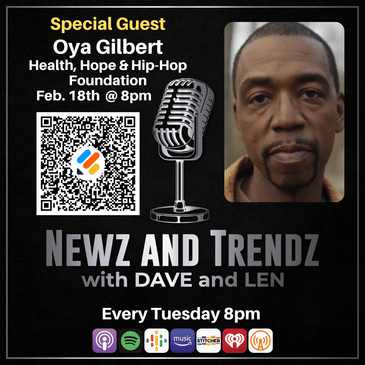

🎧 News and Trendz with Dave and Len – Exclusive Interview with Oya Gilbert + Hot Topics! 🎤
In this powerful episode of News and Trendz with Dave and Len, we sit down with Oya Gilbert, Founder and CEO of the Health, Hope & Hip-Hop Foundation, to talk about the first-ever Hip Hope Ball—a transformative event designed to combat healthcare disparities in the Black community. Set for Friday, February 28, 2025, at The Queen in Wilmington, Delaware, this star-studded evening will bring together hip-hop celebrities, healthcare advocates, and community leaders for a night where culture meets purpose. Oya shares his vision, the impact he hopes to make, and why this event is a game-changer in the fight for equitable healthcare.
But that’s not all—we also tackle this week’s biggest headlines, including:
🔥 Super Bowl Halftime Show Controversy – Kendrick Lamar’s performance and the racial debate surrounding it.
🔥 Issa Rae & Shonda Rhimes Make Bold Moves – Why Issa canceled a sold-out show and Shonda stepped down from a major board after Trump’s Kennedy Center takeover.
🔥 Maternal Health Crisis – The racial gap in deaths among U.S. mothers during childbirth is widening. What’s being done about it?
🔥 Black History Fact: Vivien Thomas – The unsung medical pioneer who changed the world of surgery.
🔥 Dave’s Corner – What three things should have us most concerned as we head toward the 2028 presidential election?
This episode is packed with insight, inspiration, and unfiltered conversation—so don’t miss it!
🎙️ Listen now and stay informed with News and Trendz with Dave and Len!
#NewsAndTrendz #HipHopeBall #HealthEquity #KendrickLamar #IssaRae #ShondaRhimes #BlackHistory #Podcast
[00:00:13] Alright y'all, get ready for another edition of News and Trendz with your host Dave and Len.
[00:00:32] Welcome, welcome, welcome to News and Trendz with Dave and Len. This is one of your hosts, Mr. David Coker, proprietor of Dave Mark Inc, promoter, event planner, management, you name it, I do it, all around good guy, hanging out with my partner Mr. Leonard Young. What's going on sir?
[00:00:52] Hey Dave, everything is good. This is Leonard Young, CEO of National Black Guide, DelawareBlack.com, black media specialist, all around good guy. How goes it Dave? Man, I can't call it man, it's one day at a time. You know, this winter man, what we gonna do with it man? We got, we figured, you know, the ground all did say six more weeks, but I didn't believe him. You know, because when he said it was a nice day.
[00:01:22] You know what I said? But the snow ain't trying to leave us without a fight. I know. Well, who was it? Was it a, oh my goodness, who, who had the, the, the book, the coldest winter ever? Wasn't that a, was that Zora Neale Hurston? Uh, I'm gonna leave that up to you because I never read it. So I, hold on a, so Dave, you watch all these movies and you don't read no books?
[00:01:47] Hey, no, I'm not a book reader man. Never have been. Never have been. Yeah. Yeah. Well, luckily, luckily I'm not gonna criticize you for it. But long story short, this right here is the winter that will not stop wintering. I mean, it's just crazy how long, how cold, how much snow we've gotten, how much ice, how long it sticks around. You know what I mean? It's just crazy.
[00:02:12] Yeah. I mean, we, we've been fortunate because we haven't had that big, big, big snow. Like, you know, everybody keeps talking about, you know, I don't know if you noticed that over the last couple of years, it's come up about the winter of 96. I mean, the last couple of weeks has come up over the, about the winter of 96 because everybody keeps talking about how it keeps snowing. Right. And they keep thinking that we're going to have a real big one before winter is over.
[00:02:41] And I'm like, I'll take the little ones as long as we don't have that big one, you know, because that's just going to shut everything down. You know what I mean? So, um, I don't mind, I don't mind the little ones, but, but then the weather keeps going up and down and, you know, people, you know, we keep talking about this global warming and everything because one moment it'd be 20 and 30 degrees and the next moment it'd be 50 plus.
[00:03:09] Yeah. You know, so, but, um, hopefully we only got a few more weeks. Um, we can make it to March. Uh, that's when the time changes again. Right. Um, in March. Right. So, so we make it to March. I think we can, we'll be almost done with it. So, um, other than that, man, everything
[00:03:29] good. Yeah. I mean, everything, same old, same old, um, I mean, really just saying I'm, I'm looking forward to this week because, uh, my son has a state championship. So, um, um, now Dave, he's in another state championship. Yeah. Well, it won't be the two Pete, but yeah, for, uh, for swimming and they have the prelims on Thursday, they have the finals on Saturday, but you, you know what they're doing?
[00:03:59] I don't, I don't like. So last year, and I mean, I get it. The university of Delaware, their swimming pool, and I'll make it super quick last year. Um, the, the balcony was just super packed, super hot. So this year, what they're doing is they're only allowing two tickets per participant. So each swimmer who's swimming in the championships or the prelims, they only get two tickets. So of course, you know, that's one ticket for me. And that's one ticket for his mom.
[00:04:29] And then any remaining tickets, they're kind of like first come first serve via like a lottery. And I'm, I'm kind of upset about that. Cause I plan to get a couple of additional tickets for, you know, family members to come out and watch them. So, you know, now I just know that I got to be on the ball when that lottery comes out to try to get some tickets. Otherwise, you know, How many people does, how many people does it hold?
[00:04:54] Um, I'm not sure. I mean, it's a lot, but it's not, it's, it's a lot, but it's not, cause you know, last year people were bringing their aunties and uncles and cousins and kids. So, I mean, it definitely won't be none of that this year still.
[00:05:08] So we'll see, but long story short, I'm super excited for Thursday and Saturday to see how well he does. And, uh, but yeah, I mean, other than that, David, it's a regular week. I know we got more snow coming. So, you know, we, we, we, we, uh, just trying to, uh, survive. Okay. Well, that's, that's good. Uh, Quincy on a little roll right now.
[00:05:30] Yeah. All right. All right. Okay. Well, congratulations there. Congratulations there. Um, other than that, you know, um, we're in our, God, February, almost over. We're mid, mid February already. I mean, you know, but, uh, happy black history month to everyone. And, um, we didn't get a chance to talk to you guys last week, but, uh, black history,
[00:05:55] you know, we, we definitely got to enjoy black history month because, you know, people try and take it away from us. So, you know, we can't, we can't have that happen. We can't have that happen. Black history month may not be here next year. Yeah. Might just celebrate now. Juneteenth might not be here this year. I know. It may not be a federal holiday. I know they ain't playing around. He, you know, he trying to get rid of everything, you know, he figured, he said black history month is part of DEI. Okay. All right. Whatever.
[00:06:25] You know, Dave, I already told you last time too. Um, I believe you're scheduled to report to the plantation on March 1st. You know, bring on your cotton picking gear. Yeah. Well, yeah. Well, you know, we laugh and we joking about it right now, but of course, those guys are probably sitting there. They say, okay.
[00:06:48] Uh, they turn the page on their next project 25, uh, 2025 page. Oh, the plantation. Okay. Here we are. Okay. Let's get started there. And so, but you know, um, it's, it's, it's interesting, you know, with all the stuff that's going on with the president and his people, that's what I call it, his people.
[00:07:12] And, um, you know, we just, we're just in for the next four years. It's going to be interesting. Um, it really is. And that's all I got to say at the moment. There's so much I want to say, but I'm not because I, you know, I don't want to get us canceled.
[00:07:28] You know, but, um, folks, um, we have, um, a guest with us tonight. So, um, we're going to actually, let me see, Leonard, why don't you go ahead and tell everybody who we have on tonight and, um, let's, let's, um, bring our guests on.
[00:07:49] All right. Sure. Well, so our guest tonight is Oya Gilbert and Oya is a podcaster, a father of three, a notable artist in the Delaware hip hop community. He's known as Grand G and he, he came up with hard spitting rhymes in the streets of Wilmington, eventually leading to a record deal and numerous song releases.
[00:08:13] In December of 2017, he was diagnosed with multiple myeloma and incurable blood cancer that impacts the black, that impacts black people twice as much as other ethnicities. He has been unwell for more than two years and was actively seeking medical help and still his condition went undiagnosed for far too long.
[00:08:37] It was then that Oya learned firsthand about healthcare disparities. Since his stem cell transplant in 2018, Oya has turned his pain into power, leading support groups and working to empower other patients to advocate for themselves. In 2024, Oya founded the health, hope and hip hop foundation to help spread awareness.
[00:09:02] The black in the black and Brown communities about their propensity for certain types of cancer and important things. Everyone should know about what we need to do to survive. So without any further ado, Oya, we'd like to welcome you to the show. How you doing? I'm good. I'm good. I appreciate it. That was a, that was a nice little intro there. I like the music y'all got when they play. Oh yeah, appreciate it. Oh yeah, that's my, that's my favorite song by the way. Yeah, you know.
[00:09:32] Yeah, yeah. And we'll, we'll, we'll have to thank one of my best friends and I guess your publicist, Portia Green for, you know, sticking everything together. Cause you know, we, we, we, we already know Portia is a hard worker. She is on her grind. Yes, she is. Selfless shout out to Portia Green. I mean, purpose PR agency. But she cares. She really cares about. No, no, she does. Oh yeah. Oh yeah. She does. She definitely does. She definitely does.
[00:10:01] And Portia will be a little pit bull sometime. Like, you know, if you still be doing something, she'll, she'll be on your butt about it. No doubt about that. Never lie. I'm trying to stay on the good side though. Oh yeah. Definitely. Definitely. But first of all, we just want to thank you for coming to the show and, you know, coming to speak about, you know, the healthcare disparities, which unfortunately you experienced firsthand. And then of course your upcoming events. So I guess to start it off.
[00:10:31] Um, so with the multiple myeloma for people who may not be familiar, can you kind of explain what it is and how it affects the body? Yeah. So first of all, thanks for having me on the show. I appreciate it. Sure. And so multiple myeloma is a blood cancer.
[00:10:53] It's a type of cancer that affects the plasma cells, which are the white blood cells that respond for, you know, that produce your antibodies. Uh, and what it does is it, it creates a situation where, uh, it starts to erode or those cells get, those cells get infected. They get confused with what they're supposed to do. And they start eating away at your, you know, your bones.
[00:11:18] And so what winds up happening is softens your bones to a point where, um, you know, have an issue where you can break bones very easily. Gotcha. Great. Um, huge back problems, kidney problems, fatigue, obviously. Uh, and you know, it's just a really nasty blood cancer. It's incurable. You can't, it's not curable. Um, so that's another strike against it, but it is very, very treatable.
[00:11:46] And you can have a really good quality of life. And thank God I'm, I'm, I'm living proof. Sure. So, um, of course it said you were diagnosed in 2017. Was, um, the diagnosis, was this being from just like a routine checkup or were you feeling a certain way? Like how, how did that diagnosis come up? So the diagnosis, I live currently, I live in a very rural area with, uh, predominantly older white communities.
[00:12:16] So, you know, so, you know, I'll just leave it at that. I'm around a bunch of Trumpsters as you guys. Oh, trust me. I, I, I know about that too. Yeah. So, you know, but in all seriousness, uh, the dynamics of it is, is that I was going to see, uh, the different healthcare providers and they were just telling me it was something else. And I've never really been sick.
[00:12:44] Like I've had regular colds, things that have never broken the bone. But the bottom line is, uh, I started feeling weird. And so I had this episode, which was, I thought was like a heart attack. And then I went to see a bunch of doctors here for years. I kept telling them something was wrong and they kept saying, no, you're not. You know, they labeled me a hypochondriac, said I was looking for drugs and all this like really bizarre stuff that didn't fit anything. I was telling them, like I told them, I don't like medication. I don't like to be addicted to things.
[00:13:14] So this was just a really strange. And what happened is I was so sick every day that I definitely knew I was going to die. And so I decided to increase my life insurance policy to try to get more money for my kids. I was at the space where, you know, you start making decisions like that. And I was at the space where if I'm going to go out, let me see if I can get them some more money, some more stability.
[00:13:40] And so it was their doctors that because of how much I asked for to raise the policy, they said I needed to get a medical examination. And, you know, the irony of the things that we kind of hate or we dislike about insurance companies and the policies that they have about, um, uh, you know, covering preexisting conditions is actually the thing that saved my life.
[00:14:04] And so I was diagnosed by trying to increase my life insurance policy because I just knew I was going to die, which I, which I was on the road. Because it wasn't anxiety or a hypochondriac. I had, I definitely had cancer. Now, can you kind of explain how the stem cell transplant? So, and I know you said it's not curable, but what was the wording you used? Like you can still maintain, I guess, a good quality of life.
[00:14:34] So what exactly did the stem cell transplant, how did that, um, help? Yeah. So the word I used was treatable, uh, you know, that you, and that you could have a decent quality or a very good quality of life, uh, through different therapies.
[00:14:52] Um, so the stem cell transplant is, I would say in the, within the last five to 10 years, definitely the go-to for a particular cancer and quite a few blood cancers. But a stem cell transplant is essentially the short version of it is this, uh, I'll give you the analogy after I tell you what it is.
[00:15:15] It's basically extracting your, uh, cells, your T cells out of you, uh, your, um, and then, uh, what you're essentially trying to do is separate the cancer cells from the good cells. And then you then reintroduce those back into the body. That is, uh, what they call, uh, uh, uh, auto where you get your own cells.
[00:15:41] Uh, and so that's what I got. I got my own cells. They put them back in my body. What the concept is, the short version is this, say a golf, you know, you got to go off course. That, that grass is, you know, immaculate. And so if you don't take care of it, you know, it'll grow weeds. So what they're basically trying to say is, is they're going to take and extract, uh, all the good.
[00:16:11] Grass out of that golf course, put it to the side, introduce chemo, which is trying to make the good dirt. It doesn't know the difference. It kills everything, but now the dirt is fertile. Right. Without any cancerous stuff, put the good, put the good grass back in there and hope that it grows without the cancerous cells. That's the best analogy I could give people to understand what a stem cell does. And then the ideal is just like any good lawn, you have to maintain it to keep the weeds out.
[00:16:40] So that's where they call maintenance therapy or, or maintenance chemo that happens after you get a stem cell.
[00:17:16] Gotcha. What's the best way to do that? What's the best way to do that? Do you think, you know, black, the black community is better treated here in Delaware or maybe worse treated? Like what, what, what are your general thoughts regarding that? I mean, in general, I think one of the statistics about Delaware is, you know, might sound crazy, but a lot of people do have health coverage. Now, how they're utilizing it and what type of health coverage is it dominantly?
[00:17:45] Is it on the dominant side being private? Yeah. Or is it government? That's the question. You asked that question. I know one of the things is obesity is, is an issue in Delaware, but I do think from a healthcare standpoint, the system itself, it does rank pretty high, you know, high amongst the, amongst the nation. So that's, that's a good thing.
[00:18:09] And so the level of care, if you can get healthcare does appear in Delaware, it is decent. Is there, is there room for improvement? Obviously in certain areas, there definitely is, but that would be my assessment of the Delaware healthcare system, at least from a standpoint of the Northern version.
[00:18:31] There's a, you know, I'm not familiar with, I think it's BB down in, and I'm not sure what's down in Sussex, but the point is, is in Newcastle County and the healthcare systems that's here, which is Christiana Care is the largest one here. Right. Yeah. Yeah. I do believe they do offer great care. Gotcha. Okay. Now, I guess, get into the meat of everything.
[00:18:58] Now, tell us about the, the health, hope and hip hop foundation, kind of like, you know, what spurred you to start it and, you know, what's, what's your mission with that organization? Yeah.
[00:19:10] So it really started from the whole journey that, you know, I kind of explained, you said in the intro that the whole journey of the discovering my, that I was starring in a disparate film, if you would say, led me to say, Hey, this is, you know, it's just really not cool. You know, more people should know about it.
[00:19:34] And I mean, my family was calling it melanoma and, and multiple sclerosis and all, you know, because they never heard of it and neither did I. Right. So, but the point is, is that, uh, that was the problem. I mean, when you really, you know, it's funny, but that's what was the, not the funny part is, is that they didn't know what the disease was, nor did I. But yet it affects African-Americans, uh, twice as much. Now, the good news is there is some good news with the disease and not getting to the foundation.
[00:20:02] The one good news I want to share it is that if we do receive treatment, we tend to do better than our other counterparts. So that is a positive. I will, I really want to emphasize when it comes to, uh, the treatment aspect of it, but as far as the foundation, at some point, I used to have a hip hop career. That was in public in Delaware.
[00:20:25] Um, I produced a, uh, the album called project X back in the day and it had Riverside bucket two, six on there and some other, uh, tri-state local jams that I think a lot of Delawareans that's my age might remember. And I'll hold y'all. I'll say Dave probably smiling. Cause you know, Dave, Dave, Dave from that area, he from Riverside and he said, I know, I know, I know, but I know, I know, I know the, I know the, uh, the project. I know exactly what he's talking about. Yeah.
[00:20:55] So I did start smiling when he said, I know. So yeah. Cause I'm, I'm actually from Riverside. So I know all about that. Yeah. Yeah. That's dope. Oh yeah. See, I told you Dave, would I make a connection somewhere? Like high school. Right. Right. It wasn't auntie, but he didn't got this music now. Yeah. Yeah. Yeah. Oh, I did that album. Hip hop. Um, definitely was living in New York for about a year or so hanging with the, you know,
[00:21:25] what we consider the greats now, but I always continue to do music. So it's a cathartic, passionate hobby, whatever way you want to call it. So fast forward to the portion of getting the disease, I started speaking at events and advocating for the disease. And then that became a passion of mine. And so I have a really great relationship with God. And so I told him, Hey man, like I'm going to do one or the other for the rest of my life,
[00:21:54] uh, change my life, uh, do something I've dreamed of doing, helping others. I can't do both. And then one day he said, yes, you can. And that's how the ideal was birthed. And it was formulated with a lot of hard work with, um, just doing some research, God putting the right people in my life. And so the foundation was formed. And what we do is we take the hip hop culture, hip hop music to teach health literacy.
[00:22:20] When you think about hip hop at this stage of the game, uh, it's touched every facet of the planet. There's third world countries that don't have running water, but they know TikTok dances and they know who Nicki Minaj is. So it's a great vehicle. It's just that today's hip hop, we are not using it in a, in a, in a way, in a format that's uplifting our generation, our people, not just in our ethnicity, but all ethnicities that listen to hip hop.
[00:22:48] So when I say we're using hip hop, it's the, the formula from the golden era of hip hop, where it was used to, to be a voice, to, to bring positivity, to teach. Uh, you had 9-1-1 was a joke back in the day to, on a movement to bring black people together. So it's that version of it blending it also so that we can reach today's youth. And so hip hop can do that.
[00:23:14] Hip hop can touch the older generation and the younger generation. So the foundation uses that through health advocacy songs, through community events, like the one that's coming up now, which is the hip hope, the hip hope ball. And it is a precursor to the health, hope, and hip hop block party, which will happen later on this spring in Delaware.
[00:23:38] And so that, so the hip hope ball is just a great way to bring grassroots and industry together to fellowship. And the fellowship inside of this building is about understanding what the foundation is trying to do and the programs we're trying to develop and bring into the community, where we're trying to not only bring information, but also infuse finance into the community.
[00:24:02] The last component of that ball is to also show what our baby mini version of what the block party is going to look like. And the after, uh, the afterwards, uh, uh, you know, once the block party is over, we'll have an ambassador team left here to continue to work inside the city for the rest of the, you know, for the rest of the duration, as long as we can keep the program going.
[00:24:28] And that's how you trust in the community. You can't come in there and do an event and leave, right? You can't come in all the time, you know, too hot with your own agenda. You know, you got to listen to what the people's issues are. You know, we might can't even get to talking about cancer. If we can't understand the fact that that maybe their issue is housing or food or of that nature, but those are all things that are contributors to good health.
[00:24:55] Sure. All right. So for people who are attending the, um, the foundations event. Oh, well, I'm sorry, before I get to that. So Portia was saying that you may have a special guest or guest. Um, can you kind of explain who may be, uh, let's say a, you know, but, but besides Dave Coker, who may be like a celebrity in Bloomington that day.
[00:25:18] Oh yeah. Okay. Yeah. So there is also, uh, to be a live performance. I, I'm not going to share it right now, but it is a hip hop iconic legend. Uh, and it's not vanilla ice.
[00:25:37] So that's one aspect of it, but there are also be some other folks in the house. Uh, we have been, we have gotten RSVP for Sean Jackson. I said, the Sean Jackson. Okay. Sean Jackson's going to be in the building, uh, young guru. Who's a huge hip hop. Yeah. Right.
[00:25:57] Some other city officials and some other guests freeway, uh, was, uh, supposed to attend. So we're going to find out if, you know, he comes, but it's no telling who's going to be there. It's just a matter of, uh, in that space, they could call you the night before and say, Hey, we know exactly.
[00:26:14] Unfortunately, that's the way that that goes. Right. And, and, you know, I was thinking too, because, um, it's freeway who's he's been an advocate for health too. I, I, I can't remember what disease he has, but I know he spoke out a lot of with it and doing a lot of community stuff.
[00:26:30] Yeah. Yeah. He had renal kidney failure. Um, and so he wound up getting a kidney transplant. So that's the state he's at right now. Yeah. He's huge. Uh, like you said, advocate for, uh, kidney disease and, uh, you know, high blood pressure and controlling, you know, a lot of things that. Cause those things to happen, uh, along with, um, a foundation called the gift of life, which is another foundation that we are, uh, in conversation with as well.
[00:26:58] Gotcha. Okay. And then I think my last question, and then I'll let Dave, um, talk about Riverside and PS Dupont. Anyway, go ahead. Yeah. So, um, I know that there, um, there are going to be some live performances from hip hop artists. Can you name some of the people? Um, if you're able, the people you're able to make. And, you know, I'm, I'm glad to have a talk with Portia because, um,
[00:27:26] um, I almost blurted out the name of the special guest and I was like, well, you know, I'm just gonna let him do it. You know, Portia didn't, Portia didn't prep us on that one. But anyway, I'll, I'll, I'll get with Portia later, but, um, can you speak about some of the performances or maybe some of the speakers that may be there if you have not already mentioned their name?
[00:27:48] Sure. Um, so our, uh, one of our, uh, honorary speakers is Dr. Robert Wynn. And, uh, if you Google Dr. Robert Wynn, he is a huge component, uh, towards, uh, disparities and, and controlling them issues. Um,
[00:28:07] and he is the, uh, if I'm not mistaken, I don't want to butcher his position, but director at, uh, a Massey, uh, in, in Virginia, uh, Massey Comprehensive Cancer Center.
[00:28:19] And it's, uh, it's a huge comprehensive center. He's worked with, uh, the president and those, those type of folks, um, along with this cancer journey. And I also believe he is the, on the board of the AACR, uh, which is a, another organization that is huge.
[00:28:42] Essentially they get all the money for the cancer. They go to the government and try to get all the money for the cancer research. Gotcha. And that's the American, uh, association of cancer research, the AACR. Okay. And then were there any other, uh, performers you can speak of, or is that kind of like a surprise for those in attendance?
[00:29:08] Yeah, it's really a surprise. There's only going to be really one live performance. Like I said, from the, uh, from, uh, a hip hop icon. I know Portia told you, but, uh, we, like I said, we just still, uh, um, on making sure that we don't have more than one. Yeah. Gotcha. Yes. Okay. All right. Well, I, I, I let my, my partner Dave take the mic.
[00:29:34] Okay. Um, just wanted to ask a couple of questions in reference to, um, in reference to your illness, uh, I'm going to go back to the illness. Um, and yes, Leonard is correct. We spend a lot of time talking about, um, disparities as far as treatment, um, healthcare treatment, um, when it comes to blacks and especially black women.
[00:30:02] Um, so, um, when you found out about this illness that you had, you said that, uh, it was through the insurance coverage that you were trying to get, um, you know, that led to being diagnosed.
[00:30:21] Now was this doctor or the people that diagnosed it, were they black or were they, were they people of color, um, some other color that made you, well, they actually took the time to help you with making sure that they found out what was wrong with you. You know what I'm saying here? I mean, yeah. Yeah. Yeah. Tell us about that experience.
[00:30:45] Yeah. The, so the answer that the short version is I haven't to the day, I still haven't seen a black doctor. Wow. Uh, and no, the, uh, insurance situation was I already had life insurance. I was just trying to increase the policy.
[00:31:03] Right. They just sent a, actually they sent a nurse practitioner, uh, actually to my job. They didn't even send me to a doctor's office. It came to my job. Uh, she took some blood. She did some other, you know, one twos and then took it back to their facilities with their doctors, the insurance companies, doctors.
[00:31:24] And then, uh, once those results came back, she then came back with another consultation, a doctor and said, Hey, listen, um, here's the results from that blood work. Uh, I think you have something wrong with you. And I was like, you think, I remember trying to tell people for two years that something was wrong. It was a diagram of a, of, of, of, uh, a man. It has some boxes highlighted saying here's what could be the problems around my kidneys and things.
[00:31:53] She told me, take that to my primary. I did that at that point. I was on my fourth primary doctor. I had seen all every specialist you could possibly think of some, some of them twice, which had led me to that dire reaction of saying, I knew I was going to die.
[00:32:10] Let me increase my life insurance policy. Cause as I stated, no doctor necessarily figured it out at all. It happened exactly, you know, just the way I said to you, it was, you know, God put me in a position where if it wasn't for that, who knows? I wouldn't be speaking to you guys right now.
[00:32:26] So doctors get, I know black doctors now, but no black doctors treating me through this whole process. Uh, really just me educating myself because I, you know, I wanted to live, you know, and I wanted to, you know, see, you know, I see if I could do something about it. And during this time, did you actually were, was one of these doctors like a blood doctor or. Yeah. Okay. All right.
[00:32:56] Yeah. I had oncologists. I had a local oncologist and I had a specialist for the stem cell transplant. So, uh, I had wound up having two doctors, you know, both of them being in the hematology space. Okay. All right. Okay. Yeah. You always, you know, it's funny. Um, I'm a person that I go to, I'm a person that believes in going to the doctors. Uh, and unfortunately a lot of us men don't always do that.
[00:33:26] Um, we don't want to go to the doctors. Um, we don't want to go to the doctors or we don't feel that there's a need to go. And unfortunately that's, you know, we, we go when we find out things are wrong. That's when we, that's when we go. Um, but I'm, I'm one that believes in going to the doctor.
[00:33:43] And, you know, and so anytime I feel something is wrong, I will go and I will try to find out what's wrong. Um, unfortunately we don't have every, everybody to do that. And it's a good thing that you knew your body well enough to know that something wasn't wrong. Cause that actually happened with my ex-wife where she had a situation where she knew she wasn't right.
[00:34:09] And she knew something was wrong. And she had a couple of different doctors to tell her one told her it was, and I think he mentioned this earlier. One told her it was MS. You know, one told her it was, um, beginning signs of, um, um, what was it? Um, um, Lou Gehrig's disease.
[00:34:28] I mean, you know, they were telling her all kinds of stuff and it was a, you know, there, you know, I, and she was like really vexed about the whole thing. And she said, I know something's wrong with me, you know, but they couldn't, they couldn't actually prove it, but they just kind of took guesses on these things. And that's what they were doing and guessing. Yeah. A lot of times. Yeah. Go ahead.
[00:34:54] Now I was saying, um, don't get it confused. I mean, the doctors are smart, but you know, that's why they ask you for your symptoms because it is a kind of process of elimination type thing. The part that's just disturbing in this particular case is, um, you know, it's just really about listening. You know, if they would have listened to me and I was very clear, I had no history of addiction. I'm telling you, I don't want to take pills.
[00:35:20] I'm telling you, I got a, a chronic back issue. So if I was going to be taking pills, I'd be taking it for that for sure. Uh, I've never really been sick. You know, if I'm saying these things, I can't be an addict. I can't be a hypochondriac. Something's got to be wrong. You got to dig a little deeper. And the part that's so frustrating is think about the two years that I spent chasing it. Everybody took blood and urine.
[00:35:46] And every time you go to doctors, like on some serious stuff, they're taking some kind of urine or, you know, got something going on and it's just really crazy. But their excuse was they weren't looking for that. Well, no, that, that, so yeah, I guess I, I, hopefully that answered your question, but yeah, that, that is not, that's the part of the system that's broken that we need to fix.
[00:36:12] Yeah. Yeah, definitely. Definitely. Right. You know, we definitely need to look at it and we do definitely need to listen because that's eventually what happened with my ex is that the doctor, she ended up seeing like her fourth doctor and that person listened. And that person was able to diagnose what she had, which was the first reported case of fibromyalgia in Delaware.
[00:36:37] You know, and, you know, and once they figured out what was wrong with her, of course, they were able to treat her and everything was, you know, they were able to, you know, give her a good quality of life after that, you know? So, so, but, you know, we have to people, you know, we, Leonard and I, we're always talking, you know, you guys have to make sure that you are definitely following up with these doctors, making sure that they are listening, making sure that they do hear the things that you're saying to them.
[00:37:07] So, so that you can definitely get the best results and the best treatment possible. I'm going to ask, ask a little bit about now. I'm a promoter. I've been doing it for a long time. I'm also event planner. I manage musicians, bands, groups, individuals.
[00:37:30] So, you know, Delaware has become really a hot bed for talent. We have a lot of people, especially over the last 20 years, I will say, that have really made names for themselves, either in producing music, you know, writing music, performing. I mean, we've been pretty blessed with a lot that's come out of Delaware.
[00:38:02] Listening to you talk about the hip hop thing and, and, and talking about it, especially your own experiences and so forth. It is really, it's really cool when you can pull together an event like this for a cause that, for the cause that you have. And also to bring talent together and have them kind of talk about the things that led them to where they are.
[00:38:30] And of course, you know, have this mysterious person to perform that we don't know the name of. You know, so, of course, who has a great history as well. So, tell us about your experiences here in Delaware with the talent pool and, and even with yourself in coming up in this hip hop world here in Delaware.
[00:39:02] Yeah, I mean, for me, it was always, it was always something that I just really enjoyed, like hip hop saved my life. So it was a, it was, for me, it was a lot. I can't speak for the other MCs of my, from that generation, but for me, it saved my life.
[00:39:21] And I got an opportunity to work with the guys back then that were kind of like street legends. Because I really wasn't. I was a nobody that just came out of nowhere, because to be perfectly transparent with you, like I was a nerd in school. And, you know, I just was kind of thrown into the street life. And then that's what kind of emerged out of it, this guy that was rapping.
[00:39:50] And I've been started rapping when I was like 14. And so, yeah, I started working with cats like MC Isaiah, Yerky D, you know, I did stuff with Disco Beef. You know, you had Cut Wiz and Doc D back then. And even a little bit before my time, you know, we had 7 Up, you had Kenny G, those type of folks.
[00:40:12] So I know my history prior to me, during me, and even after me, the hip hop, I would say the hip hop atmosphere in Wilmington is in very great hands. You got people like Richard Raw, you know, you got people like P.D.F., you know, 57 and his groups. And the list just goes on. I don't want to start because I don't want anybody to get mad. There's a bunch like. Yeah.
[00:40:42] Yeah. How come you didn't name me? How come you didn't name me? Yeah, yeah, yeah. That's a bunch of talent there. But but working what wound up happening is, is I always. I never had an issue with the other emcees in Delaware, because back then there was a certain kind of sound that was from Delaware. But I always felt like I really wanted to be big time. And so my measuring stick, I felt at the time frame needed to be the people that were big time and they weren't necessarily in Delaware.
[00:41:11] In my mind, they were the folks in New York. So that is kind of where I went to do my measuring stick. And that's how things develop with even recording Riverside Bucket 26 is I went to New York to record. And then that's when I got the blessing of being able to work with some of the hip hop grates and be be able to be taught.
[00:41:32] From a very high level, how things were done in music, how to record, you know, how you you know, how some of the big time emcees did their sessions back then, because we didn't have digital digital anything. I mean, I had a digital watch. That's about it. But everything was analog. So my experience with Delaware hip hop and back then was very good. I mean, I was cool with everybody, at least as far as I know.
[00:42:00] So and I love producing other people, got an opportunity to do that with Isaiah. I even did a song for York E.D. That if you know that somewhere in the archives, if somebody ever found that, that would definitely probably make a couple of dollars in the overseas. But there's something for him called Band-Aids and just work with different artists behind the scenes that people don't know. But I did a remix for Chuckie Booker.
[00:42:25] I did a couple of submissions to Puff Daddy's crew when he had that. Oh, bad word. Bad word. I know. I know. I know. My fault. I'm sorry. I'm just joking. Yeah. My fault. Too soon. Too soon. My fault. Well, let me ask you this. This is going to be my last question. I'm going to put you on the spot a little bit.
[00:42:53] I feel like I'm in a I'm feel like I'm part of the movie Brown Sugar right now. But that's a whole nother story. You know, you know, I want to say hip hop, hip hop. OK, so I'm going to put you on the spot. That's cool. Your top five all time hip hop artists. Oh, you know, this question is crazy. But I know. I know. I know. I know.
[00:43:23] That's what I said. I'm only going to tell you why. Go ahead. Go ahead. No, no. I was going to say, Dave, does he have to do it from five to one? He just he can just say him with nine. No, no, no, no. No way. Hold on. Because I know where I think I know where he's about to go. Go ahead and say what you were about to say. Yeah. All I'm all I'm trying to say is this. The difficulty for me is I've been in hip hop since its conception. So for me, it's like, what era are we talking about?
[00:43:50] You know, because if I go if I'm going to go all time, I mean, I'm probably going to stop at a certain time frame, but definitely. No. Look, I said you're up five. OK. All right. Well, you know. All right. You got the 80s. You got the 90s. Like I said, you're top five. I got you. So. OK. All right. So for sure. Let me see. Lyrically.
[00:44:19] Probably not going to make sense to some people, but I definitely think Eminem's in there. Like I'm a lyricist person. Karis One is definitely in there. OK. It's the five. Hold on. Let me let me let me slow my let me slow my selection. OK. All right. Karis One is definitely in there. He definitely got he definitely inspired me to rap. Now.
[00:44:50] Did you did you see him when he came to Delaware? Yes, I did. I was in the building. I was in the building. Yeah. That library was lit that day. Yeah. OK. All right. Nas. Karis One. Lyrically. Eminem's definitely in there. God, you got the R and you got Big Daddy. I'm going to have to put the R in there.
[00:45:19] OK. That's four, right? Yeah. Hold on. The R. You talking about Rakim or is that? Yeah, Rakim. Yeah. Yeah. Come on, Leonard. You ain't hip, man. I knew. Well, no, no, no. Dave. I was saying for our audience, you know, some of our audience. There's only one R. Yeah, I'm sorry. Rakim. There's only one R in hip hop, man. There's only one R in hip hop. Go ahead. Follow the leader R. The lyrics of Fury R. Yeah. That R. Yeah.
[00:45:48] And I would say, man, I could tell. Let me tell somebody young in there. Common, man. I mean, not common. I'm sorry. I'm not common. J. Cole. J. Cole. Yeah. Okay. Yeah. J. Cole. J. Cole. He got that old school flavor. And he, you know, he definitely got the words. He got the bars. He got the bars. I like wordplay. I like lyrics. Yeah. Yeah. Yeah. He does. But you know, you could have said, I could have said Scarface in there.
[00:46:18] I could have said, you know. Man, I could have hit somebody that might not. I'm there's a lyricist that was. Like I said, it's your top five. Jill Rob G is a lyricist. But a lot of people ain't know who Jill Rob G is. You know, so. But, but you know what? I noticed one thing, though. You didn't say any women. Well, there are some. Yeah. I mean, but they could go on there too. See, that's what I'm talking about. The list is two. Five.
[00:46:47] Hip hop all time. I know. I know. But I'm just saying. I'm just saying. I'm just saying. You know, your list is. Your list is fire. Don't get me wrong. Yeah. But who's your top woman? Who's your top woman? Just give me. Give me one. Who's your top woman? From your from your list. Hmm. I have the mighty nose. My top. I'm going to have to go with energy back then. I mean, the one I fell in love with was MC Light. I'm going to be honest with you. Okay. Yeah. Okay. I ain't mad at you for that.
[00:47:17] I ain't mad at you for that. I fell in love with MC Light. Latifah definitely was up there. But I just. It was something about MC Light's, you know, swag. And especially Paper Thin. Like, she just rode the tracks so viciously. And it just was, you know. It was hip hop at its purest in me. He was too smooth for everybody. You know what I mean? Because he just had that flow. That was just like. Yeah. They don't know. They wasn't ready for her. That's what I was going to say. I'm not sure they were ready for that. Like, she wasn't ready for it. They wasn't ready for it. No.
[00:47:45] And they still talk about it now with the water and the emojis. The young. Yeah. Yeah. Yeah. There you go. She was a track driver. Yeah. That's right. That's right. Okay. All right. I ain't mad at you. I ain't mad at you. All right. I passed. I passed. Yeah. You did all right. You did all right. You did all right. All right. So this is what we're going to do right now.
[00:48:04] I want you to take the moment to go ahead and promote your event and give your social media contact information where people can get tickets and all that kind of stuff. And then, you know, we'll do it again at the end of the show. But go ahead and go ahead and get that information at this time. All right. So the event is called the Hip Hope Ball, a celebration to ignite change.
[00:48:33] It's at the Queen on Friday, February 28th from 6 to midnight. It includes VIP seats.
[00:49:10] It comes with a three-course gourmet meal. It comes with the programming that the foundation is going to present. It also comes with that performance from this mysterious person that you keep trying to get me. And then it comes with an old-school hip-hop party to close out the evening for about an hour and 45 minutes just playing old-school hip-hop and just dance the evening away.
[00:49:39] But one of the dope things, if you're into it, it's open bar the entire night. Oh, okay. All right. You'll hear that? Not just for an hour or a couple minutes. It's the entire night. So it's going to be really dope. Got some really good guests in the house and a really great event. And like I said, so it's February 28th at the Queen. And it's from 6 p.m. to midnight.
[00:50:09] And yeah, let's close out Black History Month. Really, really dope. Okay. And people want to get tickets. Sorry about that. You can get the tickets at www.healthhopehiphop.org. That's www.healthhopehiphop.org. And you can navigate right there to tell you right where to go for the tickets.
[00:50:38] And you can see all the other information that you need about the event. Make it real easy. Social media, we are on Instagram, same thing. Health, Hope, Hip Hop. Facebook, same thing. And if you really support you and got your act together, we go on LinkedIn too. Okay. Cool. Cool. Cool. We ain't doing Twitter, you know, for a minute. But y'all might go into that later in the show. But we ain't doing Twitter. Okay.
[00:51:08] All right. All right. Well, hopefully, folks, everybody got that information. And we will make sure it's repeated before we sign off tonight. But we want to thank you, Olya, for that question and answer segment during the show. We're going to go ahead and get into our other part of the show. And thanks for hanging around with us because we definitely want to get your opinion on some of the stuff that we're about to talk about. Okay.
[00:51:39] All right. We're in the hip hop frame of mind right now. Okay. Yes. So let's talk about the halftime show from the Super Bowl. Okay. I love your face there. So, well, first of all, let me say this, Scott. I didn't get a chance to say it last week. So I got to say it now. You know, congratulations to my Philadelphia Eagles.
[00:52:09] I don't know if you're an Eagle fan. Are you an Eagle fan? No, he's not. Okay. All right. I can see that. Okay. All right. But me and Leonard. Me and Leonard. So I heard something to my throat. My son. I can tell. I saw the face. I already know. I already know. Are you a Cowboy fan? Do you have? Did Portia tell you all this stuff prior to this? No, no, no. I just thought. I picked it up. I picked it up. I picked it up. I'm sorry, man. It's a challenge.
[00:52:39] Okay. All right. Well, that would make this even better that I'm talking to a Cowboy fan. Okay. The Eagles, the world champion Eagles, or let me just say that one more time, won their championship last week. But, of course, all the talk, even though it was a great game and the Cowboys were not in it, the talk was about the halftime show.
[00:53:09] Now, I'm going to read a little bit about something that was written. And, you know, we could talk about this a little bit. But let me just read this for a little bit. And then we're going to kind of each kind of chime in on what we thought about the halftime show. It said, the biggest protest in the Super Bowl history happened on stage. And folks screaming, it's boring or trash because it went over their head.
[00:53:38] This is what you didn't see. Then again, the message in blacks is blacks have always been here to entertain. They, who are not like us, so they aren't bored. They rather have Wayne up their high, who has backed Drake the system to push the agenda.
[00:54:05] The messages Kendrick just sent to America could not use Wayne. It even started when the American flag being built out of black people as America being built on the backs of black people. Before I mentioned how being cool in our culture has always been stolen, no matter how many people try to steal it, they are not like us.
[00:54:36] This was not about white people. It was about the people who control the media and labels who create divide. Okay, here it goes. It started with dead press into beat and flow bigger than hip hop. I'll put the video in comment. First song.
[00:55:02] When I hear music, it makes me dance, squabble up. New order. Uncle Sam, you'll, L. Jackson. Started it off with the rules of the game of historical white America, America. Then said, when a bunch of blacks hanging out on the corner, too deep for the culture. Somebody gotta die.
[00:55:29] Deduct a life and create an environment to cancel each other out. The squid game start, which symbolizes the rich killing of the poor for entertainment. Hmm. Imagine rappers beefing and killing and the media benefiting from their deaths. Hmm. That's deep right there. The system allowed Drake to push the sexy red to taint the culture and empower him.
[00:55:59] The dancers in red and white and blue representing the American flag. Been dancing to the drums of the system. And we want entertainment and to be able to dance, then be educated. The main stage was a PlayStation. Squid game card.
[00:56:21] And the system is a game designed to keep us dancing and in prison, which is why it was in a prison yard. Protecting black women like Serena Williams after the disrespect from Drake. And once again, reminding the system of Drake of America and America. They plant. Are not like us. And can't infiltrate the culture.
[00:56:52] Game over. TV off. Been under their control. Revolution. Drake being used to further sour the system and be a plant for the system. Same system Malcolm X warned us about from music execs who own media and used it to divide us. This is bigger than rap.
[00:57:19] And women who feel disrespected should see it. People who are tired of being divided should see it. Notice the American flag divided. But most of all, those who didn't have a lens to see it just shows the system has worked. And you're the type it's been working on. Dude is the most creative genius in hip-hop history.
[00:57:49] But go on. Go off. Maybe we can see more well-respected entrepreneurs and family men leading for once. Here's the kicker. Look at your Facebook friends who said they wish it was more entertaining. Yeah. Well, they were who it's been working on.
[00:58:15] The system would rather keep you choosing entertainment over being educated. Watch the first 10 seconds of his rap. Dead presidents reference bigger than hip-hop. True art. Rappers sent as plants to hurt us will no longer be tolerated. We are woke. If you're mad at it, please don't complain about being looked at a certain way.
[00:58:44] Because you want to bounce the entertainer who promote killing each other and degrading our women. Wow. Wow. That's a mouthful. That's a mouthful. That's a mouthful. And I didn't finish it, but that's enough right there. Oh, Lord. This is... There was so much going on on stage. And it's been broken down. You know what's funny? It's been broken down by more white people than black people.
[00:59:14] Have you noticed this? Yeah, I can figure. I mean, I've seen more white people who caught every moment of what was going on on stage than I have black people. What about you, Leonard? Have you? You know, it's kind of hard to tell because I think I noticed the complaints more. And a lot of the white people just seem oblivious. Because, you know, so I think for black people, there's understanding the difference between...
[00:59:45] And I mean, this is just in general. A good performance and a hidden or semi-hidden message. Where, you know, a lot of the white people are just like, what the hell is going on? You know, so like, I don't expect them to understand the message. And half of them don't understand the good performance. So, I mean, it is what it is. Yeah, I mean... Well, go ahead. Go ahead.
[01:00:13] I mean, for me, I think one of the statements in there, and I heard the word genius of all time. Now, I'm not going to go that far. You know what I mean? Don't get it confused that, you know, it was very ingenious of him on how he decided to present his performance. I wasn't sure what he was going to do. What I was hoping he did not do. I was like, I hope he don't go on his stage and just be walking back and forth.
[01:00:42] That would have been boring to me. But it's... I know it's going to sound crazy, but it's the same foundation or same... Yeah, I guess I would say the same foundation or the core thing I'm thinking about with our foundation is trying to find the right blend of entertainment and education to create that edutainment. It's trying to...
[01:01:07] You know, at today's time with, you know, the children that we have today and the young folks with all this instant and the ADHD, you know, you do have to morph a little bit. However, what we've done and what you said is, you know, we just poisoning our community with, you know, hip hop music that doesn't teach anything. It teaches horrid. It doesn't teach you how to save money. It teaches how to not value life. And all those crazy different things.
[01:01:35] And now you had a halftime show where a guy was doing the complete opposite. So first and foremost, I think from a... Maybe from a cultural standpoint of white people, their imagery in their mind is they're expecting rappers running back and forth, hooping in and hollering and doing all that kind of stuff. They didn't expect this artistry, which is what it was. Because, you know, he has choreographed, you know, he had choreographed routines inside of the thing. He had messages inside of there.
[01:02:04] And I think in from the black culture, I think it just went over people's heads because I think, you know, that's what's wrong with the hip hop community. You are... The hip hop culture became what it was because we allowed it. You know, you can't do something that you're not allowed.
[01:02:26] So what happened is when they started, I feel like when they started maybe dummying down the hip hop culture, we just kept accepting like, you know, as listeners. Yep, that's cool. That's dope. To now we have songs where they're not even saying words sometimes and it's selling. So I think, you know, from Kendra's standpoint, it was a message far about, you know, hip hop. It was a message to government. It was a bunch of those messages in there.
[01:02:54] And if you're not in tune with that, you think it was just, you know, a corny, you know what I'm saying, performance. Right. Because you're missing the complexity of it. It was deeper than... It's like The Matrix. It was deeper than that. Right. Yeah. That's a perfect analogy. It was like The Matrix. You know, it was that, you know, bending your back backwards and getting out of the way type of thing. You know what I mean?
[01:03:24] You know, it was that type of thing. Plus, what was his most important part of the message, you know, got... They didn't even show at the end of the performance. You know that, right? Yeah, he's supposed to... There was a sign back there that said, end racism. Wow. They cut away from it as soon as it went up so that people didn't see that. Yeah. It flashed. It flashed for a moment and then all of a sudden it was gone.
[01:03:54] Yeah. And when you read about what happened at the end of his performance, the sign was there that said, end racism. Yeah, I think a lot of people missed a lot of things. Right. Yeah. Well, it was... And guess what? Everybody had clothes on. Yeah. Nobody twerked. Yeah. How about that one? I mean, think about it. You know, it was very well choreographed. You know, it was even funny at times.
[01:04:23] Of course, you know, when he took his little shot at Drake and he smiled at the camera and everything. And then he pulled off the most gangster thing ever. He brought Serena out. Oh, yeah. Nobody saw that coming. So nobody saw that coming. And, you know, and even having Scissor out there performing as well. And, you know, they...
[01:04:49] I just thought there was so much going on with that performance that it was a great performance. It was... It just broke Michael Jackson's record. Mm-hmm. Nobody's talking about the fact of, you know, his breath control. Because he wasn't really... He wasn't rapping over no track. You know, he had those little spots where he wanted to emphasize things. But to be moving and... I know he wasn't sitting there doing a full Chris Brown. Right.
[01:05:17] Because he was moving and staying with the choreograph and keeping his songs together. You could tell he had put the work in. Yes. This is me because I'm a lyricist. I'm a rapper. So, you know, I'm looking and listening for different things. And I think that's what happens as you watch a halftime show. So, depending on the things you enjoy, that's how you're... That's what you're looking for. So, if you're a person that doesn't...
[01:05:42] At hip-hop and you're looking for a whole bunch of rah-rah and a bunch of explosions or whatever it is, and you don't see that, you're like, oh, that was whack. But you're looking for it from a different standpoint. I am even looking past the fact of, like I said, I'm looking like, man, it's due to controlling breath. You can hear every word he's saying. It's very clear. Where the transitions from song to song, you could tell it was very intentional, very thought out.
[01:06:10] That gave it to me a very A-plus thing. When is the next time you're going to get a platform bigger than that? Even when he goes on concerts and does great things. You know, the Super Bowl is probably next to maybe the Olympics. This is like the biggest event ever in the world. You're not going to get on that platform. And they don't get paid for it. Right. So you're going to shoot your shot. I mean, I know.
[01:06:33] Like he said, hey, you don't want to leave that moment and get after that and say, oh, man, I left something on the table. Right. Right. Especially. Mission was accomplished, I think. I think he did exactly what he said on stage to do. He got the people talking. Whether it was good or bad, he got the people talking. You know, Michael Jackson held the most watched Super Bowl performance ever all these years.
[01:07:03] And keep in mind, he did that before social media. You know, so. So. And. This boy comes along and crushes that record, you know, and whether they liked it or not, people tuned in. You know what I mean? People were there. It wasn't like people. And they said people didn't tune in for a second or two. They were there. You know what I mean? They were there. So. So. But I just. I just wanted to bring that up because we didn't get a chance to talk about it.
[01:07:33] But I just thought it was. I wanted to get you guys opinion on it. And I thought it was a great. I thought it was a great performance. And I just think that, you know, and people still talking about it. That guy had a great week. I mean, keep in mind, he had just walked away from the Grammys winning a whole bunch of Grammys. And walked into this situation. You know, so. You're winning right now. Winning right now. Yeah. Yeah. He definitely winning. He definitely winning. So. All right. So.
[01:08:02] We're going to move on to this next story. Let's see. Go ahead. Go ahead, Lenny. I was going to say for the next story. And I'll just kind of make it quick because it probably happened about a week or so ago. But so for anyone who's not familiar, of course, Trump has kind of taken over the board of the Kennedy Center in D.C.
[01:08:25] And replaced some board members, which voted him as board president or, you know, so forth. But, you know, I thought it was interesting. So, of course, you know, of course, Trump is putting a lot of stuff in action. And there are a lot of people. A lot of people. A lot of people rebelling against what he's doing, rightfully so. So I'm not sure both of you have heard.
[01:08:51] But, of course, at the Kennedy Center, Shonda Rhimes, who was on the board, she resigned because of Trump and the board takeover. And Issa Rae had a show that was upcoming at the Kennedy Center that was actually a sold out show. And she canceled her show kind of in protest. And everyone who had tickets were refunded their money. Oh, yeah.
[01:09:18] How important do you think it is for artists? And, I mean, you know, we kind of saw stuff with Trump prior with, like, Snoop Dogg and Nelly and, you know, all the backlash they got.
[01:09:32] How important do you think it is for artists to make statements by, let's say, pulling out of events or venues or collaborations with people who, let's say, don't support the Black community?
[01:09:50] I think it's, you know, extremely vital that in these next four years, it's going to be imperative that we as a culture really dig deep and get rid of the crabs in the basket mentality and all those different stereotypes and stigmas have traditionally or historically held us back.
[01:10:14] So, in this particular case, I think it's imperative because it's the way we have our voice. And I don't know about you, but we want to, we have to stop trying to buck the system, learn the system and play it better. Right. So, you know what I mean is once we understand that the thing that moves things in politics is finance, money.
[01:10:43] You can sing kumbaya, you can do all those wonderful different things. So, her move to do so is a power move. And the best way I can show a person an example is I'm a sports fanatic and to show you the power of finance and how it can move policies and everything whatsoever. If you think about the former, the Washington commanders, there was a time where I worked there for the Washington Redskins. And you all know Dan Schneider. He really was what they said they were.
[01:11:13] He took out ads and said he was never changing their name. He put a Wall Street Journal. He did all kinds of stuff. But this was just people protesting. But then it came to a point where people was like they had enough of him. And then they went inside of his pockets. They cut off all his revenue, all the store stuff selling his merchandise. The three team minority group said they were great to sell their shares. FedEx Stadium.
[01:11:39] FedEx, the corporation said they were going to take away their naming rights to the stadium, which are in the millions of dollars to name a stadium. 20, 30, 40 million dollars. Not only did it make him change the name, they ran him out of the entire organization. That's how you make change. And I think it's imperative like what Issa did is that you got to make a statement.
[01:12:06] And we have to make a statement collectively since he is in office. And it does not only affect that community, but it's affecting the health community because of some of his executive orders, reducing funds and critical research areas. And it's a trickle down effect to other organizations. There's some nonprofits that are doing excellent work in communities that rely on federal funding.
[01:12:32] And, you know, he just comes in and says, you know, we're going to stop that, you know, cold turkey, which affects, you know, people that he doesn't get. It's not going to affect him. So I think it's very. Gotcha. What about you, Dave? I mean. Well, I mean, of course, you know, we know they kind of did the right thing. Do you think we'll see more people kind of backing out of Trump?
[01:13:00] Let's say, let's call what is Trump affiliated events and. Well, yeah, well, I think it's going to happen. I mean, for those who watch Super Bowl, he got booed. He got booed at Super Bowl. You know, we have on the 28th. Also, I think there's a protest that's being done about the companies that, you know, not to the boycott that's being planned to boycott all the companies.
[01:13:30] That, you know, refuse to have the, you know, that's removing the DEI products and so forth. So economic blackout. Yeah. The economic blackout is what it's being called. Yes. So. So, yeah, there's a lot of stuff that's going to happen over over. Over. Look, this is going to be an everyday occurrence. Come on. Think about it. It's going to be an everyday occurrence. Every time he does something, we're going to balk. We're going to balk about it.
[01:14:00] We're going to. We're going to rebuke it. You know, it's going to be everything, man, because, you know, he's. He's not. He named the Gulf of Mexico. I know. He renamed it. How are you going to change history like that? But, you know, how can you do that? I mean, come on now. And that quick. Yeah. He said it one week and now, like, if you go to Google, it says Gulf of America already. It's amazing. It's amazing how they let. And this guy is a felon.
[01:14:30] He's a felon. He's been convicted felon. And felons can't even vote. And he's changing things. Okay. So. Is that, you know, I, I, I compared Trump to like the kid that goes inside somewhere, like a kid who likes a bunch of gizmos and he goes inside this room and it has buttons everywhere. And all kinds of cool things.
[01:15:00] And kid goes in there and just like, oh, what does this button do? Hit that. Oh, what does that button do? Right. Yeah. Yeah. Yeah. Of it. What happens down the road? Just. Oh, the instant gratification of, oh, that's it. NDI. Let's press that button. See what it does. Ooh. You know, not that's just kind of. Not worried. Not worried about the repercussions of anything. Right. Yeah. Yeah. So. Yeah. In fact, it kind of reminds me of, in fact, oh, yo, when you just talk about it
[01:15:27] now, remind me of the Simpsons when Homer went into Mr. Burns' nuclear thing and he was trying to figure out what was going on. Yeah. Just doing stuff. Just doing stuff. Yeah. It's amazing. It really is. But, you know, I mean, all we can say is God help us. That's all we can say right now. You know, God help us, you know. Jesus. Jesus. Yeah.
[01:15:57] And hold them. We got to hold him accountable. We got to hold. Well, I just, you know, I think me and Leonard both kind of, you know, we talked about this. I'd be totally shocked if he's in office. When the next election comes around. I'd be totally shocked. I will be. I'm serious. If he makes it to that next election, I will be totally shocked. He's going to do something that's going to be.
[01:16:27] Agreed. It's going to be. You're going to be like, look, we ain't even his home is going to be like. Yeah. Yeah. Yeah. Yeah. Yeah. Yeah. He's going to do something. He really. Because right now you got too many egos floating around in his cabinet right now. So that's a whole nother story. So, but anyway, we're going to move on. I just want to say for the record, little X said Donald Trump is not really the president.
[01:16:55] So I, I just want to, I just want to say. He said, you are not. He said, hush. You are not the president. Yeah. Okay. All right. A lot of validity to that. I'm going to say. Yeah. Yeah. That's true. I'll leave that alone. Yeah. That's a whole nother world right there. So, all right. We're going to move on to our next story. Let's see. I'm going to read.
[01:17:24] Racial gap widens in deaths among U.S. moms around the time of childbirth. I just want to read a little bit of this in reference to, here we go about the disparities that we were talking about earlier with health care. Black women in the U.S. die at a rate of nearly three and a half times higher than white women
[01:17:49] around the time of childbirth in the year 2023 as maternal mortality fell below pre-pandemic levels overall, but racial gaps widen according to the federal health data release on Wednesday.
[01:18:08] In 2021 and 2022, the maternal death rate for black women was about 2.6 times higher than white women. 2.6 higher than white women. The data suggests that COVID-19 pandemic at its peak impacted all pregnant women.
[01:18:31] But once we went back to usual activities, then the impact of the systemic racism and unequal access to medical care came right back into place. The Centers for Disease Control and Prevention report Wednesday on the 2023 death was drawn from the death certificates.
[01:19:00] The CDC counts women who died while pregnant during childbirth and up to 42 days after birth. The maternal death rate for white women dropped from 19 deaths per 100,000 live births in 2022 to
[01:19:29] 14.5 per 100,000 in 2023. So it dropped like almost 5%. The rate for black women went from 49.5 to a little over 50, though the report says that the increase was not statistically significant. The rate for Hispanic women dropped from about 17 to 12.
[01:19:57] The rate for Asian women fell from 13 to 11. In total, 669 women died in 2023 during pregnancy or shortly after childbirth, the CDC reported. That's down from 817 deaths in 2022 when it was the highest in more than 50 years. So I'm going to stop there.
[01:20:26] I think we see where this is going. Why is it that we can't get the care that they're getting? Dave, we already know. Yeah. I mean, you answered your own question with the question. I know. I know. I know. I know. It's amazing. I mean, you know, when you, you know, let's. Oh, yeah. Leonard and I, we've been doing this show for four years, a little over four years now.
[01:20:56] Okay. Congratulations. Oh, well, thank you. Thank you. Thank you. What's amazing is how many stories in four years, Leonard, do you think we've done about this type of stuff? At least once, one to two a month. We can't get away from it. No. And it just, it's, it's, it's amazing.
[01:21:19] And the fact that they have the numbers and they know it's right there and they still, excuse me, have not been able to figure out why is it so different than these other numbers? You heard the other numbers I just read. That's nowhere near what they were saying the black women were. Yeah. You know, that's like your story with the treatment that you had.
[01:21:46] But, you know, one of the things I think has become very apparent to me is when it comes to ratios and the disparity category, we always are on the short end of the stick. I don't care if it's or, you know, just anything, you know, it just seems like we just always on the short end of the stick. Okay.
[01:22:13] So part of, I think for health reasons wise, I think there's two things going on and we have to come to some kind of happy place to figure it out. You do have historically some things where, you know, men, we got to stop using the ER as our PCP. So, you know, to me, that's not a white thing, if you would say, or a healthcare thing. That's a us thing.
[01:22:43] So, you know, there is some self-inflicting wounds. Now, can we say that's from historically being brainwashed or whatever case? Yeah, yeah, yeah. You might could say that. You could. But I also feel like this is 2025, you know. I mean, you can find out anything you need to know in today's time. So I think you have an issue with changing the mindset of the person. That's for one thing.
[01:23:13] Then like on the healthcare side, we need more people in there to look like us that understand it. And then I think there's a third component of it is, which is the part that's really kind of walking on that fine line of what do you, how do you feel? But we have very low participation as African-American in clinical trials. Any medication that's on this planet got to go through a clinical trial.
[01:23:41] Like, I'm sorry, in the U.S. Let me just say that. In other countries too, but they got different kinds of rules. But in the U.S., clinical trials. So let's just say hypothetically, you have a clinical trial that has 30,000 participants in it. But if those 30,000 participants and only 1,000 of them or 500 or 10,000, that's too high,
[01:24:03] 1,000 to 5,000 more African-American, then just ratio wise, that particular drug or therapy is going to give more results leaning towards other race, the other ethnicity, the white person. So it's obvious our genetic makeup is different and it requires more. So you can't get data on, you see where it's like a catch 22. You can't get data if we don't participate.
[01:24:33] You can't make what I call disease or specific precision medication. That's what it's called, precision medication. If you don't have the data to collect it. So historically, all clinical trials are participated by white people, majority. And so naturally, the drug has data more geared towards them.
[01:25:00] And so they don't know exactly how maybe it's going to affect us on a larger scale because the participation and what it does in their body wasn't there early in the stages of development. Are you following me? Yeah. It makes a lot of sense. Yeah. Because, you know, one thing I've real quick. Oh, yeah. I'm sorry. One thing it makes me think of is, well, so I've had people who look to advertise clinical
[01:25:27] trials at the University of Delaware and a lot of black people are skeptical of clinical trials. It makes me think, is there a Tuskegee experiment where they injected them with, was it syphilis or something like that? So, you know, I guess how do we get black people or the black community to feel comfortable? Because it's almost like COVID. And, you know, now we kind of know that everything with COVID wasn't what we were, what was told.
[01:25:53] But there's a lot of mistrust among black people for clinical trials. You know, how, how do you kind of see that changing? I mean, for me, it's the first thing, and I know it sounds cliche, but it's definitely to get educated. But that's with anything. It don't have to be about clinical trials. It could be about going to purchase your house. If you go out there and don't get educated and just go buy a house, you're going to get what you're going to get.
[01:26:20] I mean, but if you go get yourself educated, it doesn't mean you need to be an expert at purchasing homes, but you do need to know what you need to be looking for to get, you know, to give yourself a better opportunity, the best chance to get a quality home. So you take that same perspective. And I know about Tuskegee and all those different things, but you do the research on it. It's a little bit deeper. It's not just always this story that goes around that they spew out.
[01:26:46] But the biggest thing that's different is one, back then there wasn't any laws in place. There's laws in place for first and foremost, and how drugs are developed and how they're distributed. I just explained to you about the clinical trial situation and how it works. The second thing is we got a seat at the table. I am a living proof of that. I am on plenty of pharmaceutical committees, steering committees.
[01:27:14] And the reason why we need a seat at the table is to capitalize on it. But you can have a seat at the table, but if you're not educated, then you're just sitting there and it's a check the box movement. But you got to have a seat at the table and you can't be afraid to address the elephant in the room. You can't keep ignoring the elephant in the room. The only thing that's going to happen is it's not going to disappear. It's just going to get bigger. So I think we need to address the elephant in the room. And why is it that you won't go to the doctors?
[01:27:41] And I think a lot of times you'll find out it has nothing to do with distrust. That's just sometimes a quick excuse for like what one of my friends said is he don't want to go to doctors because he don't want to know. That ain't got nothing to do with the Stiggy. You know what I mean? And there's plenty of hymns with that same mentality all across. I think it's about getting educated about what it is and how clinical trials work and not that they just throw you in some dungeon with this weirdo doctor like Frankenstein
[01:28:08] who's injecting you with all these different fluids and different things. Clinical trials don't work like that. They are highly regulated. You have the smartest people in the world working with it because one, they want it to work. And there's all kinds of ramifications if it doesn't. So it's a thing about really understanding it. And then lastly, you got to make a sound decision because there's no perfect decision when you're making choices in the cancer space.
[01:28:38] There's no like right decision. You're making a sound decision. And in order to make a sound decision, you need to be educated. I'm going to say this before we move on. It all goes back to the pandemic and when the vaccines came out. And if you notice, who were the people who first jumped on all the vaccines? It wasn't us.
[01:29:09] We all had our conversations with each other. I'm not doing it. Everybody remember, you know, hey, they ain't going to shoot us up. They ain't going to put a chip in me. I know. You know, everybody was saying it, you know, and, you know, because everybody, you know, everybody was worried, you know, but then, you know, and I work for, you know, Leonard can tell you, I'm working for the division of social services.
[01:29:36] And so, and people, you know, we had people coming into our building to get the shot. So I saw it all day long. I know, I know exactly what was going on back then and who was getting those shots. For the first couple months, 95% of the people getting those shots were white people. Okay. And they were older, they were younger, but they were getting them shots, you know.
[01:30:03] And before the black people, you know, before the black people started coming, you know, and it led, it was the education that finally got to them. I know I said no at first. And then I was one of the first people in my, in my building to get the shot. I mean, it was me and another person. I said, you know what? Nobody else wants to get it. I'm going to do it. And I went on and got the shot. You know, I said, look, y'all can, y'all can fool around if y'all want to.
[01:30:33] But I went on and did it, you know, because I did my little research and I said, I'm going to do it, you know? So, and I did it, but this is the kind of, you know, mentality that we have and we have to do better. You said it. You, oh, you, you definitely put it out there correctly. We have to do better. We have to do the research. We have to get out and be involved so that we can take better care of ourselves and make sure we get the help that we need.
[01:30:58] Because these numbers, you know, like what's going on with what happened with these women, these pregnant women, and what's happening in healthcare in general, when it comes to us, we have to, we have to make this stuff better. We have to get it in a definite way. And we, and we control everything. We can control what's going on in the narrative. Leonard and I did a story about, you know, the Black Doctor Network that they have started.
[01:31:26] There's Black doctors all over the United States that you can actually look up. If you want a Black doctor, you can, there's a network that you can look them up if you need to. So, and we did a whole story about that one day. So, folks, you know, you got to, you got to do it. You got to, you got to do your research. We're, you know, we're, we're all calling out to that.
[01:31:50] And, you know, Oya is a testimony, you know, into being diligent with his, because, you know, you heard him say on this show a couple of times, he shouldn't be here. He wouldn't have been here. You know? So, we got to do better. And we got to make sure that we're on top of things. So, I'm going to leave that there. Okay. We're going to move on with our, being this is Black History Month.
[01:32:21] I know in the past, Leonard and I always like to spotlight, you know, a couple, you know, Black history icons and idols. And I don't like using that word idols, but, you know, people of importance, I should say. So, I wanted to talk about, since we're talking about medicine, okay. This will happen to fall right into place.
[01:32:48] You know, it says the website reveals the life and times of Black 20th century medical pioneer Vivian Thomas. First of all, Oya, are you familiar with Vivian Thomas? Oh. Doesn't that sound familiar? Oh, absolutely. It's one of my favorite movies with one of them. Ah, okay. All right. Underrated, underrated rap actors. But, yes. Yeah. Yeah. God by the name of Mos Def, right? Hands that God. That's the name of the movie. Yeah.
[01:33:18] Yeah. Yep. There you go. There you go. Good. So, just for those people who are not familiar, just in time for Black History Month, a new website appears. VivianThomasBook.com. With fresh finding about Mr. Vivian Thomas, the lab technician best known for his blue baby surgery. It is designed for students, teachers, and parents.
[01:33:48] This includes a timeline describing all the key events in Thomas' life as well as displaying 30 different photos illustrating his life and medical accomplishments. The website also explains the harmful impact that segregation had on Mr. Thomas and his family. Readers will learn of Thomas' extensive contributions to solving the mystery of traumatic shock, which
[01:34:17] immediately resulted in saving lives during World War II and many millions in the years since. The two different groundbreaking heart surgeries Thomas created are described, including the famous blue baby surgery, which was the subject of the movie Something the Lord Made.
[01:34:40] The website also shows Thomas' involvement in early efforts to develop CPR and electronic defibrillator, both of which are now routinely used to save the lives of people having heart attacks.
[01:34:59] If you're looking for great ways to quickly understand how medical progress is made or what life was like in the United States until race discrimination was outlawed, the website provides a fascinating way to do so. If you got a chance to see the movie, it was a great movie. I got a chance to see that movie.
[01:35:29] It was definitely a great movie. And I butchered you earlier. It's something. It's something. Yeah. Yeah. You think about the other movie. You think about the other black doctor. You think about the other black doctor. That's my fault. But I knew what movie I was talking about. Okay. But yeah, you knew what you. It was a good movie. I did see the movie myself too.
[01:35:54] And I actually, I thought I thought most definitely a great job as planned out to Vivian too. But he. He definitely was definitely a pioneer and definitely somebody for those people that didn't know anything about him. You need to look them up. Anytime you're in the hospital or you're watching a movie and you see you see them people put them paddles on or defibrillators being used, think of Dr. Vivian Thomas because that was the guy who was responsible for it.
[01:36:24] And believe me, he had saved millions of lives because of it, you know, and especially when it comes to the blue baby surgery as well. So definitely wanted to put a spotlight on him. Anybody wanted to comment about him? Well, I just, I guess people might want to know that he was working at John Hopkins. So that's a huge component to it. And that timeframe, you know, as we talked about the segregation aspect of it, first of all,
[01:36:55] black doctor not happening. Come in the building, doing anything besides being a janitor or something of that nature. Yes, you can. Well, he started out as a janitor, right? Yep. Yep. And then worked his way up to, you know, sort of like a lab tech. But the point is, is it's the amount of, I'm sure the movie didn't do it justice, but
[01:37:20] you can imagine the ridicule that he had to go through, the laughter of these people that were, first of all, probably racist. And then two, coming from these prestigious schools. And here's this guy from basically from the streets talking about there's really nothing you could really say to them at all, let alone something medical. So I can, I can't imagine how frustrating it was for him to, to navigate through all that
[01:37:48] and having to travel the distance he had to travel to get to the hospital because he couldn't live in the neighborhoods close to it. So, you know, and afford that. So you got to think about those things. And that's what I think about when I think about our ancestors and, you know, the things that we complain about, you know, the Uber's late, you know, they had to walk hundreds of miles, you know, just regular stuff done. So, yeah. And just amazing what he did and in that space of medical field.
[01:38:18] Okay. Glenn, you got anything to say? Um, no, but I will need to check the movie out again. I feel like I saw a few pieces of it, but I probably need to go back and watch it because y'all made it sound like something that I should probably. Yeah, definitely something worth checking out. There's definitely something worth. And those type of movies, you know, I like true story movies. So that's why it was very good. It was well done.
[01:38:45] And for him acting, which I was not very used to at the time frame, you know, he really killed it, especially since it was such a serious role. Right. Yeah. And keep in mind, this guy is on the wall at John Hopkins where only doctors, white doctors were on the wall. Right. Yeah. So, you know, that tells you how big of a contribution that that dude made, you know.
[01:39:13] So, um, you know, so hats off to Dr. Vivian Thomas and, uh, his great contributions that he made. Um, you know, so that's, that's our black history, um, you know, um, look at our history right there. And, uh, we'll have another one for you next week when we talk to you guys again. All right.
[01:39:40] That brings us to our last part of the show, which is Leonard's favorite, favorite part of the show. He loves this by the way. Oh yeah. He, he, he, you know, you see him over there smiling, right? He can't wait. He can't wait for me to do this every week. So this, this part of this favorite part of, uh, Leonard, uh, this, I can't even get it out because I know you're so excited.
[01:40:05] I know you're so excited to hear what I'm about to say, but this, this is, everybody knows this is Leonard's favorite part of the show and it's called Dave's Corner. That's why it says favorite part of the show because it's called Dave's Corner. Um, yeah, but this is where we usually throw out some philosophical questions or we throw out a little bit of fun things here, but, um, this is what I'm going to ask both of you guys today.
[01:40:31] What three things have you extremely been concerned? Well, have you, um, extremely concerned between now and the next presidential election in 2028? I kind of threw this out there a little earlier. So what are the three things that have you most or extremely concerned between now and the next presidential election in 2028? So, oh yeah, we're going to go with you first.
[01:41:01] What three things do you think are the most, are going to probably be the most concerning things as we move to the next presidential election? Uh, one I would say is what is going to be the fallout from the casualty of this administration? Because it is definitely going to be some.
[01:41:28] So, but what, what, what that fallout looks like and how deep, you know, that it's going to take to recover from that. Um, I'm afraid that from a standpoint of things that our ancestors laws are just things that they
[01:41:51] had achieved for us through blood, sweat and tears and some death can get reversed or be reversed in a heartbeat. And, you know, setting us back, you know, decades when it comes to racial tension and, and, and, and, and the division of a country.
[01:42:17] And so I, I, I am really concerned about maybe even possibly civil war. I mean, that's how. How extreme his actions and his historical behavior leads me to believe he could do. I'm not saying he will do, but yeah, it's certainly possible. It's not out of the realm. Um, so I'm concerned about civil war aspect of it.
[01:42:44] And I also concerned about him rubbing other countries the wrong way and going to war. Uh, with the fact that his poor decor amongst his own people, let alone a foreign country. And just like, like you said earlier, just doing something asinine. If I could use that word. Yeah. Yep. You sure can.
[01:43:15] Just doing something asinine to create. Because really it's ego. That is the most scariest thing of a man. You know, they always use, and I'll end with that. They say that statement is what does a man with power want? He wants more power. And that's true. However, what people don't fail to realize is that the X factor or to that situation is the ego of that man.
[01:43:43] That's the part you can't control to a man who wants more power. And that's where I feel Trump is so dangerous because it's his ego that is so uncontrolled and out of, you know, out of, you know, out of sorts. And you add that mix with power. You know, history shows people like that. I mean, I'm not going to say this is the guy, but Napoleon is one. Great orator.
[01:44:13] Not the brightest crayon in the box. But got people believe in a bunch of cockamamie. Division. You know. So maybe that might have been a little too harsh for him, but I'm just saying that's a similar comparison. I'm not saying that's who he is. I don't want to buy, you know, coming to the ball or living in this weird neighborhood. But I think those are the things I'm concerned about.
[01:44:42] I'm concerned about the future of the of our children and the country and what could happen as far as war, then internally from a civil war and the future of racial tension and all the things that go along with that. And then obviously the thing I said the first time from the beginning of just setting things back and the casualty of it. Can we are we going to be are we going to be able to recover quickly?
[01:45:10] You know, what's it going to look like the next four years as far as life? Not just black people, just period. From a standpoint, what is America going to look like? So we're going to find out, though. Yeah, we are. We're definitely going to find out. That's one thing for sure. Two things for certain. We're going to find out, though. We're going to find out. Yeah, definitely. All right. All right. Let it be with your thoughts. Yeah. So, you know, and I'm going to agree with. Oh, yeah. On.
[01:45:41] I'll just call it potential wars. You know, I'm sure Trump is slowly and surely he's going to turn off every country. And, you know, some of these countries ain't trying to play with us. You know, so, I mean, that that's concerning. And I think that kind of goes back to what Oh, you said, like his ego. So, you know, I feel like his ego doesn't match his brain power.
[01:46:07] So it's like, you know, it's almost having an ego, but not being smart with it. Right. And, you know, just some of the stuff he says, you know, the ignorance, the lack of knowledge. Right. The lack of care and concern. So I think he's going to turn some of these countries off. And I think that could be a potential. What are we on? World War Three or World War Four? I can't remember. We'll definitely be. Yeah. Yeah. So, I mean, I can see that.
[01:46:34] Gulf War and Afghanistan. Right. We haven't had World War Three yet. Yeah. I mean, let me not use the word yet. I'm sorry. No, no, no. That's not true at all. I mean, sorry. So, it's not true. And then for number two, it may be, and I just heard it today. It probably came out a couple of days ago, but he's ending race-based scholarships.
[01:46:59] So, any institution that offers race-based scholarships is going to be withheld of federal funding. So, of course, oh, yeah, where Dave knows, I got four kids who are about to start that college. And they're going to be back-to-back college. Right now, they're 11th grade, 11th grade, 10th grade, 9th grade, and 8th grade. So, yeah. So, long story short, we need some of them race-based scholarships. Yes, we do. Yeah, we do.
[01:47:28] So, I mean, of course, that's a little concerning. And then the last one, and I think we saw it during his last presidency, but just the racial tensions. I think people felt very comfortable showing signs of white supremacy and showing signs of whiteness and Karen-ness and, you know, just kind of going. Ed's in Karen-ness.
[01:47:55] Yeah, you know, so I feel like we're going to see a lot more uprising and racial tensions, people kind of rallying behind Trump, what he says and what he doesn't say. So, those are the three things that are kind of concerning to me. Well, what about you, Dave? What things during this presidential term are most concerning to you?
[01:48:22] Well, I guess my first thing, since you guys, neither one of you guys said it was, and I'm kind of glad that we're all kind of looking at different things, is the economy. I think the economy is in big trouble.
[01:48:43] I mean, you know, and, you know, because we don't have smart money people, you know, running the country right now. You know, we got money, we got money in the power, you know, positions, but we don't have smart money people who are going to keep us out of financial ruins in power right now.
[01:49:11] So, that's a big fear for me as far as the economy, because right now, when you go to the store and you go to pick up a dozen eggs and you're paying almost $15 for a dozen eggs right now, that is unheard of. I mean, you know, so this, you know, we're in trouble. We're in trouble economy-wise.
[01:49:33] And, of course, you know, the way that we do everything nowadays, you know, yeah, we got to, that's something to be really concerned about. My number two thing is health care. That, you know, you know, we started out this program talking about health care, you know, with your situation. And, you know, he's already tried to mess with the Medicaid system and the Medicare system.
[01:50:03] And, you know, you know, he always had this big Jones, you know, with, you know, Clinton care and then Obamacare. And, you know, of course, you know, he wants to make it all about his health care system and everything.
[01:50:21] So, or just totally eliminate the one, the system that only, that affects people who really can't afford private insurance to, you know, the Medicaid and Medicaid systems where only the rich people will be able to get health care, you know.
[01:50:43] So, that's a big concern is the health care system because especially as we get older, people, once you start to get a certain age, you know, you know, especially when you got to go to Medicare and those type of systems and that type of system where if you're a person that, say, diabetic or anything like that, you know, you're paying, you're paying astronomical money now for, you know, for medicine.
[01:51:11] You know, to keep yourself alive because of the, you know, tariffs and things that are going on right now. So, that's a big concern. Go ahead. Yeah, and that's definitely a huge thing because, you know, he's cutting the funding to research. It's once, remember I told you before, it's this trickle down effect. Yeah. You cut the EI program, you write an executive order for that, then you cut funding for the research of cancer.
[01:51:37] And all that says to me is, you know, you don't care about that. That's, you know, that's what that action means. And then so, what winds up happening is eventually, the thing I told you before, somebody's not going to get some funding. They're not going to be able to participate. They're not going to be able to get that medication that costs a quadrillion dollars anyway that shouldn't. And so, it's just, you know, it's just a vicious cycle. Yeah, it's a vicious monster, man.
[01:52:06] And we got to take a stand somewhere. Yeah. And my last thing, I think we all kind of touched on this one, but race relations. It's something that we have to try to, we all have to try to get along somehow. Somehow. We don't have to like each other. I mean, that's, you know, we definitely don't have to like each other. But we have to coexist.
[01:52:34] I mean, we have to be able to coexist and be able to live. You know, you joked around about being where you live. And, you know, Lennon and I also live in areas that are, you know, predominantly white, you know. Hold on, Dave. Speak for yourself, sir. Okay, thank you. Okay. All right. I live around the, look. Oh, yeah.
[01:53:04] I live around the corner from him. You know, sir. Oh, yeah. This is all I got to say. My immediate neighbors are black. The rest of the community is darn near Indian. Okay. I get it. So that's even, but that's even a whole nother level right there, right? Yeah. That's a whole different, that's a whole different show. A whole different show. Yeah, that's a whole different level. Yeah, that's a whole different level.
[01:53:30] So, but, you know, hopefully, and that just, that falls right in line with what I'm saying. The race relations. Because we all got to get along. Yeah. We all got to get along. I mean, you know, you know, we all live in, you know, we look at the diverseness of the neighborhoods that we live in. We all have to get along, you know. So, so hopefully, hopefully things don't get out of hand.
[01:53:54] We got another situation like January 6th, a couple years ago, where people are climbing the walls and trying to kill people and all this craziness. So, so those are the things that I'm concerned about. And, you know, hopefully things, things don't get too far out of hand over the next four years. So, but there we have it, folks. Whoa.
[01:54:20] So that is, you know, the more I think about it, the crazier it makes me feel. But there you have it, folks. That was Dave's Corner for tonight. And hopefully things do get better on all the things that the three of us talked about there. We want to thank our guest, Mr. Olya Gilbert, for coming on and hanging out with us tonight.
[01:54:45] Olya, why don't you, once again, tell us about your event coming up on the 28th and, you know, how people can get tickets and everything for your event. I appreciate it. Thanks again, guys, for having me. And I had a blast. I could, I could chop it up with you guys for, you know, another episode. But, yeah, it's the Hip Hope Ball at the Queen Friday. So that's two Fridays from now.
[01:55:15] February 28th, 6 p.m. to midnight. The tickets are $300 or $180. And you can get those tickets at www.healthhopehiphop.org. Health Hope Hip Hop is all one word, no hyphens. And we're on all social media platforms except for X.
[01:55:45] Under the same name, Health Hope Hip Hop. And, yeah, it's going to be a great event. Once again, just so you know, VIP with musical artists from the industry of hip hop. Three-course gourmet meal. Open bar the entire evening. Presentation from the foundation. Musical guests that we still haven't named in the show.
[01:56:11] And a dance party at the end. But, yeah, appreciate being here. And hope to see everybody there to help ignite change. All right. And we'll, Leonard, you'll put that in the... Yeah. Okay. All right. Yeah. When we post the show, it'll be there. So, you know. You might know before you post the show.
[01:56:40] See how I got right into that flow? Just busted Ron right then and there. Yeah. But I want to give a shout-out to Portia and my PR team. So, I want to give a shout-out to her. And I really appreciate this opportunity, gentlemen. Oh, well, thank you. Thank you. We really appreciate you taking the time to come on. And we both appreciate Portia, too. That's our buddy. And, in fact, Portia owes us an appearance on this show now. Think about it.
[01:57:11] Yeah. Yeah. We got to bring her on sometime soon. Yeah. Definitely. Definitely. Definitely. All right, folks. Well, that's our story. And we're sticking to it. So, we want to thank you guys for hanging out with us tonight. And remember, we are now part of the MBG Podcast Network.
[01:57:36] So, definitely check out our show on the MBG Podcast Network and the other shows that are also on that network as well. Anything you want to add before we sign off, Leonard? Nope. I think you said it all. Okay. All right. Well, thank you guys for joining us, as usual. And if you have any comments or feedback, make sure you let us know about them. Okay? Thank you. Have a good night.
[01:58:06] And we'll see you again next week. And trends with your hosts, Dave and Lynn.