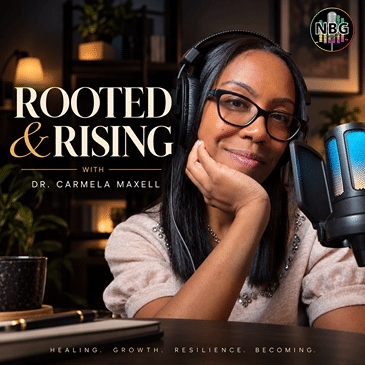
Sentence: Welcome back to Rooted in Rising. I'm Dr. Carmela Maxwell. Before we get started, make sure you're following or subscribe to the show wherever you're listening. And if today's episode reminds you of somebody who has been spending entirely too much energy responding to people who don't deserve an explanation, send it to them. Because today, we're talking about something that I think a lot of us struggle with. Learning when to shut the hell up. And I mean that in the most therapeutic way possible. Have you ever found yourself in a situation where you were inundated with questions about your values, the clothes you wear, the people in your social circles, how you parent your children, the dynamics of your marriage, or maybe even how much is being stored in your 401k each month? All because you introduced yourself to someone? Perhaps you were minding your own business, passively standing in a circle of coworkers or friends, surrounded by a peppering of other unknown entities, mindlessly observing your surroundings, when suddenly you hear Hey girl, my gosh Didn't you have less grey hair on your head the last time I saw you? It's been such a long time. How the hell are you? what the fuck? Since when did salutations come served with the cold side of insults? For your information, I'm in my Queen Daenerys Targaryen era. Bad example, maybe, but leave it alone. And here's the thing: sometimes people say things that are so unnecessarily rude, intrusive, or inappropriate that we feel an almost immediate obligation to respond, to correct them, to defend ourselves. To explain why their observation was inaccurate, to make sure they understand exactly why what they said was offensive, and sometimes, quite frankly, to remind them that we are not the one. But I want to ask you something. What if you didn't? What if somebody said something completely out of pocket and you simply allowed their words to exist without volunteering your energy to manage them? What if you didn't explain? Didn't justify? Didn't defend? Didn't deliver the carefully constructed verbal dissertation you've already written in your head? What if you just let the silence sit there? Because here's the seed I want to plant today. Not every comment deserves a response. Not every opinion deserves consideration. And not every person deserves access to your emotional energy. Sometimes silence is not weakness. Sometimes, silence is discernment. And sometimes, the most powerful thing you can say is absolutely nothing. Why do we feel the need to respond? Let's start with the psychology. Because I think it's easy to tell somebody to ignore a rude comment. It's much harder to actually do it, especially when the comment touches something personal. Your appearance, your parenting, your relationship status, your career, your intelligence, your age, your financial circumstances, your body, the way you choose to live your life. Somebody makes a comment, and before you've even decided whether it deserves your attention, your nervous system may already be responding. Your heart rate increases. Your jaw tightens. You feel heat in your face. Your stomach drops. And suddenly you're mentally preparing a closing argument. Exhibit A, why you're wrong. Exhibit B. Why you should have kept your mouth shut. Exhibit C. Why I have the time today. And what's interesting is that the intensity of our reaction doesn't always correspond to the significance of the comment itself. Sometimes, a relatively minor remark can trigger an enormous emotional response. Why? Because our brains don't interpret every social interaction as neutral information. We are social beings. Our relationships, reputations, and sense of belonging matter to us. Social rejection and criticism can activate systems involved in emotional distress and threat detection. And depending on our histories, certain remarks may feel particularly threatening. If you grew up being criticized for your appearance, somebody commenting on your weight May feel like more than a casual observation. If you were constantly told you weren't intelligent enough, somebody questioning your competence may immediately activate defensiveness. If you've spent years feeling judged as a parent, an unsolicited parenting suggestion may feel like an attack on your entire identity. The present interaction may be relatively small. But the emotional meaning attached to it can be enormous. And I want to make something clear. Having an emotional reaction doesn't mean you're weak. It means something registered as meaningful. But here's where emotional regulation comes in. Just because something activates you doesn't mean you have to act on that activation. Your nervous system can have an opinion. You don't have to turn that opinion into a press release. Sometimes your body says, we need to address this immediately. And your prefrontal cortex needs to step in and say, actually, no, we're gonna finish buying our groceries. Because not every perceived threat requires confrontation. Sometimes the threat is simply somebody with poor social skills and an unfortunate lack of self-awareness. And those people are everywhere, unfortunately. The difference between being offended and being obligated. Here's something I've been thinking about. When did being offended become an obligation to respond? Because those two are two different things. You can find something inappropriate without making it your responsibility to correct it. You can disagree with somebody without debating them. You can recognize disrespect without delivering a lecture on respect. And you can decide somebody's behavior is unacceptable without volunteering to become their personal development coach. I think many of us confuse acknowledgement with engagement. We assume that if we don't respond, we're somehow allowing the behavior. That if we don't defend ourselves, We're agreeing with the accusation that if we don't correct the misinformation, the other person is one. But relationships aren't courtrooms, and everyday conversations aren't trials. You don't have to submit evidence every time somebody questions your choices. Let's say somebody comments on your appearance, you look tired. Okay. Maybe I am tired. Maybe I have three children, two jobs, a podcast, a book I'm writing, and a mortgage that apparently requires my continued participation in capitalism. Maybe I stayed up too late. Maybe I didn't sleep well. Maybe this is just my face. What exactly would you like me to do with that information? But here's where we get caught. We feel the need to explain. I didn't sleep well last night. I've just been really busy. I've been dealing with a lot. And suddenly we've disclosed personal information to somebody who wasn't entitled to it in the first place. All because they made an observation. Sometimes we respond because we want to correct the other person's perception of us. We want them to understand. We want them to know we're not lazy, irresponsible, unattractive, unintelligent, or whatever else we imagine their comment implies. But here's a difficult truth. You cannot control the conclusions people draw about you. You can provide information. You can clarify misunderstandings. You can communicate your intentions, but you cannot force somebody to interpret you accurately. And trying to do so can become exhausting, especially when the person isn't actually interested in understanding you. Not every question is an invitation to connect. Now let's talk about questions. Because some people have an extraordinary ability to disguise judgment as curiosity. When are you getting married? When are you having another baby? Are you really going to wear that? Why don't you own a house yet? How much money do you make? Why are you still single? Or my absolute favorite? Don't you think you're getting a little old for that? Ma'am, sir, who appointed you the director of my life? And where can I submit my resignation from this interview? Sometimes these questions are genuinely innocent. People are curious. They don't always recognize when they're crossing a boundary. But sometimes the question is carrying an assumption that marriage is the goal, that having children is expected, that your career should follow a particular timeline, that your appearance should conform to somebody else's preferences, that your financial circumstances are open for public review. And we can feel pressured to answer because the question was presented as. Ordinary conversation. But you are allowed to recognize that a question is intrusive. You are allowed to decide that the subject is private. And you are allowed to decline to answer without providing a detailed explanation. I'd rather not discuss that. That's personal. I'm comfortable with my decision. Or my personal favorite a smile. Pause and a completely different subject. Because sometimes you don't need to construct a boundary statement worthy of publication in a clinical journal. Sometimes you just need to stop participating. And if the person insists, that's useful information. Because somebody who respects you generally doesn't need a 15 minute explanation of why your personal life is personal. Some people are looking for a reaction. Now, here's where things get interesting. Not every inappropriate comment is accidental. Some people make provocative remarks because they want a reaction. They want to embarrass you. They want to establish dominance in a social interaction. They want to make you uncomfortable. They want an audience. Or they want the satisfaction of knowing they can influence your emotional state. And I want to be careful here because we can't automatically know someone's intentions. A rude comment doesn't necessarily mean somebody is manipulative. Sometimes people are simply socially awkward. Sometimes they're impulsive. Sometimes they don't understand the impact of their words. And sometimes they are, quite frankly, being an asshole. But regardless of their intention, you still get to decide whether engaging is worthwhile. Think about somebody who makes a passive aggressive comment. must be nice to have that kind of free time. Or, well, I guess some people don't have to work as hard as the rest of us. Or, wow, you're really confident wearing that. Now, if you're anything like me, your brain immediately generates approximately 17 possible responses. And some of them are excellent. Some of them are eloquent. Some of them would make your ancestors proud. And some of them would require a conversation with human resources. So we need to choose wisely. Because sometimes the person making the comment is counting on you to react. And when you do, the focus shifts. Suddenly, the conversation isn't about the inappropriate remark. It's about your response, your tone, your attitude, your professionalism, your inability to take a joke. And now you're defending yourself against the reaction you had to somebody else's behavior. That doesn't mean you should never confront disrespect. Sometimes confrontation is necessary. But it does mean you should consider whether the response serves you. Don't let somebody else's lack of restraint determine yours. The emotional cost of explaining yourself. Let's talk about emotional labor. Because defending ourselves takes energy. More energy than we sometimes realize. First, somebody says something inappropriate. Then we think about it. Then we replay it. Then we imagine what we should have said. Then we tell a friend. Then we explain why it bothered us. Then we revisit the conversation while we're in the shower. Then three days later, while we're driving to work, we suddenly come up with the perfect response. And now we're angry all over again. Because why didn't we think of that on Tuesday? This is where rumination comes into play. Rumination involves repeatedly focusing on distressing thoughts or experiences without necessarily moving toward resolution. And it can prolong emotional distress. Sometimes the original interaction lasted 12 seconds. But we spend three days emotionally living inside it. That's a terrible return on investment. And I want you to think about something. How many people have occupied your mind long after they stopped thinking about you? How many conversations have you replayed with somebody who probably went home, ate dinner? Watched television and slept peacefully. Meanwhile, you're in the kitchen at 1130 p.m. preparing an imaginary rebuttal, and the person isn't even there. They have no idea you're arguing. They aren't participating. You've scheduled an entire debate with somebody who didn't RSVP. And you're losing sleep over it. Sometimes the most important boundary isn't the one we communicate to another person. It's the one we establish with our own attention. I am not giving this interaction another hour of my life. That's a boundary too. Silence is not the same as suppression. Now, I want to make an important distinction. Because when I say silence is a complete sentence, I'm not suggesting that we should suppress our emotions. I'm not suggesting that we should tolerate abuse. I'm not suggesting that we should remain quiet in situations involving discrimination, harassment, threats, or ongoing mistreatment. There are absolutely situations where speaking up, documenting behavior, seeking support, or taking formal action is appropriate. And there are situations where silence can reinforce harmful dynamics. So this isn't about teaching people to accept disrespect. It's about learning to distinguish between a response that protects you and a reaction that simply consumes you. Silence can be a healthy choice when it reflects intentional restraint. But silence can also be unhealthy when it comes from fear, avoidance, or an inability to advocate for yourself. The difference often comes down to agency. Am I choosing not to respond because I don't need to? Or am I staying silent because I don't believe I'm allowed to speak? Those are very different psychological experiences. One can reflect emotional regulation. The other may reflect learned helplessness, fear, or an established pattern of self-silencing. And we need to be honest about which one we're practicing. Because the goal isn't to become somebody who never responds. The goal is to become somebody who knows when responding is necessary. Your peace doesn't require everybody's understanding. Here's another uncomfortable truth. Some people are going to misunderstand you, even when you've explained yourself perfectly. Even when you've communicated respectfully, even when you've provided context, even when you've done absolutely everything you can to make your intentions clear, somebody may still decide that you're selfish or arrogant or difficult or unfriendly or too sensitive or not sensitive enough. And you know what? They're allowed to think that. I know. Terrible news. Because we would all prefer to be universally understood and appreciated. But that's not how human relationships work. People interpret us through their own experiences, beliefs, expectations, and emotional states. And sometimes their interpretation has very little to do with our actual intentions. You can be confident. and somebody will call you arrogant. You can be quiet and somebody will call you unfriendly. You can establish a boundary and somebody will call you selfish. You can express an emotion and somebody will call you dramatic. You can choose not to respond and somebody will call you passive aggressive. At some point you have to decide whether your goal is to live according to your values or to manage everybody else's perception of you because you cannot do both perfectly. And here's something I want you to remember. Being misunderstood is uncomfortable. It is not always an emergency. Sometimes we treat misunderstanding as something that must be corrected immediately. But discomfort is not necessarily danger and disagreement is not necessarily rejection. You can allow somebody to hold an inaccurate opinion without allowing that opinion to become your responsibility. The power of the pause. Now let's make this practical. Because I don't want you leaving this episode thinking, okay, Carmella, wonderful. But what am I supposed to do when somebody says something stupid to my face? Fair question. First, pause. I know. Groundbreaking. A clinician is telling you to pause. But hear me out. When somebody makes a provocative remark, we often experience an immediate urge to respond. And that urge can feel urgent. But urgency doesn't always mean necessity. A brief pause can give you the opportunity to evaluate the situation rather than responding automatically. Ask yourself, what actually happened? Not what you think the person meant, not what the comment reminded you of. Not what you fear other people are thinking. What actually happened? Then ask, does this require a response? Is there misinformation that could cause harm? Is there a boundary that needs to be communicated? Is there a professional or personal relationship that would benefit from clarification? Is somebody's safety or dignity at stake? Or am I simply uncomfortable with the fact that somebody said something I didn't like? Then ask, what outcome am I hoping to achieve? Am I trying to resolve a misunderstanding? protect a boundary, advocate for myself? Or am I trying to make the other person feel as uncomfortable as they made me feel? Because those goals lead to very different responses. And finally, will engaging improve this situation? Not will it feel satisfying for six seconds? Not will I get the last word. Not will everybody in the room recognize how clever I am? Will it actually improve the situation? If the answer is no, you have options. You can redirect. You can disengage. You can acknowledge the comment without debating it. You can simply say, okay. And sometimes you can say absolutely nothing. You don't have to attend every argument you're invited to. I love this idea. Because some people seem to believe that disagreement automatically creates an obligation to debate. They make a statement. You disagree. And suddenly you're expected to explain why. Then defend your explanation. Then defend your defense. Then provide supporting documentation. And before you know it, You're in a conversation you never wanted to have about something that wasn't even important to you. And the person you're talking to isn't interested in changing their mind. They just want to keep arguing. There's a difference between a productive disagreement and a conversation that exists solely to generate conflict. Productive disagreements involve some willingness to listen, consider information. And understand another perspective. Unproductive arguments often involve repetition, personal attacks, moving the goalposts, or refusing to acknowledge anything the other person says. And I don't know about you, but I have absolutely no desire to spend my limited free time participating in a debate where the other person has already decided the outcome. Especially if the subject is something like whether my outfit is appropriate for my age. Because here's my response. I bought it, it fits, I like it. Case closed. There will be no appeals process. Sometimes we forget the participation is voluntary. You do not have to attend every argument you're invited to. And you don't have to stay in every conversation simply because somebody else wants to continue it. You can say, we see that differently. I'm not interested in debating this. I've already shared my perspective. Or I don't think this conversation is productive. And then you can move on. Not because you lost, but because you decided your time was worth more than the argument. So, what happens when we stop defending ourselves? Now, here's where this becomes really interesting. When we stop automatically defending ourselves, we create space to examine why certain comments affect us so deeply. And sometimes that examination reveals something important. Maybe we care more about other people's approval than we realized. Maybe we're still carrying shame about something. Maybe we're uncomfortable with uncertainty. Maybe we feel responsible for managing other people's emotions. Maybe we learned early in life that being misunderstood was dangerous. Or maybe we're simply exhausted from constantly having to prove ourselves. And I think this is particularly relevant for people who occupy roles where they're frequently evaluated. Parents, leaders. Educators, healthcare professionals, people who are expected to make decisions that others may not understand or agree with. Sometimes you make a decision based on information that other people don't have. And you can't always explain every detail. Sometimes confidentiality prevents it. Sometimes the situation is complicated. Sometimes explaining would be inappropriate. And sometimes you simply don't owe the explanation. That can be uncomfortable, especially if you value being perceived as fair, competent, or compassionate. But leadership and adulthood more broadly sometimes requires tolerating the fact that other people may not approve of your decisions. You can be thoughtful, you can be ethical, you can be accountable. and somebody can still disagree with you. That doesn't automatically mean you need to defend yourself. Now, accountability matters. If your actions cause harm, you may offer somebody an explanation, an apology, or corrective action. Silence should never become a convenient way to escape responsibility. But there's a difference between being accountable for your behavior and being responsible for everybody's opinion of it. You owe accountability where accountability is due. You do not owe universal approval. And learning that distinction can be incredibly freeing. Sometimes the most powerful response is no performance at all. I want to return to that opening example. You're standing in a room minding your business, and somebody makes an unnecessary comment about your appearance, maybe your hair, your weight, your clothing, your age. And everybody pauses for a second. You feel that familiar pressure. Say something. Defend yourself. Make a joke. Explain. Prove you're not embarrassed. Prove you're not offended. Prove you're confident. But what if you didn't perform any of those things? What if you simply looked at that person? Allowed the comment to land and chose not to carry it. Not every awkward silence belongs to you. Sometimes the person who created the awkwardness can sit with it. Sometimes the person who made the inappropriate remark can experience the discomfort of having said something inappropriate. And you don't have to rescue them from that discomfort. That is something I think many of us need to practice. Because we're so accustomed to managing the emotional atmosphere around us. Somebody says something rude and we laugh to make things less awkward. Somebody asks an intrusive question and we answer to avoid seeming unfriendly. Somebody makes an inappropriate joke and we smile because we don't want to create tension. But sometimes, in trying to protect everyone else's comfort, we abandon our own. And I want to challenge that. You can be polite without being accommodating. You can be respectful without being available for interrogation. You can be kind without volunteering to absorb somebody else's poor judgment. And you can be silent without being powerless. When you do need to speak. Now, before somebody takes this episode and uses it as justification to ignore every difficult conversation in their life, let me stop you right there. Because I know how some of y'all are. You'll hear silence is a complete sentence and decide you're never speaking to your spouse again. Absolutely not. That is not what we're doing. If somebody tells you that your behavior hurt them, silence may not be the appropriate response. If you're responsible for addressing a workplace concern, silence may not be appropriate. If somebody is being harassed or discriminated against, silence may not be appropriate. If a relationship requires honest communication, avoiding difficult conversations can create more harm. Emotional maturity isn't about never responding. It's about responding intentionally. Sometimes that means saying, What you said was inappropriate. Sometimes it means I don't appreciate comments about my body. Sometimes it means, I'm willing to discuss this, but not if you're going to insult me. And sometimes it means, I need time to think before we continue this conversation. Notice that none of those responses require a dramatic confrontation. You don't have to raise your voice to establish a boundary. You don't have to insult somebody to demonstrate that you won't accept insults. And you don't have to become the loudest person in the room to communicate self-respect. Assertiveness is not aggression. And silence is not automatically submission. The skill is knowing which response fits the situation. Stop trying to win conversations that don't matter. I want to talk about something that I think becomes more important as we get older. Our relationship with being right. Because when we're younger, we sometimes place enormous value on proving our point. We want the last word. We want to make sure the other person understands. We want to walk away knowing we won. But as I've gotten older, I've started asking myself a different question: What exactly am I winning? Let's say I spend 20 minutes arguing with somebody about an unsolicited opinion. I explain my perspective. I provide examples. I challenge their assumptions. I deliver a response so articulate that it could qualify for continuing education credit. And at the end, they still disagree. What have I accomplished? Maybe nothing. Maybe I've spent 20 minutes of my life trying to persuade somebody whose opinion wasn't important to me in the first place. And here's the thing: I can disagree with somebody and still have a wonderful day. I can be misunderstood and still sleep peacefully. I can allow somebody to believe something inaccurate about me without making it my life's mission to correct them. Because my peace doesn't depend on winning every conversation. And neither does yours. There's a certain freedom in realizing that you don't have to prove yourself to everybody. Not because you're above criticism, not because you're always right, but because you've developed enough confidence in your own judgment to tolerate disagreement. And that confidence doesn't have to be loud. Sometimes it's incredibly quiet. Sometimes it looks like a smile. A nod, a change of subject, or walking away. So here's what I want you to practice. The next time somebody says something that irritates you, offends you, or makes you feel compelled to defend yourself, don't immediately respond. Take a moment. Notice what's happening internally. Notice the physical reaction. Notice the thoughts. Notice the urge to explain and ask yourself: is this response necessary, or am I just uncomfortable letting somebody be wrong about me? Because sometimes the urge to respond isn't about correcting them, it's about trying to control perception. And perception is something we have limited control over. You can communicate clearly, you can behave consistently. You can live according to your values, but somebody else still gets to decide what they think. And that's okay. Then ask: Does this person have enough influence in my life for their opinion to require my attention? Because let's be serious. Some of us are giving strangers the emotional authority of lifelong mentors. A person who doesn't know us makes one comment, and suddenly we're reconsidering our entire identity. Why? Why are we giving somebody who met us 17 seconds ago that much influence? And finally, what would happen if I simply let this go? Not every interaction needs closure. Not every disagreement needs resolution. Not every comment needs a correction. Sometimes, the most appropriate conclusion is that somebody said something ridiculous. And you continued living your life. Imagine that. A revolutionary concept. And here's what I want to leave you with today. Silence is a complete sentence. Not because you have nothing to say, not because you can't defend yourself. Not because you're afraid of confrontation. But because you've learned that your words, your attention, and your emotional energy have value. And you don't have to spend them everywhere. You don't have to respond to every insult. You don't have to defend every decision. You don't have to answer every intrusive question. You don't have to correct every misunderstanding. And you don't have to participate in every argument. Sometimes somebody else's opinion can remain exactly where it belongs. With them. And you can continue living your life. Now, that doesn't mean you never speak up. It means you learn to recognize when speaking serves a purpose, when it protects somebody, when it establishes a boundary, when it creates understanding, when it addresses harm, when it moves something forward. But when the only purpose is to satisfy the urge to have the last word. Maybe you don't need it. Maybe you can allow somebody to be rude without becoming rude yourself. Maybe you can allow somebody to misunderstand you without spending an hour explaining yourself. Maybe you can allow somebody to have an opinion without inviting that opinion into your sense of self. Because the goal isn't to become somebody who never gets offended. The goal is to become somebody who doesn't surrender control of their behavior every time somebody says something offensive. And I think that's a powerful form of emotional maturity. Not the absence of emotion, not pretending you don't care, but recognizing that you can feel something deeply without needing to act on it immediately. So this week, when somebody says something completely unnecessary, Before you deliver that beautiful, devastating, professionally inappropriate response you've been preparing in your head, ask yourself, does this person deserve my words? And if the answer is no, save them. Save them for the people who want to understand you. Save them for the conversations that matter. Save them for the relationships worth investing in. Save them for situations where your voice can actually make a difference. Because your piece is worth more than proving a point to somebody who wasn't listening anyway. And remember, you don't have to attend every argument you're invited to. You don't have to explain yourself to everybody who questions you. And you certainly don't have to respond to every shitty thing somebody says. Sometimes silence is a complete sentence. Remember to stay rooted in who you are. Keep rising into who you're becoming. And the next time somebody asks why you have more gray hair than the last time they saw you, just smile. Because apparently we're all aging. Some of us are just doing it with better manners. Take care.