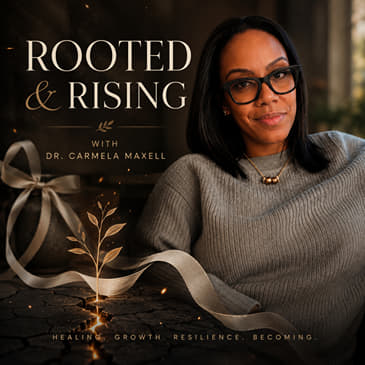
speaker-1: Hello, everyone, and welcome back to Rooted in Rising, the podcast where we explore the experiences, beliefs, and stories that shape who we are and who we're becoming. I'm your host, Dr. Carmela Maxwell, and today we're talking about something that I think many of us have experienced, but we don't always have the language for. Today's episode is called The Price of Being Pleasant.
speaker-0: ⁓ no.
speaker-1: From a young age, many of us are taught to be agreeable, accommodating, understanding, and easy to get along with. We're encouraged to keep the peace, avoid conflict, and make other people comfortable. While those qualities can certainly have value, there often comes a point where being pleasant begins to cost us something. Sometimes it costs us our voice, sometimes it costs us our boundaries.
speaker-0: Hey chant.
speaker-1: Sometimes it costs us our identity. And for many women, particularly women of color, the expectation to be pleasant isn't just a suggestion. It's often treated as a requirement.
speaker-0: Mm-hmm.
speaker-1: Joining me for this amazing conversation is TR Munro, author, educator, advocate, healer, and someone whose work has helped many people navigate questions of identity, self-worth, healing, and personal growth. TR, welcome to Rooted in Rising. I'm so glad you're here. Tell us about where you're from, where you're at, a little bit about you.
speaker-0: Thank you, Dr. Max, for having me. I am ⁓ born and bred North Carolina. North Carolina So but I am a mother of two ⁓ boy and a girl. and ⁓ those are my heart. That's my heart, yeah. And then I have ⁓ I'm a ⁓ daughter 'cause I'm also a caregiver for my mom and ⁓ educator.
speaker-1: Okay. Yeah, I get it.
speaker-0: I'm a caregiver for a whole lot of students.
speaker-1: Whole lot of people, whole lot of whole lotta. ⁓ wow. Okay.
speaker-0: point where it's been twenty eight years and I'm seeing students that I taught who are grown now. Wow
speaker-1: That's amazing. That's amazing. Wow. Okay. So what grades and like just kind of a spectrum? Wow.
speaker-0: All of college, elementary, middle, and then now high.
speaker-1: Wow, thank you for for what you do as you know as a fellow educator. I ⁓ so I work with college and ⁓ graduate students. Their their minds are just so amazing. It's just wonderful to watch them. Yeah. Wow. Well, thank you once again for being here. I am so profoundly blessed to have you here with me today. And and I know our audience is gonna have a blast listening to this. ⁓ I wanna start with a simple question.
speaker-0: Uh-huh.
speaker-1: When you hear the phrase being pleasant, what comes to your mind?
speaker-0: Conditioning. And also can be manipulation. ⁓
speaker-1: ⁓ wow, okay. So tell tell me more about that. Because I I I might be picking up what you're putting down, but
speaker-0: Because Sometime people know that you are trying to be a people pleaser. People know and they use that to their advantage. And to the point where if you don't do what they say, well, I thought you wanted to make me happy. Well, I thought I thought you loved me. So but We gotta break away from that. We really do.
speaker-1: And I'm hoping that you could help help me help the audience understand how we can. Because ⁓ I think I think that's definitely something in in my you know my private practice, ⁓ working with clients, just coaching folks over the years, and even with myself. Right. I've I've definitely stepped into that role. ⁓ and I've experienced shame about it. I have I have definitely had to do a lot of self-reflection, like why do I do that? Why? do I give in to make this person happy, completely surrendering my boundaries and what I want for my life. So so let me ask you that. Why do people people please? What what what's that about and where does that come from?
speaker-0: Well, I think it comes from, and this is my opinion. Sure. So but it comes from the black woman being the anchor for the family, for the church. For the community. They had to help everybody. They had to go around, say yes and do this, say yes, okay, I'll help you with that. ⁓ that fundraiser, yeah, I'll do that. Uh-huh.
speaker-1: Please yeah. Yeah.
speaker-0: And no one ever poured into Nell. Yeah. And it's gone down through generations and generations because our parents didn't know any better. They thought that that was the way we're supposed to be. So they trained us up in that way. They conditioned us in that way. It wasn't their fault. That was just the times.
speaker-1: Yeah. And they passed it down to us. Do you think do you think that it was ⁓ a form of trying to keep us safe? And and I say, you know, ⁓ right now this is from the perspective of like the the the black family with black women being the anchor. And I think this could apply across the board, right? And we'll we can talk more about that in generalities, but were they trying to keep us safe?
speaker-0: They felt like they were. They felt like they were keeping us safe. That that would put us in the in the arena that we were able to be helpful, but we were able to also be okay with our lives. The only problem is is this when you're Doing it so much became that people pleaser as an adult. Some people can see that you are and they use it to their advantage.
speaker-1: Yeah.
speaker-0: 'Cause we all heard that we all heard the chrome. I thought you loved me.
speaker-1: ⁓ if if you if you do this for me it's because you love me. If you don't do this is because you don't love me. Or that's what people do when they show each other, yeah. it you know, in previous relationships or y you you set that boundary and it's you should be grateful. You should be this whole lot of shoulding. Whole lot of shoulding. Yes. ⁓ my.
speaker-0: B Mm.
speaker-1: And so, you know, outside of family, do you think that there are other parts of of society that reinforce this, like culture and school and religion?
speaker-0: They all do. They all do. They they They put us in a place of submission. And So that we are able to take care of the community. We're able to take care of the family. We're able to take care of the school, the church. But it has to come a point because that is the quickest way to burn yourself out.
speaker-1: ⁓ yeah. No, that's right. ⁓
speaker-0: But that's the quickest way. And if we don't learn how to set boundaries, healthy boundaries, and stick with them. That's the thing. If you set a boundary, stick with it. Cause once someone sees you're gonna let that boundary slide a little bit.
speaker-1: They assert themselves. Yep. Yeah. ⁓ Yeah. Mm-hmm. Yeah. S so prior to to our conversation here, you know, you and I had talked about this concept that I think has maybe been situated in many of our minds, but you put it together and I was like, ⁓ we gotta we gotta talk about that. So nice guy, good girl syndrome. Tell me about that, how this applies.
speaker-0: I got you.
speaker-1: On both sides, what does this look like?
speaker-0: Okay, so For the nice guy. They were told to ⁓ to be helpful, to be there, to be the support, to be the safety, to provide. And then that way you're a good person. You're a good a nice guy. You are a a good husband. But the nice girl, good girl. We were told we need to be a good girl. If we help other people, we're a good girl. If we always say yes, when someone needed us, we're a good girl. Mm-hmm. Once we said no, we were that bad girl. And nobody wanted to be categorized as the bad girl. That problem child. Mm-hmm. But I mean It works in us so strong that we carry it to our d adulthood and then we wonder why we always tired. Because we're always pouring into everybody else. What about my cup? Mm-hmm. That's that's my that's my theme this year. What about my cup?
speaker-1: that my my theme this year is ⁓ is discernment and so I think it it sort of pours right into that and that's so interesting you said ⁓ a couple of things that made me me think the good guy sounds amazing but what's his problem? Like what's what's the issue? Because every time I think ⁓ you know, this is what I think women will say what they want or or how we try to raise you know, our boys as the nice guy, it doesn't seem to produce the effect that
speaker-0: Uh-huh. It doesn't produce the same effect as it does on us, but it prepares them to be that leader or what they think is a leader. It prepares them to be controlling. It prepares them to make sure and it's not well, it is a bad thing, to make sure that you are beneath them.
speaker-1: The nice guy. Hmm.
speaker-0: Mm-hmm. I mean, and that's just how is it just depends on your upbringing. Because I know some nice guys that are not not like that. They're very kind, they're very sensitive, they're understanding. They're like, Okay, do you need help? Mm-hmm. I was like
speaker-1: Somebody somebody asked that. Like it's not just presentation. So okay. So this this whole facet, I'm I'm picking up what you're putting down. This idea that the the presentation of the nice guy, like I'm gonna go out on the limb and make it seem as if you're ⁓ I'm I'm X, Y, and Z, that I'm helpful, that I'm I'm supportive, that I'm kind. But underneath all of that, there's that very sinister.
speaker-0: Mm. That gaslighting.
speaker-1: I just had that. I just had a conversation about this. ⁓ that's interesting, right? So in essence, the nice guy will tell you he's the nice guy.
speaker-0: ⁓ huh. Mm-hmm. He will. Cause he wants you to believe that. He puts that into you all the time. ⁓ I'm a nice guy. You need to trust me because I'm a nice guy. Mm-hmm. Mm-hmm. You need to let me take care of that because I'm a nice guy.
speaker-1: Yeah. Yeah. Yeah. And so in pairing with the good girl the girl that is good. The the aspect of that though is then she's walked all over.
speaker-0: Mm-hmm. Yeah.
speaker-1: Hm. Wow.
speaker-0: But that comes in where We are part of our ancestors. Mm-hmm. The black woman has always been the anchor. The black woman has always been strong in the community, strong in education, strong in the church, and was always doing things for everybody.
speaker-1: Yeah. Yeah. I I watched this growing up. My my father was a a minister and I watched this growing up. ⁓ you know, the the expectations of just roles of people in general. ⁓ but y you know, just in the church How, you know, different people presented. There was always the one that would bake something. And there was always the one that was we'll taxi all the children around. Or, you know, for Sunday school, we'll you know this ⁓ and then the one that's dressed in like the the large brimmed hats and ⁓ all the presentation, but there was just something there ⁓ that was much different. You find out about it, right? 'Cause people talk.
speaker-0: Yeah. ⁓
speaker-1: Yeah. It wasn't substance. Yeah. Yeah. And to keep that image together. because I also want to say I I've definitely seen too, you know, outside of our community, the the males that are the people pleasers, because you know, society has basically said, well, this is what women want.
speaker-0: Mm-hmm. Mm-hmm.
speaker-1: You know, so you have to do this just to to get burned. And and this concept is just dynamic, just so interesting. Because I think the concept of people pleasing really for me
speaker-0: Mm.
speaker-1: Stems from trauma.
speaker-0: Mm-hmm. Yeah. Definitely. I had to deal with abandon abandonment. So I spent a lot of time in my life. Trying to deal with are they gonna like me? I gotta do this so they can like me. I gotta be there for them if they can like me. I have to I have to make sure I cook this. I have to do that. I want them to like me. But the thing was I didn't like myself.
speaker-1: Mm-hmm. Or you always felt like you had to top yourself, right? I mean that's so relatable. ⁓ and and so painful because as we're we're talking, I'm reflecting a lot on on my own life and decisions that I've made and relationships I've been in. ⁓ if I dress a certain way, maybe if I anticipated their needs, which was like a a moving goalpost. if I
speaker-0: Mm-hmm.
speaker-1: wasn't too educated or if I if I was, if I just continued to climb, if I made more money to support us, if you know. ⁓ And I found myself just destroyed. Absolutely.
speaker-0: Mm-hmm. I mean, it's the quickest way to burn out. It really is. The quickest way to burnout. And that's what a lot of us females are dealing with. Across the across the range, we are dealing with burnout. Mm-hmm. Because we are pouring in everybody else.
speaker-1: But
speaker-0: not pouring into our cup and not no one else's porn. No one asks the strong one ⁓ if they no one asks the strong one if they need help. They no what they say is if you need help, let me know.
speaker-1: Puts it on us. It puts it on
speaker-0: If you see what I'm doing and you see how I'm I mean, I'm frantic, guess what? I might need help.
speaker-1: But to but to your point, you know, I'm a for for many people for the people that that know me that are in my very small close circle, I might spin for them, right? They'll they'll see the signs, the nuance with me.
speaker-0: Mm-hmm.
speaker-1: For people who don't know me, they would not be able to really tell that I'm breaking down. And it's almost as if there's like a a we have to put forth a yeah. Well well, we so we're wearing that mask, but we have to put forth something recognizable in order for them to f to feel compelled to say anything. I didn't say do anything.
speaker-0: Mm-hmm. Yeah, Mayo.
speaker-1: But say something about it. Because the likelihood that people will follow through. We talk about this in psychology. We talk about the bystander effect. How, you know, an emergency happens and there's this assumption within a group, ⁓ somebody else got it. I'm I've kind of always been that person that's like, I don't assume anyone's got it. I'm gonna go in there. I'm gonna figure it out.
speaker-0: Mm. ⁓ they don't understand. I can take care of it. Mm-hmm. Mm-hmm. Mm-hmm. Mm with the hundred other things on my plate. Mm-hmm. Mm-hmm. Mm-hmm. Sure it ain't too much No. ⁓
speaker-1: ⁓ Yeah. I'm you know what you're calling me out here too? Be and and and but I'm learning. I am I'm I am learning every single day about why I do this. I mean we we wanna be we wanna be liked, we wanna be appreciated, we want for people to understand our worth and what we bring to the table. And I is this the way to do it? No.
speaker-0: ⁓
speaker-1: And at the same time it's what we know, right? What because let's look at the other side of that. As I'm curious to know what your thoughts are. I've had many a conversation with people who have said, you know, Dr. Maxell or ⁓ Max as they call me in you know, in my my circles, ⁓ I I I'd love to just see you stop people pleasing for a second, or to know your own worth, or to to not feel compelled to have to do everything for everybody. The same people who are constantly demanding stuff are the same people that are exercising that judgment. And I want to know your thoughts about that.
speaker-0: Mm-hmm. I mean, they will exercise the judgment because they're not getting the full aspect of what they want. Mm-hmm. Mm-hmm. Mm-hmm. That's just all in that the gaslighting. Mm-hmm. It did they just wanna say, Okay, yeah, but I know you need help, but can you really take care of this for me? Mm-hmm. I mean
speaker-1: ⁓
speaker-0: I'll help you. I'll be down there later. I'll h I'll come and help you. ⁓ is that
speaker-1: ⁓ well there yep, there's that. Or it's always at a cost, right? Yeah. You get that phone call three months later. So you remember I helped you on January fifteenth? ⁓
speaker-0: Yeah.
speaker-1: Can't never get out of anything. ⁓ yeah.
speaker-0: I mean I've actually had males to tell me, Well, I've always been there for you and I have helped you out and t ⁓ make sure that you were okay. I was like, Am I supposed to give you a gold star for that? That human nature? That's what you expect from me. So why can't I expect it from?
speaker-1: Hmm. Well, well Well, well you know, this brings me to another piece here. Power and expectations. Do you think that certain are expected to be pleasant or more pleasant than others?
speaker-0: Mm-hmm. Mm. Groups. Yes. Yes. And I'm sorry, is females of our race.
speaker-1: Yeah, yeah. Yeah. I would I'm with you. I think other ⁓ educators, ⁓ caregivers,
speaker-0: Mm-hmm. Mm.
speaker-1: Any like people in the helping professionals, ⁓ you know, ⁓ in the helping profession, sorry. ⁓ anyone tied to service. Right. ⁓ it's it's funny because they'll say, Well, I I've never been one to pull punches. And so I've the people will say, you know, you came off a little strong. I said, Yeah, I said what I said, right? I said what I said and I said what I meant. and and that is a cultural
speaker-0: Mm-hmm.
speaker-1: That's a cultural piece. And I'm sorry if you don't like it. ⁓ but you can say the same exact thing to me and somehow I'm supposed to swallow that that pill. So I f I just find it very interesting that ⁓ the way that I might come across or the way that me may come across is is seen in such a bad light, right? But people will then tie it to my ⁓ my position.
speaker-0: Huh?
speaker-1: And mental health. Well, aren't you a mental health professional? How can you be so mean? I'm like, I'm having a conversation with you, and I'm not a mental health professional right this second. I'm having a conversation with you. Like, hold on. That's that's not the only hat that I wear. Thank you. ⁓
speaker-0: I'm not on the clock. Now you wanna go on the clock, let's go ahead and start conversating.
speaker-1: Right. Right. Yeah. Why do you think that these groups that we just mentioned? So let's start with what you said, women across the board. Is it about what society may or may not have placed on women, what's happening in current state? Just in general, if we if if we remove for this portion of the conversation the color line.
speaker-0: Mm-hmm.
speaker-1: What is it about what is it about women that makes it s that that we are expected to be more pleasant, whatever the hell that means.
speaker-0: For the longest. Women have been told that they need to dress a certain way. They need to act a certain way. They need to be able to do certain skills in order to get a husband. A long time ago, women were told that. And they've passed it down to Day Child. They, yeah, you gotta be able to do this. You gotta wear this, you gotta do this. This is the way you gotta act. You gotta act like a lady.
speaker-1: Okay.
speaker-0: And it followed us. It followed us all the way to where we at now. We feel like we have to fit in that small box. Everything that we are. The only problem is is when you start setting boundaries, that box doesn't fit.
speaker-1: Yeah. Yeah. And you know, I'm ⁓ I'm thrown back to parts of my childhood that when I think about them now as an adult are just very ⁓ I I just sort of cringe at that.
speaker-0: Mm-hmm.
speaker-1: what it meant to be a lady. Right. ⁓ first of all, I'll say I'm a foodie. I love food. ⁓ right. I I and I think food is such a cultural like there's such a cultural tie. It's such a human thing, right? Food brings us together. And I feel like and I I may make a lot of people mad, but with black folk, we will use Any excuse to get together and have some food. And I love that for us. I love that for us, right? And on my Filipino side, we do the same exact thing. So it's a double whammy. So I'm just I the ⁓ I used to work with someone who said, you know what, I love to bring food and celebrate on any day ending in Y. So every day. She's like, Yep. Every day. Every day. Right? But love this, right? But yes. I also remember growing up having to learn which which fork to use for what. And you know, that you take if you're wearing a dress, you would take your serviette and you put it in your in your lap, right? ⁓ huh. And you don't sit there and eat like a beast. And you know what? Small bites and you cut up your food. Now, see, this is also why this this this is also why I'm single, right? I I in my own house, I'm like, nope, just you know, sitting here eating and and and doing my thing. But just those things carried over or even ⁓ I remember I would hear men growing up telling ⁓ little girls or young women, which in my mind I think is appropriate for several reasons, but just ⁓ cross your legs. Right, right, or yeah. Or you wear your hair down. Don't cut your hair. That was a big thing. Me men love women with long hair. Ugh Yeah.
speaker-0: I mean long hair. Or also she had hair down her back to her butt. But when we cut our hair
speaker-1: Yeah my dog
speaker-0: Does that make us less feminine?
speaker-1: Don't think it does. Because I'll tell you, I've had every I've had every cut under the sun. I've had a like a buzz cut. My hair has been down under my butt. And and then I cut th ⁓ three or four inches, five inches, I think, ⁓ early earlier ⁓ this year. And I don't think that the length of your hair determines your level of femininity. We are women because and you know, I just like on the opposite end. Men that have long hair, ⁓ I don't think that that makes them less masculine. Right. Like let's stop. Let's stop that. ⁓ but well we have been bred, I think, to think we have to learn a certain look a certain way, right? Like to to right, like, you rouge or wear blush and to or or you know, wear hats, wear skirts. I remember ⁓ just just hearing ⁓ well Why are you wearing pants? What like wouldn't you feel better in the skirt? I'm like, Okay. Okay. Yeah. Yeah.
speaker-0: I just remember growing up looking at the different magazines and being like, ⁓ I wanna be like her and taking the little perfume thing, the little sample and putting it on my wrist, that little piece of paper.
speaker-1: I I still do that. Can I not lie? I yeah, I remember you you you whip open that adhesive and you sit there just
speaker-0: But my thing is is that we saw it in everything that was around us that this was what a woman need to look like. This is what needs to be done. This is how she needs to act. And if not, then I don't know why they call it the you you're that cat lady that nobody wants to be around. I love
speaker-1: I'm cool with that. I love cats too. Yeah, I don't even know where mine is. She's she's she usually floats around by now. I'm like you know. Mm-hmm. Yeah.
speaker-0: Somebody called me now, I'll be like, Thank you.
speaker-1: Thank you. What's that saying though? If if if you don't have haters, you're not doing it right. Right? Yeah. You know, and ⁓ I think the it becomes a really hard lesson to being pleasant. ⁓ what have you experienced with this, both ⁓ you know, personally, professionally, what have you? Once the nice girl
speaker-0: That's right.
speaker-1: Or the good girl has gone bad. And it's so funny, right? Because and I as we juxtapose these two things, the nice guy's not really the nice guy, but the good girl is also not the good girl, right? So when she decides to go bad, she's not bad. She's just finally standing up for herself. When and and when the the bad guy, you know, ⁓ I think it's just we need to take some time to get to know who this this man is and what he brings to the table on you know on both sides. But what what happens when the people pleasers and I can tell you I'm all I'm already just in just there's a lot of just trepidation in this. When they become direct, when they establish boundaries, when they start advocating for themselves, when they refuse to shrink. What labels do they get outside of, you know, angry black woman, big
speaker-0: Slut
speaker-1: You know ⁓ and I guess
speaker-0: Think you're better than everybody? Mm-hmm. So I mean, we're just I mean, all kinds of labels that come on us when we decide to care and love ourselves, to let our voice be heard. I mean, we have been the backbone of things for a long time. Now
speaker-1: ⁓
speaker-0: We at the point where we want to be heard. We want to be understood. Not just put on the shelf as a little trinket. That's that's my perfect wife. That's my step for wife. No. We don't want that. We want to be heard. We want to be able to literally know who we are. And love ourselves. 'Cause the other side of that is not knowing your identity. You're wrapped up in everything else you do. And not like
speaker-1: It's uncomfortable. It's uncomfortable no matter what. That's right.
speaker-0: It really is. It really is. I'm sorry. I'm at the point now that if I gotta be the villain in your story for me to have peace, I will be that villain. Mm-hmm. Yeah. Go ahead and call me the bitch. Go ahead and call me whatever. But I'm gonna have my peace.
speaker-1: Yeah. Yes. There is no replacement for peace. And I have learned this lesson time and time again. I keep coming back to this theme, right? Of I said in the beginning, you know, nobody likes feeling uncomfortable, which is why we have our vices, right? Which is why we we stay in that relationship. Which is why we continue. We don't I don't want to get into an argument with this person today. I'm just gonna go ahead and smile and keep it going. I don't You know what, I'm gonna avoid driving down this street. I just don't even wanna ruffle feathers today. I'm not even gonna wear that. People are gonna ask too many questions. But I think what's more uncomfortable.
speaker-0: Mm-hmm.
speaker-1: Is not living a life of authenticity.
speaker-0: That's right. Not having that honesty, not not knowing it's like, yes, this is me. Like it or Like it or not. Yes, that's that that circle gonna get smaller. That just means they wasn't there for the ride. They were there for what they can get. So we just have to. Stay over ourselves.
speaker-1: Yes. Well, l let's talk about that 'cause I'm sure that there are gonna be many people in the audience that are asking, Okay, but T R, I've heard you. Doctor Maxwell, I've heard you. And this all sounds great and and very ideal, right? But how do we say no? How do we reclaim who we are, or if we're not trying to reclaim that, how do we how do we rebrand? How do we say no? How do we establish boundaries? And most of all, how do we trust ourselves?
speaker-0: Mm-hmm. And that comes with getting help. There is nothing, there's not a negative stigma to going to see a psychiatrist, going to see a counselor, having that person that doesn't know too much about you, and they're able, you're able to bounce all these feelings off of them, and they will get you to the point where they're organized and you know this feeling, you're standing on that feeling, you're already over that feeling. So I mean, getting help it's nothing wrong with it. At all. For men and women. And I really think men need it too. Mm-hmm.
speaker-1: Mm-hmm. And I think too, you know, we also need to to to stop our judgment about men seeking help. Right. We can't sit there and say we we want the truly nice guy or we want the one that actually gives us what we need. And then also shame him when he does go to therapy or when he does build that support system or when he cries or has any type of emotion. ⁓ we We I think as as women too, we can empower our men and this is it across the board. And I think, you know, in in many ways too, you know, men can empower women by going and getting that help. That's right. We all need support. We all need support.
speaker-0: support. Yeah. And I know a lot of people do couple therapy, which is good for your relationship. But I also think that both of them should have individual therapy to
speaker-1: Yep. I I actually ⁓ I I co sign on that. I tell any couples or families that I work with, ⁓ the the couples session is wonderful when you're working as that unit. But there's still some individual fires you gotta put out that you gotta work through. You th there has to be some self rescue ⁓ that happens. And so I I one hundred percent endorse that and and now ⁓ with the level of accessibility and I continue to say this ⁓ across the board. ⁓ we have apps now, right, where people can meet with with folks virtually. ⁓ there's still brick and mortar places where people have offices and you can go in there. You know, there's websites where you could find that support for for people of color, you can find people of color, people that you trust, ⁓ or feel like you can ⁓ work with. There there are so many avenues and arenas ⁓ to to get that support that I just don't think it's an excuse.
speaker-0: It shouldn't be. It shouldn't be. We gotta get to the point that we're we're we're not using excuses anymore. We don't have time for excuses. We're trying to build our life. Excuses do nothing but hold you back. And you don't want to be yelled at. You wanna keep growing. The thing about it, I mean, even God says that he gonna prune the tree. The fruit because he wants to take away the dead things to software.
speaker-1: The dead things. Yeah. Because 'cause it it festers, it all spread.
speaker-0: The spread and that that does not grow dies.
speaker-1: Yeah.
speaker-0: And that's the same with us. Why do you think they call the Dead Sea the Dead Sea? It's just there. It doesn't have a lot of circulation, a lot of flow in it. And that way things just stay there and it gets stagnant. And we don't want our lives to be stagnant.
speaker-1: Well, I you know, my hope for people is that they don't want to stay in their life. But you know, we talk about ⁓ getting that help, setting those boundaries, you know. I also think Google helps, right? ⁓ instead of doom scrolling, you definitely sit there and research some of the detrimental effects of being a people pleaser and and pleasing. And your mental health takes a huge dip, but but your physical health, which is tied to your mental health.
speaker-0: It will. It it it will.
speaker-1: Yeah, 'cause 'cause talk to me about people that you know or your own experiences where you know they've people pleasing, they've done they've done the most, done too much. And you start to just see them age. You start to see them fall apart, you know, weight fluctuating, not eating, all ki hair falling out. ⁓ that was that was this woman right here. Right here, not taking care of myself and expecting to still show up for everybody and people still holding their hands out like, Hey, hey
speaker-0: Give me, give me, give me.
speaker-1: Gimme, gimme. Yeah. Tell me about your experiences there because that ⁓ that's so devastating. And I want people to know and see themselves in this.
speaker-0: Being a people pleaser and Always wanting things to be right and people to approve it and people to appreciate what I'm doing. ⁓ it it came real stressful to the point where I didn't know why I was that stressed, but I ended up having to have two brain surgeries. ⁓ my. Because of stress. It was called trigeminal neuralgia and they had to go in this side of my head and this side of my head. On two totally different occasions. So I didn't learn my lesson the first time. That's all that was. Mm-hmm. Mm. But it always takes We'll keep giving and giving and giving until we don't. Until something happens that breaks that camel's back. Me, it was it was a trauma. Yeah. It was it was to the point where I really had to take a time and self evaluate myself. Honestly. Honestly. Because for some reason I was always getting about the same kind of guy.
speaker-1: No.
speaker-0: And they always treated me the same way. Mm-hmm. I knew I deserved more.
speaker-1: But mm-hmm. But y it's hard to attain right here. I I I tell people, ⁓ I believe in energy work. And when we vibrate low, you know, what we attract tends to be low. And that's and that's in all aspects of life, you know, not just relationships. ⁓ but we vibrate high. You think of the ladder. And I've talked about this in in an episode where, you know, ⁓ The higher you climb on a ladder, the less stable it is. So when you vibrate high, you're not meant to take everybody with you.
speaker-0: You're not. You're not. Mm mm. But everybody needs their for a season. And that might not be their season. It's time for you to grow. Go through dead seasons. Right. Yes. I mean I lost a lot of lot of things in my last traumatic event. Mm-hmm. But I also found myself. Mm. And was able to 'cause I like to write, able to use my journals and just go back and reflect on ⁓ Yeah. Dag, I was that thing. Wow. What in the world was I doing? What was I thinking? Why was I putting my self worth down for someone else? Just so I can get their approval.
speaker-1: Yeah. Someone who wasn't worth it that you didn't it w Yeah.
speaker-0: Was it really wasn't. And when I stopped doing that, ⁓ my goodness, the peace, the joy.
speaker-1: But let's be real for a second. Did the peace come immediately? And I I because I I like to warn people, because for me, the peace did not come quickly. There was some shedding. There was some things. It it was almost rougher. ⁓ It was almost rougher. Right before my peace came.
speaker-0: Mm-hmm. ⁓ Mm-hmm. Mm-hmm. There's always a heavy storm before the calm. Always. I had to I was at a point where I had to get I had to get group help. I had to have medicine. I think medicine. So but it was needed to help me be able to calm down and focus on what was important for me. Me. Me and mine. Me and my two kids. Me and my mama.
speaker-1: For him.
speaker-0: And I'm sorry, there are some parents there that you might have to set those boundaries to. And as an adult, you have to set the boundaries too. You're not dependent. Yep. You're trying to grow. You're helping them. They help you. I mean, it's that part of that inconditional love.
speaker-1: Big one, setting big.
speaker-0: Mm-hmm. ⁓
speaker-1: It's nothing like people that have watched you grow and feel responsible for your growth. You know, I I have definitely experienced with ⁓ family members, you know, friends, ⁓ exes, ⁓ this idea that, well, you know, you were like this before and this is the reason, you know, this you don't want to fall into that trap again or and I y you gotta separate yourself from that, right? No no is a complete separate ⁓
speaker-0: Mm-hmm.
speaker-1: ⁓ this idea especially as an adult you don't owe anyone anything right it i think outside of kindness i always believe in being kind we do owe kindness kindness does not mean that you get to mess over kindness means that you lead from a place that is spiritually driven and and inspired right so
speaker-0: Yes.
speaker-1: I have had to set some boundaries, which means that I'm not picking up my phone for you all the time. Right? Or you you're not about to find out what's going on in my life. And I think that's important, you know, for people to to know peace doesn't just come I I and I I have seen it come ⁓ easier for s for some than others, but but that as soon as you Put those boundaries in place, be prepared to be tested on those boundaries that you set.
speaker-0: Cause you have to be consistent with your boundaries. You want somebody to be consistent with you? Yes. You have to be consistent with yourself. Because once they see that that boundary is negotiable, that boundary is going to be gone. And they gonna they're gonna take it and run with it.
speaker-1: And the ways in which ⁓ you know, I think so many people, this will probably resonate with so many people. I've worked with ⁓ with kids and clients, you know, with kids that have been ⁓ abandoned or hurt and are just trying to find their way and you know, wanting to please their parents. ⁓ I've had to have the conversation with them that's like, hey, I know. that you want this this love. You you have this expectation about who this person is to you, a mother, a father, an aunt, an uncle, brother, cousin, what have you. Just because they have the designation doesn't mean that they live up to the job responsibility.
speaker-0: Yes.
speaker-1: and you know, we we we really have to I think we as ⁓ black women as as as the black community and then you know people in general, we do have an obligation to one another to check on our strongest warriors, to to to lift up our weakest, and and to educate and I think that there is a lot of brokenness right now and I have seen people pleasing and being pleasant in many situations now because of the state of the world as a way to just Protect our
speaker-0: Mm-hmm. Yes. People pleasing is nothing but a magnets of control. And the only one that needs to have control over you is God and yourself.
speaker-1: Yes. Yes. Yes. You know, this I had an amazing time with you today. And I also want to make sure ⁓ that people are aware of your books and how they can heal. So I want to give you some time to talk about your writing and where they can find you. ⁓ TR Monroe's information is going to be available in the show notes, everybody. And on my website HTTP colon slash slash Carmellamaxell dot com. But tell us a bit about your work, any projects you're working on that you want to share, ⁓ please.
speaker-0: My ⁓ project that I've just completed is called is a series of three books called Healing and Freedom. The first book, We Still Rise, is a journal about betrayal, loss, and becoming. Because There we gotta lose some things in order to be who he wanted us to be. And I mean he. Not them. Then we go to the next step, which is beyond the good, which looks at the scientific facts and stuff about the good girl syndrome. And it also talks about how to How to sit on your emotions. How to be honest about this is the way I feel. Ladies, it's time to put down that mask. The only time we need a mask is when we go to a masquerade bar.
speaker-1: ⁓ they're very few I've been looking
speaker-0: I mean, that's it, but these both are journals. So I have guided prompts in them to give you a deeper dive into your emotions. And it's something that just like my journals, it's something that you can look on later and be like, Okay, why did I do this? How did I do it like that? 'Cause you gotta gr you gotta learn.
speaker-1: Yeah. And you gotta document, right? Because if we don't document it, we don't I I don't know. This is this is a silly example, but my best friend cracks me up every time I I go into the grocery store, which is now why I get all my groceries on you know, online. And I'll go in there and I am notorious for coming back and then I have five bags of onions in my house. Why did I do that? She's like, Where is your grocery list? And I'm like, I remembered it in my head. Obviously not. Right. And and so if you don't write it down or if you don't, you know, you can commit all this to memory, but but we are also poor historians. And so journaling is so wonderful. The fact that it it has guided prompts, I think is fantastic and is a great way for people to not have to think it's not just your regular line journal. ⁓ where can they order your book? ⁓ I got one more. Because ⁓ yes, please. The third book
speaker-0: is F cube, the symbol, math symbol, and it stands for faith, feeling and freedom. And this one is a fifty two week prayer journal.
speaker-1: Well.
speaker-0: It gives you a weekly scripture, then you got a insight which goes a lot off my testimony of what I've experienced or what I know others have experienced. ⁓ then it gives you an unfiltered prayer and it also provides you with a song that relates to the scripture of that week. Then you have your deep dive that you can just get into it. the good thing about those songs is that I put ⁓ all together on a playlist on Spotify and if you got the book, the cure code to it is there.
speaker-1: That's so cool. Okay. All right. Okay. Okay.
speaker-0: ⁓ all my books are available. they are on Amazon, but they're also on T R Monroe. dot com
speaker-1: TR MonroeBooks.com. The link is going to be in the show notes. and ⁓ TR Monroe will also be featured in ⁓ my featured voices on my website so that you have multiple ways of getting there. Get on Amazon, get copies of these books.
speaker-0: And the good thing about getting it from my website is that it comes from me and I autograph every single one of
speaker-1: Get you an autographed copy. Go ahead and get you an autographed copy. I love this. I love this with everything in me. Well, TR, thank you so much for being here with us today. I have learned so I this has been a blessing. ⁓ I can't even tell you. I am so ⁓ just profoundly in awe of ⁓ your resilience, just your wonder, everything that you're putting out. And I can't wait. You know, for the the commentary for people to learn and to heal to grow.
speaker-0: Mm-hmm. Yeah. My next project is going to be a ⁓ a virtual discussion.
speaker-1: Okay.
speaker-0: Getting into those deep dives that are in the book.
speaker-1: Okay. Okay.
speaker-0: Having that surrounding you hearing other people like they're going through the same thing I'm going through.
speaker-1: That's what we need, more relatability. People to hear that. People need to hear that. Yeah.
speaker-0: So that's my next project right now.
speaker-1: Will you keep us posted? I will you know, I will ensure that I showcase all that ⁓ you know, I wanna do nothing but build us up and continue to help us heal. Thank you. ⁓ yes, absolutely. Thank you. And if today's conversation resonated with you, I hope you'll remember this, everybody. Growth begins when we stop abandoning ourselves for the comfort of both the
speaker-0: Mm.
speaker-1: The goal isn't to become hard or cold or unkind. It's to be honest enough with your own needs while still extending compassion to others. Until next time, stay rooted in who you are and keep rising towards who you're becoming. Take care.
speaker-0: Yes.