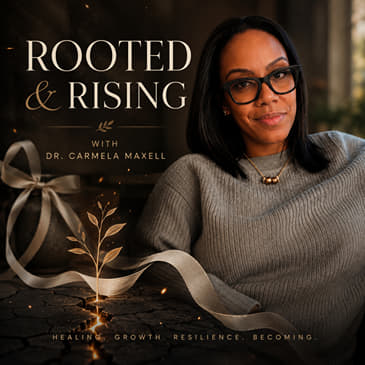
Dr. Carmela Maxell: Welcome back to another video podcast with me, Dr. Carmela Maxel. I'm your host today. Welcome back to Rooted in Rising. Today I have a phenomenal guest, and I'm so excited to have this conversation with him, Dr. Kevin Scott Sr. Today we're going to be talking about the cost of compromise, moral injury, and the hidden wounds of people of color. And Dr. Scott, I am so honored that you're here with me today. So honored to have you in in my presence and for you to speak about this with our audience. and let's let's get to it. So Dr. Scott has an EDD from Liberty University, also a master's degree in criminal justice and law enforcement administration from North Carolina Central, and a Bachelor of Applied Science. And I see that magna cum lauding criminal justice. And then also has a leadership background and and received some credentialing from Harvard from the School of Public Health. So we have a very decorated professional with us today. I am so supremely blessed to have you here. So today we're exploring a topic that many people experience, but few have a language for the cost of compromise. Not the healthy compromises that help us work together and build relationships. But the compromises we make with ourselves, the moments when we silence our voice, suppress our truth, minimize our experiences, or abandon pieces of who we are in order to survive, succeed, or belong. For many people of color, these compromises are not occasional. They are often woven into daily life, workplace culture, educational systems, and professional advancement. Over time, these compromises can leave invisible wounds that are difficult to name, but impossible to ignore. So Dr. Scott, once again, thank you for being here today. Tell us a little bit about yourself and the work that you do.
Dr. Kevin Scott Sr.: be first I would be egregiously remiss if I just say that I am the one who was humbly flattered and honored to be in your presence Dr. Max with the work that you do and in creating a conduit of sharing healing space which is so necessary when we talk about this topic. So I was excited when you called me
Dr. Carmela Maxell: thank you. Thank you. Thank you.
Dr. Kevin Scott Sr.: I have I've been in this space. it is truly a testimony, if you would, based on a bifurcated pathway, through lived experience and academic experience. So I come from a background of an e extended family, but from a product of a single mother.
Dr. Carmela Maxell: okay.
Dr. Kevin Scott Sr.: who gave birth to a set of twins. I have a twin sister, who yeah, who is fifteen minutes older than me. So this is in the mid sixties. And as you know that ignominious stigma. but nonetheless, I come from a very blessed background. there was no and I'm and I'm not saying this in any way, to throw shade or get a great I was fortunate enough to wear My mother literally gave us the very best. I went to Catholic school K through twelve, literally all my life. my sister tr my sister went she left in the ninth grade and went to a renowned the renowned should I say, so they think, Cash Tech High School in Detroit, Michigan. Yeah.
Dr. Carmela Maxell: Yeah. We have a lot of similarity there. Yeah. Yeah. yeah. Okay, okay. You know what? I I know some people that went to runny. Okay, I hear the wh yep, okay.
Dr. Kevin Scott Sr.: Yeah. Yes indeed. Go back and forth as far as that regard regarding their academic pedigree and prowess. So and and so so I I I grew up, you know, very athletic, playing sports, this and that. And then you know, I made some poor choices, very young. and then I I'll get into a conversation of not having that father figure arrive.
Dr. Carmela Maxell: Go back, yeah. yes, yes.
Dr. Kevin Scott Sr.: as well and we'll I will get into the we'll delve deeper into that moral injury piece in those hidden wounds. We'll talk about that. But I've worked in spaces of I'm a v I'm an of course as you can see I belong to the greatest fraternity on the planet, Omega Psy Five Fraternity Incorporated. I ruled to the brush and I'm also I'm also a combat air veteran of the Marine Corps. Persia Gulf War, thank you.
Dr. Carmela Maxell: Eee Okay, okay. Thank you for your service.
Dr. Kevin Scott Sr.: So a lot of trauma comes with that. And then I've made some personal decisions that I said that took me to places that I didn't want to go, Dr. Maxwell, made me stay, unfortunately, longer than I wanted to. However, in his book, Man's Search for Meaning, Victor Frankel, who was an existentialist theorist, I'm sure you're familiar with his work here, he invented the theory logotherapy. And he says, he that has a why to live.
Dr. Carmela Maxell: Ranking. Really.
Dr. Kevin Scott Sr.: Can withstand almost anyhow, and he was referring specifically to those individuals who went who were Holocaust survivors, he himself being at the infamous Auschowitz concentration camp. And he talked about how the best of them didn't come back. but that was one of the one of his quotes, and he has several. that resonated with me even through my most abject and darkest hours and to that point, existentialist theorists promulgate, if you would, that even in our most darkest space, that we can find a reason to carry on.
Dr. Carmela Maxell: Yes, we can find meaning of the experience. Yes. Yes.
Dr. Kevin Scott Sr.: and to have it to have meaning in all of that. And so I I I work from that I work from that vein. So that's just a little bit of background what I do. But I work with Justice Involved Trauma, Trauma Involved Suicidal Audiations, Veterans. just just just the traumatized aggregate groups that a lot of that are very challenging. And a lot of individuals, I don't wanna say eschew, but they do from that population because it is uncomfortable space. It really is. And you have you have to have the temperament to deal with that.
Dr. Carmela Maxell: Yes. Yes. just brilliantly put. And I'm I'm a huge fan of Victor Frankel. In fact, I you know, when I teach about different modes of of therapy and and theory to my own students, I I I love the idea of e existentialism and we can make meaning. We can find that light in the dark place. sometimes we have to search a little bit more, and I think specifically as people of color, right? I believe in the idea of creating your own light. And sort of figuring out what that means for us. I think even now in this time, which which seems maybe on some surfaces to be progressive, but there are some things that are sort of thrown us back into these historical dark places and we need to find we need to find that light again. We need to find that light again. So let me ask.
Dr. Kevin Scott Sr.: Yes. And it's funny you mention that. I I just want to pause briefly because when you talk about finding that light again, because we could because you mentioned two two words that I that I loved, abandon and compromise. We can become so disconnected from that light that we don't even recognize it or even forget.
Dr. Carmela Maxell: Please, please, please. Mm-hmm.
Dr. Kevin Scott Sr.: actually the illumination of it. I've had to reinvent my life by God's grace and mercy. And then when I thought was my life wasn't my life. so it is a very to say it is a a a slippery slope is an understatement. And I I think that you make a very, very great point.
Dr. Carmela Maxell: Right. Mm-hmm.
Dr. Kevin Scott Sr.: And I'm gonna I'm gonna give you a a quote that I think that you'll really love and put in your tool toolkit later on when it comes. So well I'll do it now. We'll talk about life. I always tell individuals that I work with that you can never leave an old situation until you create a new one. And it is and it was so apropos for me, but go ahead. Yeah, it was I mean it was
Dr. Carmela Maxell: Please. Ha ha ha. Mm, mm-hmm, mm-hmm, mm-hmm. Well, it's it's like that idea of, you know, you yeah, you can't you can't enter a new chapter unless you close, you know, the last or you you gotta close that book before you enter a new one. And I think that's where many people get stuck. We get stuck between the pages, stuck between right, stuck between the folds. And isn't that the the in in many ways, isn't that the definition of insanity? Just doing the same thing, right? We expect these
Dr. Kevin Scott Sr.: It it it is. It is. And I know for me, and again, 'cause I'm very transparent. I'm I'm gonna keep it so one I keep it one hundred that I would I would rather deal with the minutiae over here that I'm used to. And it it it amazes me how I would have rather lived in the pain that I was used to than take a chance.
Dr. Carmela Maxell: Keep one hundred, yeah. Mm. Right. Mm-hmm.
Dr. Kevin Scott Sr.: on engaging in happiness that I've never seen. Because that is so unfamiliar to me. I don't even know what the hell that looks like. What?
Dr. Carmela Maxell: Ooh, or Yeah. Yeah. I hate. Yeah. Yeah. Yeah.
Dr. Kevin Scott Sr.: I'd rather stay right here in this bus right here, because it's comfortable. I love the smell, I know what it feels like, I know how long it's gonna stay on me. All that, all all that's nothing.
Dr. Carmela Maxell: Yeah. Yeah. Yep. Right. I don't have to do anything different. And I you know, there's a there's an an episode that I made for for some of my my Apple subscribers talking about the cost of compromise and how it's really it it can get really uncomfortable. People don't want to feel uncomfortable. and there is a risk in in changing and progressing forward, right? There there are
Dr. Kevin Scott Sr.: Mm-hmm. Absolutely.
Dr. Carmela Maxell: of that skin that we have to shed in order to grow. And sometimes, you know, you mentioned I know what it smells like. I might like how it smells. You might not like how it smells, but you're not sure if it smells better over there. Right. So there's so many things I think people will hold on to. And I talk about the the cost of holding on to things that no longer serve you.
Dr. Kevin Scott Sr.: Is that Exactly No.
Dr. Carmela Maxell: But I think in this process, it's really about identifying when something doesn't serve you anymore. And that's where.
Dr. Kevin Scott Sr.: And I think that, well, no, you and I didn't want to, but that aha moment, that coming to moment, that epiphany, if you would, can only take place when we feel we deserve better. Because a part of this moral injury thing, or you know, this compromise is that we all we lowered. I lowered.
Dr. Carmela Maxell: Mm-hmm. Mm. Uh-huh.
Dr. Kevin Scott Sr.: My sense of dignity and value based on what how others were seeing me and validating me. Because I read somewhere that we have to renew our mind every day, and that old things become new, and that we have to put on a new creature in Christ. We have to put on new creatures. And I just was on my prayer call this morning and
Dr. Carmela Maxell: Mm. yep. Yep. Yep. That costs that cost a lot. Mm.
Dr. Kevin Scott Sr.: One of my frat brothers brought the faith face the the have it a faith the a faith list, not a facelift, a faith lift. We have to continuously go get spiritual Botox, if you will, because all the rays. Give me just a little credit, give give me a little bit of credit for that. You know what I'm saying? We have to we
Dr. Carmela Maxell: Mm-hmm. Yeah. Yeah. Yeah, I like that. You know I might try five bows. Okay, you know what? The you primary author on that one. I'm gonna go ahead go ahead and write that down right here. Woo. Yeah.
Dr. Kevin Scott Sr.: So, you know, so I don't mind sharing. I don't mind, but yes, it is so true. even for me, it was until I understood that there is absolutely no way possible humanly of my own volition of anything that I could have ever done to be sitting right here with you. Today having this conversation, it was only because I know that God is real in my life, only because I know from the hail and the belly of the beast that he brought me from. Because I know that he is the potter and I'm the clay. And trust me, I was a fractured vessel the first time that became marred in his hand.
Dr. Carmela Maxell: Wow.
Dr. Kevin Scott Sr.: And for whatever reason he felt to make the pot the lump of clay again into another vessel that was good for him. And so when we talk about this, when you asked me to invite it me, should I say, I was so just humbled because people struggle. I'm talking about ord ordinary people, forget these damn degrees and all these letters and all that I'm associated with because before they called me doctor.
Dr. Carmela Maxell: Mm-hmm. Yes. Right. Mm-hmm.
Dr. Kevin Scott Sr.: They called me a whole bunch of other stuff that was that was that was applicable. Trust me. There was a time when my mother fed me off the porch and made me sleep in the basement if she let me in the house. So I hurt a lot of people. I made bad decisions. I was helpless, homeless, addicted, incarcerated, suicidal, and homicidal. So I'm trying to tell you when we talk about this moral injury journey.
Dr. Carmela Maxell: Yeah, yep. I yep. Relatable. Relatable. Mm-hmm. Mm-hmm. Mm, mm.
Dr. Kevin Scott Sr.: Although it does find its nasce in the military culture and in military space, it is applicable every facet of our lives in the work that we do.
Dr. Carmela Maxell: across spaces. You know, I definitely think about as as you know we discussed prior to to to this, how it shows up and and being self-serving as a healthcare professional, how this shows up especially in healthcare settings, educational settings, a lot of the circles that you and I are both in. and the toll that it takes on on how we do our jobs, how we feel about ourselves and our careers, how We show up in service to others. And before we dive into that, we've talked about the term moral injury. And I want to clue the audience in for those of you who do not know. Yes, the the the origin of the term moral injury stemmed out of the Veterans Association with the military. And I want to talk about that. Let's define this for our audience. What is moral injury? And then piggybacking on that. How does that differ from burnout?
Dr. Kevin Scott Sr.: Yeah. well in my personal minute opinion, moral injury when you put it in the con in the context of veterans as you as you mentioned. it comes from individuals who have served in the military, active duty military, when they were deployed or sent somewhere, that they were given orders and the orders instructed them to engage in behavior that went that was completely contrary to their morals and values.
Dr. Carmela Maxell: Hmm.
Dr. Kevin Scott Sr.: So when we get these individuals who have to go into combat, and now they're killing women and children, blowing up school buildings, things like that, or watching their fellow military individuals engage in certain inter ent interrogation techniques that they'd up that it just it just completely is just askew.
Dr. Carmela Maxell: Yeah.
Dr. Kevin Scott Sr.: And completely diverse, diametrically opposed to their true internal moral compass. so.
Dr. Carmela Maxell: And that has to be difficult, right? Because my my father was was a veteran, my sister is a veteran, yourself, and I you know, I I am my my ex-husband is a veteran. And you know, you hear stories, whatever it is that you can hear, and then you gather data and historical information over time. And I've worked with veterans in in private practice and such. And There's there seems to be a bumping of heads, right? Like you said, there's there's not a values alignment between what you what is requested and directed of you and how you might in where your internal compass is. So I look at this if if I sort of zoom out for a little bit, that has to be a very difficult position for veterans, right? You are in a position where you are getting orders from your superiors who are getting informed probably by their superiors, who are probably informed by the state of what is going on in the United States or across the world. And If I was to place myself in that position, I may have a hard time, even with the values I say I have and try to live out when I'm thinking about what's best for the country, what's best for my children, what's best for my friends, even if I don't feel good about it, I may do it for the betterment of all. I and I might be misinformed, you know. So Let let's talk a little bit about your experience and and just you know being in the service and maybe where you might have experienced that. And if I'm completely off kilter, I'm just a person, you know, I am a civilian, but I can only imagine from a veteran's perspective. I mean, I have I have quotes for days, experience for days as a healthcare professional, but that is such an interesting position to be in.
Dr. Kevin Scott Sr.: Yeah. Mm-hmm.
Dr. Carmela Maxell: when at the end of the day it's it's not about you, right? It it's not just about you, but it's not about you because as as a service man or woman or person, there's a lot at stake.
Dr. Kevin Scott Sr.: absolutely. And you are so spot on that I want to even go down the rabbit hole deep. I want to drill down even further because I don't want your audience, I don't want you to gloss over this for your audience because you've just touched on something so profound.
Dr. Carmela Maxell: Mm.
Dr. Kevin Scott Sr.: That it needs to be fleshed out even more so that people who are listening to this will be like, wow. So we go back to what you said about being in the military. Now I want to add, because we're going to talk about there are cultural pieces to this and gender pieces. So I want to, I want to, I want to take the scenario, the innocuous scenario that people may think that you just gave, which is not.
Dr. Carmela Maxell: Mm-hmm.
Dr. Kevin Scott Sr.: Just imagine right now our active military personnel. Now let's go ahead and break that down to an even greater microcosm. Instead of the macrocosm, the macro being everybody in the military. When we start getting into the micro and meso levels, we're talking about specific groups. Well now let's talk about active military of color.
Dr. Carmela Maxell: Uh-huh. Mm-hmm.
Dr. Kevin Scott Sr.: Now, here you're having this individual, no matter what side of the aisle you're on, that have put us in a situation. And I often the first thing I told my sons was if I was still in active duty right now, I don't know how I would respond. You said you follow orders even if you don't agree with them, and that is so very true. But to hear an individual demonize. Pathologize people of color, women, and other groups. Who we know are in active military. How do you in return? Serve your country to your best ability. So when you talk about to explain the difference between moral injury and burnout, the moral injury, and I want to make this as salient and point as possible, you can have a moral injury even as a veteran of color. But when you start hearing this degrading,
Dr. Carmela Maxell: Yeah. Mm-hmm.
Dr. Kevin Scott Sr.: The destruction, the eradication of Of your history by individuals, your ancestors, and maybe even relatives, grandparents, and great-grandparents who have come here and put in that work. Now you're dis now you're burnt out. Now you wake up every day hating you're in the military, waiting to discharge and get outside. I'm I'm so glad that you point that out because that struggle is real. People will not
Dr. Carmela Maxell: Mm-hmm. Mm.
Dr. Kevin Scott Sr.: articulate and verbalize it in public. So and that is this key of more that is well one of the keys of more. So we will suffer in silence.
Dr. Carmela Maxell: Mm-hmm. Mm. Mm. man. You know, I had a whole script and now I'm like, well, I want to dive into that. That suffering and silence. I can only speak, you know, I've I've introduced myself on the show as a, you know, I'm a black and Filipino woman probably. And my existence has not been without discrimination, without prejudice, without without commentary. my education has not been without commentary. I can't I can and I cannot imagine some of the scenarios as an active duty, you know, person or a veteran who has seen some things, experienced some things. I know as a just a woman, if we if we don't look at the intersectionality between race and gender for a second, just as a woman, the fight that I'm already contending with against other women.
Dr. Kevin Scott Sr.: Right. Absolutely.
Dr. Carmela Maxell: Well you know, intentionally, unintentionally, and with my male counterparts.
Dr. Kevin Scott Sr.: Mm-hmm. Mm-hmm.
Dr. Carmela Maxell: And when you sort of peel those, you know, or you you peel those layers back or you or you drill deeper as you said, you just wanna show up and be of service to your country. You show up to be of service to your country. And it's a sort of damnation that either you're not qualified enough or you don't look like certain people, even with the same qualifications on paper. In essence, what I hear is you're not good enough to serve.
Dr. Kevin Scott Sr.: Absolutely.
Dr. Carmela Maxell: And that just that just doesn't sit well. That doesn't feel good at all.
Dr. Kevin Scott Sr.: You are again, you are so spot on when you constantly are undermined. and just again, in my opinion the Marine Corps was the most racist branch of the military, in my personal opinion. We didn't integrate till seventy two. and I remember I'll share just a quick narrative with you myself and a young man it was PFC Bell I'll never forget his name we had just we were in Panama at the time and we were staying in Kwansen huts and it was boom it was hot. So we walked into the HQ Kwansen hut and they had the air on and it was Arctic cold.
Dr. Carmela Maxell: Stark difference.
Dr. Kevin Scott Sr.: He was Ricole. You know, I love the cold. I don't mind. you know, but they, you know, most of we tend to be tropical. So he so I'll never forget Marine Bear went over to cut it down, and his first sergeant, I think his name was First Sergeant Cash, said, if you don't get your black paws off that air conditioner, and I'm like, wow, what did he just? That was one. And then another time I was they were doing it was the anniversary. another Marine, fellow Marine who happened to be black, had a jet magazine. It was the it was the anniversary of the c of of the killing of murder of Emmett Till. And they were discuss we were discussing it and there were two white officers there, one of the officers one of the officers was the the officer of my unit and he was telling the story about it.
Dr. Carmela Maxell: Yeah.
Dr. Kevin Scott Sr.: and then one of the other white ones responded. He said, Well, that's what he gets for whistling at a white woman And again, you can't believe well you can. But this is I mean this is li there's I mean there's no I mean I mean there's no reservation and no hesitation. And so my Lieutenant said, What you think about that, Scott? And I just particularly said, I mean, you know, I said whoever's that ignorant to make a comment like that I really don't have anything To say sirs, but going back to your point about them being the blatant audacity of at the time, I think my rank was a PFC or something like that, to tell two lieutenants to speak that way to two lieutenants. Because again, when we talk about moral injury, but when we get into that, the military is a place where you go to preserve everybody's rights but your own. It's is predicated on the caste system. It's predicated on almost a very everybody's the same, you know, you're the same rank, the same. So the higher in rank you go, obviously, the then the more leverage you have. So it's it's you're you don't have any rights. You can't speak up. You forfeit I tell people this all the time. When you go into the military, you forfeit all of your constitutional rights, literally, to provide it for other people.
Dr. Carmela Maxell: Well, you know, they say what what what is the saying? You you in essence sign a blank check.
Dr. Kevin Scott Sr.: Well, it's a d well we s it's a different acronym we use it in the military. So but in the in the in the marine in the Marine Corps, you know. Yeah, yeah, yeah. Yeah, you signed that you signed that F and contract. Yes indeed. That's it and that's exactly and that's exactly and that's exactly what you did. So yeah.
Dr. Carmela Maxell: Yeah. my. You know, and and I put this I put this disclaimer out there 'cause I also want to make sure for those of you who are veterans, for those of you who are actively serving. We absolutely respect and and honor, because I honor you as a vet, Dr. Scott, my my father, my sister, for the work that you do. And simultaneously we acknowledge that there are systemic issues within the branches of service. Absolutely, you know, and I and I think we see it in healthcare. I you know, I've experienced this in healthcare, I've experienced this in education.
Dr. Kevin Scott Sr.: Thank you. Thank you. Absolute. Absolutely.
Dr. Carmela Maxell: being a single black mother, I experienced how the world looks at me and the expectations of me in this space. And I I'm constantly kind of scratching my head. I don't I don't know where to go. I don't know, you know, so there's several blank checks, several MF and contracts that I think were were signed right across the board.
Dr. Kevin Scott Sr.: Absolutely. Absolutely. Hey I I absolutely and but you make a great point. there's no way without ever disparage our active military. In fact, I do a lot of crisis intervention training for law enforcement. Just did one last week and I had a large it was a large class and I had a large contingency of veterans. And one of the first things I make it a point to do is ask who in this room is a veteran.
Dr. Carmela Maxell: Yeah. Yeah. Yeah. Yeah.
Dr. Kevin Scott Sr.: and then I tell and I tell them, other than our active military service members, law enforcement officers have the most dangerous job on the planet day in and day out, bar none. So I would never take anything from our service men and women who literally put their lives on the line every day, which further perpetuates this conversation because now
Dr. Carmela Maxell: yeah. Mm-hmm.
Dr. Kevin Scott Sr.: I have to go into this knowing I signed that contract, but yet my voice is taken away, like you said, in your beautiful, eloquent soliloquy to the show. So
Dr. Carmela Maxell: appre you know I appreciate that because I mean it's what what I want the audience to know is it's it's not either or it's both and right it is absolutely both and it's we are hurting and we are trying to heal and and this is that space this is that space I want to create and so I'm so so grateful for this opportunity which sort of leads me to why do so many people struggle so if we talk about how
Dr. Kevin Scott Sr.: No, absolutely. Absolutely.
Dr. Carmela Maxell: Moral injury is, you know, is this misaligned values or the execution of of values that may not be your own? Or let's say we've defined a value, but we're going off into two different directions about that same value. Why do so many people struggle to recognize moral injury in themselves? And especially people of color, why do you think?
Dr. Kevin Scott Sr.: Again, you're introducing that cultural piece, and I think it is very significant. And apropos, for number one, there is such a disconnect, or there's such non-congruency with that moral compass because society is telling us we can do this, or it's okay.
Dr. Carmela Maxell: Mm-hmm.
Dr. Kevin Scott Sr.: To do this so there's no conforming. So now we have to either amend that, adjust that, delete it, or to your point, abandon and compromise it. So and for that moral injury for people of color where I believe the struggle comes in, or where it is where the bottleneck comes in and where it's most uncomfortable and difficult. Well first of all, is that we've used it as a coping mechanism. So and what do I mean by that? I mean that let's take for let me give an example of a moral injury. I want to have a job. And again, I'm not in any way advocating criminogenic behavior. But let's say I gotta get my bag either way ago. All right. So let me just use a real So this is what I this is what really blows my mind. So we live in an industrialized nation with the highest use of illegal drug use in the world, the United States of America. That is a fact. Okay. So then we flood.
Dr. Carmela Maxell: Mm-hmm.
Dr. Kevin Scott Sr.: urban major urban metropolises with these the crack cocaine epidemic the heroin epidemic coming back from vietnam and we put individuals in a position okay well this is how I'm getting my money so then we put in a position where we don't want to hire we're not going to hire give them poor education. So they s so they're on the block, get in their bag, then they get caught, and then we give them football numbers.
Dr. Carmela Maxell: Yep.
Dr. Kevin Scott Sr.: I'm sorry, I'm specifically talking to the crack cocaine epidemic. Yet I know for a fact that the war on drugs there, that whole program was a farce. It was a lie. From the depths of hell. Go Google, go Google it.
Dr. Carmela Maxell: Yeah. Yes. Yeah. I j I was in the jail, I think many of us remember that. I
Dr. Kevin Scott Sr.: Go Google it. That was the greatest. I'm sorry, I'm trying, I'm trying to be nice. That was some straight bullshit. They sold us a dream. I'm talking about it was straight smoke screens and mirrors. They wanted the world to perceive we're fighting this big world. It was a lie from the depths of hell. Period. It was never set up to work. It was never intended to solve anything.
Dr. Carmela Maxell: Yeah.
Dr. Kevin Scott Sr.: Google it. Do your history. There was a report that came out by Pew Study a few a few years ago said it was the worst, the one of the worst spending and squandering of federal monies in recent history. So I say all that to say this going back to your book about the more as far as it being a coping in a coping mechanism for us culturally.
Dr. Carmela Maxell: Mm-hmm. Mm-hmm.
Dr. Kevin Scott Sr.: Sometimes we struggle. Let me tell you about first one. Let me put just expand the bandwidth of moral injury. Let's say you're a parent, you have a child that just ain't acting right. You're gonna ask yourself, what did you do as a parent? Part of a moral injury. If you end up having a bad relationship, that you you end up one of the spouse leaves the other spouse. What did I do?
Dr. Carmela Maxell: That's what that's Yes. What did I do? Why did I why did he leave? They leave. Why did she leave?
Dr. Kevin Scott Sr.: Is it I mean all that one was that you know if infidelity was involved. Am I I'm inadequate? What makes me this so then when you have so with moral injury when you have those type of situations can manifest itself with an individual man who grew up in a ha loving household now has morphed, if you would, into an individual because he has been hurt by a by a female. Now he's distrusting physically, verbally, emotional, emotionally, financially abusive, and he knows that's not who he is. Exactly. Exactly. But for me to have some type of control over something.
Dr. Carmela Maxell: Or who he wants to be. Yeah.
Dr. Kevin Scott Sr.: And to ease this pain that I've been dealing with and perhaps maybe and it may even come back what I call those mother woundedness issues, attachment issues. Because we have a lot of that. we have a lot of virtually every issue we're dealing with in adulthood, we literally, to your point, brought with us from childhood. That's why ACE scores are so important. Understanding understanding how trauma shows up.
Dr. Carmela Maxell: yes. Yeah. Yeah. Yes.
Dr. Kevin Scott Sr.: Dr. Bessa Vanderklock says that trauma doesn't come back as a memory, it comes back in behavior. So when we understand why we're behaving the way that we do, it is so, it's so it is so informative. And I just did a training a couple of weeks ago. A young lady said, All behavior is communication. And I had to steal that from her because she is I I said, You are I said, I'm gonna tell you her name was Anna. I said, Anna, girl, I'm stealing that because you are so a thousand.
Dr. Carmela Maxell: It is communication, yes.
Dr. Kevin Scott Sr.: percent right. All behavior is communication.
Dr. Carmela Maxell: And you know, I say that in my practice, an offshoot of that. I say, you know, all behavior is data. Right. So so what people are you know, with with verbal communication, that's such a small or a small percentage of communication. Body language, you know, how people show up, those things are really informative. I it's just a matter of whether or not we choose to listen, you know. my favorite quote is from
Dr. Kevin Scott Sr.: Yeah, absolutely. Absolutely. Yeah. Yeah, absolutely. Yeah.
Dr. Carmela Maxell: You know, Maya Angelo, when someone shows you who they are, believe them. Believe them. And I will tell you personally, I will put myself out there. I struggled with the believing part because of what we're talking about. This idea that I if if I follow the rules, if I show up the way this society wants, even though the target just keeps moving, right? And they want
Dr. Kevin Scott Sr.: But out what? Believe them. Mm, mm, absolutely, absolutely, absolutely.
Dr. Carmela Maxell: This way, another day they want me this way. I'm not feminine enough. I'm not this enough. I'm not black enough. I'm not enough.
Dr. Kevin Scott Sr.: Yep. Exactly. Absolutely. Ain't no question. And the the goal the the goalpost is always they move the goalposts all over the field.
Dr. Carmela Maxell: Always moving. And and the thing is, I I can't. Am I a liar then? Right? If I say, well, well, I value being genuine. But the truth of the matter is what genuine means from day to day shifts because I also gotta get that paper. I also gotta make sure I'm feeding my babies. I gotta make sure that I have this job. So I have to show up in a way that may not align with the way that.
Dr. Kevin Scott Sr.: No question. Salon.
Dr. Carmela Maxell: I interpret and live out my values elsewhere. And that is painful. That is pain. Right. So it's I I joke about these gas prices, but I'm not joking anymore. Right. But but the the expectation of being a a black female, being a black single female, and what that means for showing up for my kids, what parenting looks like. well, you know, you can't move to the hood.
Dr. Kevin Scott Sr.: Yes it is.
Dr. Carmela Maxell: First of all, I've gotten you wo you wouldn't survive. I'm like, for all of you out there, I, you know, I I I lived on the the east side of Detroit. I, you know, I I grew up well, I was born in Michigan, raised in New Jersey. We got we got we got some of that mentality. And at the same time, the spaces where I had to I had I was elevated to, I had to think differently. I had to be a chameleon, I had to I have to work those spaces and navigate differently. And that is exhausting. That's so exhausting. And so I think what you're talking about, and when I t I mentioned compromise and abandonment, I think for many of us, part of the reason why we can't recognize moral injuries, because we can't recognize ourselves anymore. and for you and I who are who are very educated, formally educated, as well as educated, you know, in the world, it does something. It and and I think that it's it's very esoteric, right? There's something about when we get to these spaces, there is a there's a language unspoken.
Dr. Kevin Scott Sr.: Absolutely. Absolutely.
Dr. Carmela Maxell: And we can't necessarily bring that back to our communities always or the ways in which we have to bring it back has to be palatable. because we we can't get our black cards revoked. And then at the same time, we can't we can't show up and present it out the door at like predominantly white institutions.
Dr. Kevin Scott Sr.: Is that right? Exactly. Mm-hmm. Right. No, you make a you you know, you y what you just said, I am literally trying to really contain myself because they say we know yeah, I listen, because you know they my my Bible tells me with much wisdom comes much sorrow, with much knowledge comes much grief. And when you talk about what you just talked about
Dr. Carmela Maxell: I know there's so much I'm like,
Dr. Kevin Scott Sr.: showing up in that space, the fact that you can't be your true authenticated self because we cold switching is real. And and the more and and the more letters we acquire the more the more pieces of papers that you and I acquire now it is imperative that we do this now what's the moral injury the moral injury for me looks like this I show up
Dr. Carmela Maxell: Yes, it is.
Dr. Kevin Scott Sr.: in the space to your point. we know that we're qualified. We know we deserve a season to stable. and then you get s some off the cuff reason why or you don't get the second interview. Even if you get first interview and I literally had to I literally have to write some people back. You know, I mean I thank you, you know, for letting me know that I didn't get the job. But I just for my own personal edification. Could you just tell me where I fell short at? Tell me where I fell short. Tell me where I was missing. Tell me what I was lacking. Because I know for a fact just like you I put in the work. I put in the work to be an expert at what I do. And I know there's very few, not saying I'm the most that I'm that.
Dr. Carmela Maxell: Yep. I burned my
Dr. Kevin Scott Sr.: And not saying that I'm the best, but what I am saying, I can carry my own brick. That's exactly what I'm saying. And I know that no matter who you put in front of me across from me, I guarantee you, I got just as I got just as many 16 bars as they got. I can drop, I could drop, I could drop hot a hot 16 with a hook just like they can. So it it is it gets to be frustrated. So we talk about moral injury, success.
Dr. Carmela Maxell: what is that?
Dr. Kevin Scott Sr.: can be can be one of the most
Dr. Carmela Maxell: Daunting?
Dr. Kevin Scott Sr.: Counter counterintuitive.
Dr. Carmela Maxell: Coun yes. And in some ways I hate to say counterproductive. I I it just like
Dr. Kevin Scott Sr.: Absolutely. And listen, see me see, I see you about to go where I was going. We just we just read the miseducation of the negro on my fraternities on my fraternities book club. And the the irony, the irony, the irony of that is truly is the education of the Negro, the miseducation of the Negro. That was the whole banter between Dubose and Booker T.
Dr. Carmela Maxell: Yes. One of my favorite books. Yes Yes. Mm-hmm.
Dr. Kevin Scott Sr.: One was promulgat academics, the other was pro was pr promulgating what appeared to be more of a skilled labor. And now what is in great demand across the country? Skilled labor.
Dr. Carmela Maxell: labor. Yeah. Yeah. It is it's it's it's painful and and because I lack the verbiage, I mean there are many things I want to say.
Dr. Kevin Scott Sr.: It is painful. Yes. I I know absolutely absolute absolute absolute. Anyway
Dr. Carmela Maxell: You know the Yeah, and and you know, I I I'm not in the I not even blame placing because I I I I'm always in a place of self reflection. 'Cause you're right, you know, we ask ourselves in in relationships, in in jobs, in positions, in education, where did I go wrong? What did I do? Because we were we were I don't even want to say taught, I think.
Dr. Kevin Scott Sr.: Right. Absolutely.
Dr. Carmela Maxell: To be taught means that there's a an educational piece that that there was a buy in. We were directed, we were enslaved, we were
Dr. Kevin Scott Sr.: Yeah. Mm-hmm.
Dr. Carmela Maxell: threatened into a a sort of submission that I think looks in many ways very nuanced now. I notice I have to check myself, right? So I can come off. Anybody that knows me knows I I like I can go there. I'm a straight shooter. I I will absolutely tell you what is on my mind. And then I have to be mindful of my environment and who I'm talking to. And that's hard because our vernacular can be different. How we were taught to engage is different. I even noticed,
Dr. Kevin Scott Sr.: Absolutely.
Dr. Carmela Maxell: Just this the the term advocacy. Advocacy looks very different across the board, depending on who you are, your walk of life. And I'm talking about black, white, yellow, orange, you know, man, woman, you know, LGBTQ plus, right? All of it. And at the same time.
Dr. Kevin Scott Sr.: Absolutely, absolutely. Absolutely. Ever all that, the whole all that.
Dr. Carmela Maxell: the way that I promote advocacy may not look like yours or may not look like you know, a c a counterpart from a different race or ethnic background, religious creed, what have you. And it I have to remind myself that that isn't a bad thing. What what I think may be one of the issues with moral injury. Is yes, we experience this this lack of values alignment, but it calls for a veiled conformity. that makes it very hard to recognize because it's like if if you go off on somebody because they disrespected you and you know and and your space and your rights, just because you went off on them, unless I mean violence is violence, let's not go there, right? But if you if you got a little louder, if you if you said some things, you you said it with your chest, right? how is that an inappropriate form?
Dr. Kevin Scott Sr.: Mm-hmm. Absolutely. Absolutely. No, no, no. Right.
Dr. Carmela Maxell: of advocacy. Now, once again, mind your environment, an inappropriate form of advocacy. No, what it is is you just got uncomfortable and you didn't like how I was advocating from a cultural perspective when
Dr. Kevin Scott Sr.: Mm-hmm. Absolutely. Absolutely. Absolutely. Absolutely. I mean if you if you play the music, you can't tell me how to dance to it. I mean it's just it's just it's just it's just that simple. And you again, I don't want to minimize the point that you're making. You're absolutely correct. And because
Dr. Carmela Maxell: Y you know, I'm ooh. Ha ha.
Dr. Kevin Scott Sr.: We know as we culturally black people, we have such a subservient mindset. We have well, we were indoctrinated with that subservient mindset because we were, you know, the manner in which we were, where we came from. So even for us, the first thing we'll say, that's ghetto.
Dr. Carmela Maxell: Yeah, we have that. Yeah.
Dr. Kevin Scott Sr.: Now, what what what do we mean by that? So when you talk about the moral injury piece from a macro level cultural aspect, we have to ask ourselves, as a culture, when did we start failing as parents? Fathers.
Dr. Carmela Maxell: Others.
Dr. Kevin Scott Sr.: Mothers, husbands, pastors, because we have compromised.
Dr. Carmela Maxell: Wives. Yeah. Mm-hmm.
Dr. Kevin Scott Sr.: A great deal. And the black culture itself, which is why it is so difficult. For those of us who are wealthy and don't ever think that ain't no black wealth in our cult. We trust and believe that if we were to ever put that together, what would that look like? Because I'm trying to tell you, let professional athletes get together one day and say, we ain't going to work. And white America will lose their ever-loving mind.
Dr. Carmela Maxell: there's absolute black wealth. Hmm.
Dr. Kevin Scott Sr.: The stock market would crash. There's so many things that we could do collectively. And so let me get back. So to your point. So that's when we talk about moral injury from a broader bandwidth perspective as it pertains to Black America. We have to really ask ourselves: where did this compromise and abandonment occur? When did we start having kids beat parents and kill parents? When did that happen? When did we start going outside in pajama pants and hair bonnets? Jiggling all over the place, coming to school, beating up our teeth, our kids' teachers? When did we start filming one another being violent? When did this start take place? Until we understand that everything evolves.
Dr. Carmela Maxell: Mm-hmm.
Dr. Kevin Scott Sr.: And if you go back to the Saint the banks of the St. James River around 1786 and read that Willie Lynch letter, you will see that this is just a manifestation that has perpetuated itself back, and now it has really ensconced itself in our community.
Dr. Carmela Maxell: Yes. So
Dr. Kevin Scott Sr.: So the moral injury to your point is is we can bring break, I said you can go at the macro, micro, and mesolevels of moral injury when it comes to the not just to individuals, but to our culture as a collective whole. And I know that's a lot. I know that I know I mean I know that's I know that's a lot.
Dr. Carmela Maxell: There's all levels, yeah. Yeah. No, you know what I mean it this and and this is a heavy conversation and it needs to be had. It it needs to be had we need to we need to have this conversation and you know it took it took me a long time to get here. We hear right like a long time to get here and and I am so I am so honored to be in your presence have this conversation and and
Dr. Kevin Scott Sr.: Mm-hmm. Me too. Absolutely. Yeah. I'll stop it.
Dr. Carmela Maxell: We're we're gonna have to keep talking because man, we got we've got things to do, okay? We got to do. I'm like I I had all these questions that I wanna like but but but I have I have a big one for you. I'm just like forget the rest of these. We you know, we talk about trauma. We could talk about capital T trauma, we could talk about we could talk about but my question is I sit in this space and I'm like, ooh, I also know I'm part of the problem.
Dr. Kevin Scott Sr.: We do. We do we absolutely do. We absolutely do. And and yeah. Okay. Sure. Yeah. yeah, right, right, right. Exactly.
Dr. Carmela Maxell: Like we have to also acknowledge that we all are part of the problem. I'm a pro part of the problem when unfortunately, even if I don't know, I'm complicit. I'm not I don't always get the chance or the opportunity to help my people in the way that I like, right? I'm part of the problem. I'm gonna throw myself out there. But my question to you, how do we fix it? How what do I do? What do what do we do? How can we start?
Dr. Kevin Scott Sr.: Mm. Absolutely. Yeah. Mm-hmm. Yep. Yep. Right. Mm-hmm.
Dr. Carmela Maxell: Is there hope?
Dr. Kevin Scott Sr.: Of course. I I there of course there's so but you make a great point. Ignorance does not absolve, okay. okay. But when you talk about how do we fix it and that as we're part of the problem, that is the multi million dollar question. And I I I think that
Dr. Carmela Maxell: well.
Dr. Kevin Scott Sr.: Me, I had to really ask myself Who can I help? who can I help? Because you talked about the level of advocacy. but I think I twant to believe that one of the things that keeps me grounded and humble is the fact that every individual that I meet that may be temporarily less fortunate than me in whatever capacity, I still used to be that same individual. So I could never I pray that I never think, I never lose sight of helping individuals who I know need that help. And I'm talking about those transition From being justice involved because they don't know. I'm writing a I'm writing a curriculum right now because black men coming home from the penitentiary do not know, but well, the majority of them do not know how to transition successfully as men, fathers, lovers, husbands, they don't know, they don't know how to navigate that space. And it is very challenging, very challenging.
Dr. Carmela Maxell: Yes, yes.
Dr. Kevin Scott Sr.: Which is why another thing that we have to address and it's not just not pervasive in black men, but domestic violence and intimate partner violence. These are things that the these are things that we have to address because trust me, I have been around those individuals who have some very distorted and twisted
Dr. Carmela Maxell: Yes. A across the board. Yes.
Dr. Kevin Scott Sr.: Misogynist views when it comes to women.
Dr. Carmela Maxell: Yes. And that goes across the color lines.
Dr. Kevin Scott Sr.: Absolutely. That's why I said it's just not per it's just it is just not pervasive to black men at all. Absolutely not.
Dr. Carmela Maxell: I love this. and I I I wanna speak to this from a from a clinical perspective. I have worked with individuals who are are victims of and I struggle with the term victims because I I want to empower individuals to to be agents of of change for their narratives, right? So this thing happened to you, you are not responsible for that thing that happened to you. Unfortunately
Dr. Kevin Scott Sr.: Yes. Mm-hmm. Mm-hmm, mm-hmm, mm-hmm, absolutely. Right, absolutely, absolutely.
Dr. Carmela Maxell: I call it for anyone that that has interacted with me, my very close friends, I call it the rear-end effect. you know how you get in your car and if someone rearrends you they're at fault, you still gotta deal with it. Okay. And so people are like, it's fine. If you get rear ended, they'll have to pay you for it. I still got a messed up car. So, you know, what is that? So I I really try to empower individuals ac across the like the behavioral spectrum to
Dr. Kevin Scott Sr.: Yeah. Yeah, exactly.
Dr. Carmela Maxell: you are not broken. You are not this. You're not right. It's so that we do a lot of that change talk in that narrative. right. At the same time, I I I would be remiss if I did not mention that interpersonal violence also means that we are talking about emotional violence. We are talking about verbal escalation. because even if someone's not hitting on you,
Dr. Kevin Scott Sr.: Absolute. Absolute. Catch it, check it, change it, exactly. Absolutely. Absolutely. Absolutely.
Dr. Carmela Maxell: And I will tell you, as a person who has experienced this, the detrimental effects of someone just continually breaking you down and and hurting you in that way, those are invisible scars.
Dr. Kevin Scott Sr.: Absolutely.
Dr. Carmela Maxell: Those are invisible scars. And we we need to have conversations with our our communities about how to talk to one another, how how to how do we manifest respect and preserving the dignity of of our our our men, our women, our children. What are we teaching our children?
Dr. Kevin Scott Sr.: Absolutely. Again, no, it goes it goes back to exactly what I'm saying. Although we know we can point to the ancillary outliers that are contributory and maybe even causal and qualitative in nature. We get that. But at the end of the day, at the end of the day, I had to take ownership of not only my healing.
Dr. Carmela Maxell: You know, it's yeah. Mm-hmm. Right. Right. Mm.
Dr. Kevin Scott Sr.: But of my transformation.
Dr. Carmela Maxell: So that's the key it sounds like. You know. Yeah, before we go on to anything else, before we can even look at who we can help.
Dr. Kevin Scott Sr.: It is the key. But here
Dr. Carmela Maxell: Hey, we gotta get we we gotta get right with ourselves. We gotta get right with with God. We gotta get right internally. We gotta put our our mask on before we put anyone else's mask on.
Dr. Kevin Scott Sr.: Absolutely. I didn't even I was I had wrote out because I'm keep I'm I'm keeping copious notes as you talking so I could keep up with you and I had wrote I had written down imposter syndrome moral in moral injury is injective position with imposter syndrome and we didn't even we I mean we can't that's a that is a that that yeah that's I mean that's it is it it would I seriously it I mean it because they go hand in glove.
Dr. Carmela Maxell: huh. Ooh. Mm-hmm. Mm-hmm. That that's a whole you know, y we're gonna have you come back. We're we're gonna have to do a whole like five part series here. But but that's another Yes. Mm-hmm. You know, and I I read something that was like, it's it is not imp you are not experiencing or you do not have imposter syndrome. You are experiencing people's perceptions of you being an imposter. And I don't know what that did to me. I I kind of glitched. What?
Dr. Kevin Scott Sr.: They go hand they go hand in glove.
Dr. Carmela Maxell: But that's the other piece, you know, un until I actually feel sol until we actually feel solid in who we are and and what we bring to the table and to know that we have look, this whole idea of having a seat at the table, the the table might be crowded and it might be a fold up chair. Scoot, scoot on up, right? Make make your presence known. I had to do a lot of soul searching on
Dr. Kevin Scott Sr.: Mm-hmm. Absolutely.
Dr. Carmela Maxell: Personal and professional level, yes, I do belong in these spaces. Right? I might not look or smell or dress like anyone else in this circle, but yes, I do belong here. Yes, I am qualified. And no, I do not have to continue to prove my worth and who I am by the the number of paper stacks that I have.
Dr. Kevin Scott Sr.: Ain't no question. Absolutely. But Ab absolute. Absolutely. Absolute. And that's funny because Richard Pratt told a joke and he was like, you know, I d I know what I said. I'm the symptom. Tell me what I got. So my thing is I when I laugh at people in our spaces, you and I, and I I I chuckle. I have to chuckle because I'm like, you know, even despite my flaws, 'cause we're all beautifully flawed, but despite
Dr. Carmela Maxell: Mm.
Dr. Kevin Scott Sr.: My journey that got me here because the journey is just as important as the destination. for you to even think that I'm not as qualified as you is a joke because what you're studying, I am the personification of that. I'm the epitome of that. In lived experience and in academia. So not only am I qualified, actually, I can teach you some things because you are talking about something you have no experience, experience in. So when we turn, you know, with man work for harm, God made for good. When we understand the value of even in our brokenness, and when I said I'm talking about the value of it, I'm talking about the bag. When you can change your brokenness.
Dr. Carmela Maxell: Mm-hmm.
Dr. Kevin Scott Sr.: What society has told you your worthless is that you can when you can transform that into now they're coming to t to ask you. In my case, to come and I get calls from across the country to t to invite me to come speak here, to speak on this, to do this.
Dr. Carmela Maxell: See, I'm lucky that okay. Once again, thank you for being here. Thank you so much for being here because I'm so serious. I'm so serious. Cause we these conversations need to be had. And you know, I I would say I used to have conversations like this with my father all the time when he was alive. And what I hear now or what I don't hear now,
Dr. Kevin Scott Sr.: Stop it, stop it, stop it, stop it.
Dr. Carmela Maxell: is is talk about the pervasiveness of this. Like th there's still we we have come a long way and we have a long way to go. And I think that is a a an injury within itself. That is morally injurious within itself. I want to definitely welcome you back. We we're gonna have to have like I said, this is gonna have to be a five part series 'cause there's too much we're gonna talk about. But
Dr. Kevin Scott Sr.: Yeah. I I will you have an open standing invitation for me. Anytime I could be at service for you, Dr. Baxter. I would I I I I would love to be in all seriousness, I truly number one. it is so refreshing to see a strong, thorough, gorgeous black woman handling her business.
Dr. Carmela Maxell: I love this. Thank you. Thank you.
Dr. Kevin Scott Sr.: and and un and unapologetic about it because until we get there we ain't that's I mean that's the bottom we ain't you know we ain't until you you ain't you know just it's just it's just that simple it's just that simple period
Dr. Carmela Maxell: Mm-hmm. We ain't there. We ain't there. We ain't there. Until we get there. We're there. Yeah. Mm-hmm. Right. Right. Well, before we wrap up, I I want to take the opportunity to to to give you the space if you want to share anything with our audience about if if they can reach out to you or speaking engagements, where you're gonna go next. books written, things like that. I want to give you that platform because what I want to do is I want to continue to build us up, which also means we got to put ourselves out there. And so anything you want to share with this audience and I also make sure this will be in the show notes for everybody as well. Please take it away.
Dr. Kevin Scott Sr.: Well, thank you so much. And dittoes. absolutely. If please you can go to my I'm not a social media guy. I got some individuals that are getting me together. My youngest son was like, Dad, you playing you play you playing games. So you can go to my web go to my website, www.the crisis peer. T H E C R I S I S P E E R
Dr. Carmela Maxell: Absolutely. Ha ha ha
Dr. Kevin Scott Sr.: dot com. and you can also email me at the Crisis P the same address at gmail dot com for any speaking engagements or collaboratives, podcasts, or whatever. Please feel to reach out to me. Keep the scheduled appointments through that platform as well. And I promise to get my Twitter game up and my, you know, Instagram game up. yeah, so but I I I again I just wanna again thank you and your audience just for this space. I think it's imperative. one of the things that I tell people to give anything validity and leverage.
Dr. Carmela Maxell: A lot for you.
Dr. Kevin Scott Sr.: I think it's imperative for individuals to see people who are products of the process. And I'm here to tell you, for all of you who are listening, I'm trying to tell you, when I tell you, I started out on my knuckles with nothing. I just had a very loving and supportive family. belong to a great fraternity. my LBs would have turned it back on me, but I'm trying to tell you. God ain't never out of blessings.
Dr. Carmela Maxell: Yes.
Dr. Kevin Scott Sr.: And he is no respected of persons. So you ain't never got to validate your work to nobody but yourself. And your healing is for you. You're not healing for your kids, your mama, your daddy. Your healing takes place for you. Now others may benefit from it, but you have to heal for yourself.
Dr. Carmela Maxell: Yes. Yes. You Where you also gotta use discernment. Yep, yep. I'm telling you, where more to come, folks. More to come. The the amazing, wonderful, just I'm just so blessed. Dr. Kevin Scott Sr. Everybody, if today's conversation resonated with you, I hope it reminds you. Survival is not the same thing as living. There are parts of you that were silenced, hidden.
Dr. Kevin Scott Sr.: Absolutely. Absolutely. Well looking forward to it.
Dr. Carmela Maxell: minimized or compromised in order to survive. And those things are still worthy of being reclaimed. Healing begins when we stop apologizing for our existence and start honoring our truth. Thank you so much for being with us here today.
Dr. Kevin Scott Sr.: I got my real quick. You're gonna love this and you can take it. You can ch I'm glad you know you can steal this. For those who listen, based on what the Dr. Max said what you just said, you owe your future more more of an opportunity than you owe your past. An apology.
Dr. Carmela Maxell: Yeah. Mm. Okay. Yes, you owe your future more of an opportunity than you owe your past. had a mic I would just drop it just drop it just drop it remember that remember your worth until next time stay rooted in who you are and keep rising into who you're becoming
Dr. Kevin Scott Sr.: Yeah.