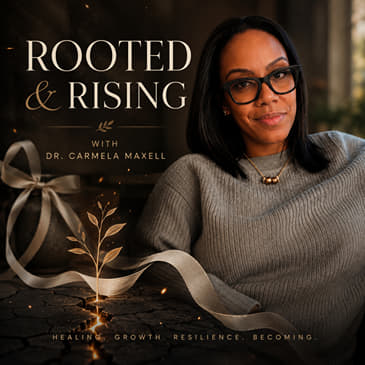
speaker-1: Welcome back, everybody, to this video episode of Rooted in Rising. I'm your host, Dr. Carmela Maxwell, and today's conversation is one I believe every person needs to hear because trauma doesn't simply affect our thoughts, it affects our bodies, our relationships, our nervous systems, and often the way we move through the world. Joining me today is Dee Mosley. author, speaker, wellness advocate whose work Yes, hello. And ⁓ her work centers around healing, restoration, and helping others reclaim themselves after trauma. Dee, thank you so much for being with us here today. I can't wait to have this conversation with you.
speaker-0: Thank you, Doctor Camella, for having me. I appreciate who knew that ⁓ the West Coast would meet the East Coast on Mid Terra.
speaker-1: Yes, yes, yes.
speaker-0: Okay. So thank you so much for having me. I'm excited about being here.
speaker-1: Absolutely, absolutely. And ⁓ if you would if you would please tell everybody what what state are you hailing from?
speaker-0: Hailing from Georgia. Yes, yes, about forty-five minutes south of Atlanta. Atlanta. Atlanta I am originally from neighboring ⁓ state of Alabama, but yes, I'm a country girl through and through.
speaker-1: Yeah, yeah. Okay, all right. Yes, ma'am, yes, ma'am, you know. and I've told my audience before, ⁓ so my father was ⁓ from Georgia. Yes. Yeah, so I got I got some southern roots and then I lived on the ⁓ yes, yes. I you know, certainly there's there's so much rich culture and just amazing, so many amazing people in the south. I love this so much.
speaker-0: Only way to go. our family reunion. everyone is is dispersed all over the country, but there is nothing and no place like home to come back home to the country. So we just we just came off of a four-day family reunion and everyone ⁓
speaker-1: I hear that. I hear that. You got that good sunshine, that good food, all of it. Yeah, I hear that. Well, once again, welcome. Tell us a little bit about your journey and what inspired your healing work and ⁓ what led you to writing a book.
speaker-0: All of it, all of it. Wow. So for years, ⁓ I won't say that that that it started that this whole idea popped in my head of, ⁓ I'm gonna write a book. ⁓ it didn't start out that way. but you know, for years I did so did what so many women do. You know, ⁓ I worked, I served, I took care of, I took care of everybody, you know. ⁓ I just kept pushing ⁓ and from the outside looking in, I looked like I was, you know, all put together. but inside, ⁓ I was slowly, you know, kind of falling apart. ⁓ and eventually my body said, you know, I don't yeah, I don't yeah, we're done. I don't know about you, but if you're not done, I'm done. and that's when my healing journey began, which ⁓
speaker-1: We're done.
speaker-0: basically led to ⁓ writing a book about it, but the healing journey began when my body started letting me know that it was not going to go any further than than I had pushed it, you know, really for. I wanna say the culminating part of it was for three years. ⁓ my body was trying to say, hey, hey, hey, hey, hey, stop right here. ⁓ until it I it just eventually my world seemed to just fall apart and crash around me. ⁓ and in doing so, in that season of my life, I began to ⁓ write things down because at some point I began to say, Hey, you know, I need to be trying to get to the doctor because whatever's going on is not ⁓ it's unrelenting, it's not stopping. So I need to begin to pay attention. ⁓ so that led to a series of doctor's appointments and things of that nature, ⁓ which led to me trying to remember what I needed to tell the doctors when I got there. So I started writing things down and journaling things. and at some point during the process of all of that, I just felt the need, I'll say on the other side of the process of healing. ⁓ just if I can be honest, I I feel I feel like I heard God say you need to put this in a book ⁓ because other people need to hear, read, hear, and understand that you were going through what they are afraid to vocalize and what they're afraid to ⁓ face themselves. There, you know, for the folk who are where I was in not being ready to commit to saying I need to ⁓ I need to take care of myself. So that's where the inspiration came from. Just crashing out. Yeah. Was the the start of the the inspiration. So yeah.
speaker-1: This. I love that you're bringing this to light. one, ⁓ the the the first thing I can think of, right, as a mental health clinician, I think of, ⁓ man, we push our bodies so far. ⁓ and and if we, you know, we just take a second to honor ⁓ our body and express gratitude for our bodies and what we put our bodies through. I know I am I am definitely ⁓ one that that is constantly striving to figure out ways to take care of myself. better, especially, you know, as a mother, as a as a mental health professional, all the different hats that I serve. I feel like sometimes we live a little more recklessly than than we probably should, right? Like, ⁓ we're just staying an extra hour, do this, push ourselves really hard because of societal demands and and family demands. Yeah. But but I think what's also so beautiful about what you just said is
speaker-0: Mm-hmm.
speaker-1: you know, God spoke to you in this way and and you're helping people with a putting a language, putting putting vocabulary to the experience just so, A, to know that they're not alone. And I know in in b in mental health, I hear these things all the time, right? Like I'm ⁓ they may not say, ⁓ hey, I've pushed myself too far. They may say, you know what, my body is just tanking. I'm I as you say I'm crashing out. I'm You know, I can't sleep, I can't eat, or I'm I'm n I'm eating too much, I'm sleeping too much. And our body gives us signs and we we're not listening to. We're not listening to.
speaker-0: That we're not listening to. For so many of us, like I I believe you just ⁓ made reference to giving language to it. It's so me so many of us don't know how to give language to it because I and I know this from my own lived experiences because I did not know how to give language to what I was going through at the time. And it was a learning, I was on a learning curve while in the the middle of my storm. Yeah. ⁓ because ⁓ before we understand where we are, ⁓ we get, you know, you ⁓ I don't feel well. Let me go to the doctor, let me go to my my primary care physician, ⁓ so that they can give me something like a quick fix. But when you're dealing with something chronic, ⁓ first of all, you don't you you know, at the onset you don't know that it's going to be chronic. Sure. But at some point in the middle of that, you're learning, okay, I need to learn. And you know, how to advocate for myself. I need to learn ⁓ the language, even in my my minute layman, you know, terms, I need to understand so that I can ⁓ help the the professional help me because there's only so much that they can do. So even if a person picks up Grace and Glow or talk to a D Mosley ⁓ just to listen ⁓ to what I can offer them. ⁓ it it helps them absolutely ⁓ begin to find their own language on their own journey, you know.
speaker-1: Yeah. Yeah. And and truth be told, right? when you talked about like the the chronicity of things, right? We we oftentimes don't know if something is gonna start off as chronic. I know I d I did not believe that the pain that my body was in when I was dealing with chronic pain before, you know, I had a surgery, I didn't know it was gonna be chronic, right? I thought this was just a a minor inconvenience that, you know, if I just like had a little more coffee or just like spent some time in the sun, maybe that would help. And I interestingly enough, you know, for our audience, much of the time what we're dealing with and where our bodies start to fail us a bit, it's never singular. Right. It's usually this complex web of things all coming together. It's not just, ⁓ I'm getting frequent headaches. It's I'm getting frequent headaches and I'm light sensitive but I also can't eat and I'm dizzy and I'm and this and this and this. Right.
speaker-0: Exactly. Yes. Absolutely. Absolutely. And that is where I was. ⁓ it it it was like a domino effect. You know, ⁓ at first you're thinking it's this, right? And then when you go to this specific doctor with this speci you know, specific thing ⁓ and they're they're checking all the you know, they're going down the rabbit hole and there may be some issue with whatever you think that specific thing is, and then they're like, Okay, I've gone as far as I can go. Right. You know, it's not necessarily what you think it may be, or it may be this, but it may be connected to something else. So then you go on your merry way because they've done all they can do. ⁓ but and then you're wondering
speaker-1: What else?
speaker-0: is what's what what's what's happening so you're going from doctor to doctor different specialties and yeah it's it's all it's never one specific thing and it's never like a ⁓ what I'll be better in a couple of weeks it you know for me it went from a month to two months to two years to three years you know ⁓ and then when you get into learning what is actually going on. ⁓ and you tie the emotions and the mental and the physiology and all of these things together and you begin to understand how it all works. You start to think about well, this really didn't start two years ago. This really didn't start three years ago. This this started forty years ago. Right. So ⁓ and then then there's this whole thing in in ⁓ Dealing with that and the healing goes to a deeper level in dealing with what happened forty years ago, fifty years ago. to make sure and understand that the your healing needs to be come full circle. And in order to do that, there has to be ⁓ some accountability and basing yourself and you know, pulling things from the back of your your your mind to know that. All these things have to they they tie in together in order if if you're if you're on a s a true healing journey. Mm-hmm. Mm-hmm.
speaker-1: Ooh, I can't wait until we deeper dive into this. And and and you know, this particular episode, we're not just talking about these physical and psych ⁓ you know and psychological ⁓ and physiological effects of trauma, but we we also want to zoom in on our our our black women, our women of color. Absolutely. Because I think ⁓ the ways in which these body aches and pains and s and things show up ⁓ can look quite a bit different for women of color. And also in terms of time frames, right? ⁓ sometimes they don't hit in the same ways. ⁓ the responsibilities look, feel and are experienced very differently. ⁓ but before we get into that and we dive into that, let's talk about ⁓ trauma and just like beyond beyond mental health. So you know a lot of people think that trauma only affects your mental health. But like Bessel Vanderkalk ⁓ you know has has has talked about the body keeps a score, right? Our bodies often remember what our minds are trying to forget, right? So so for you, your experience and maybe what you've written will and we'll make sure the audience ⁓ gets to to hear about your book, what happens in the body? after someone has experienced trauma, whether they recognize it as trauma, right? 'Cause that's a cat. Like 'cause sometimes we don't recognize, ⁓ that's that thing that affected us. Yeah.
speaker-0: Yeah, absolutely. ⁓ and I can you made reference to ⁓ Grace and Glow and absolutely I talk about that. ⁓ I touch on because ⁓ obviously I I am not a doctor, but I I reference everything from my own own lived experiences, right? ⁓ so I'll answer it from from my experience. Trauma for me, I would say that trauma doesn't like if if if you get hit, right, it it may leave a bruise. ⁓ but when we talk about trauma that affects us internally, you're you're ⁓ and that affects the nervous system, that that that doesn't leave a bruise, right? ⁓
speaker-1: People don't see it. Those invisible ⁓ you know, it's it's that those the invisible scars of trauma and that's hard to identify.
speaker-0: Yeah. Yeah. Yeah. Yeah. Because with the nervous system, when the nervous system is dealing with ⁓ trauma and traumatic experiences, what happens ⁓ and what I had to learn was or maybe I'm I'm sure I learned it somewhere along the way. we've I I'm I'm almost fifty three and I talk and I think about that that whole fight or flight thing phenomenon and when you're in when you're on constant high alert, that's what trauma looks like to the nervous system. That's the best way that I can explain it. ⁓ and and once I began to learn from, you know, my doctors and my physical therapist, ⁓ I began to understand that my body has been in constant fight or flight. It's been on this this whole constant roller coaster or I could I can even say it's been stuck, right? It's been stuck in high alert. And that is where a lot of my issues ⁓ physically came from in in understanding. Once I understood that my body has been in high alert, my nervous system was stuck in fight or flight, ⁓ this is why, you know, my blood pressure from I went from a person who had really low blood pressure most of my life to a person who every time I went to the doctor, they're telling me that my, you know, my blood pressure is sky high ⁓ and that I'm, you know, on sh had I had stroke level numbers because my body was, you know, beginning to be in this whole I'm about to blow a gasket you know, mode. So that is that's what trauma can do. That's what trauma can do.
speaker-1: You know, I've ⁓ when working with clients and even teaching, you know, some some of my students having conversations with friends, oftentimes what I have used as a a visual reference, right, is imagine you're on a an airplane and we we hope we we A, we hope to get to our destination safely. But can you imagine if the airplane takes off in the sky and then barely touches down? on the tarmac and then just picks back up again and then just li you know tries to land and it picks back up again. And so you you never land, right? You never get to that place. And then you you imagine, for me, I get irritated being in cramped spaces for way too long. I think I don't think that there's anyone that enjoys that. Right. Especially when you're sitting back in like, I call it Tunican class, where you you're back there you're not in first class.
speaker-0: Damn on the top game.
speaker-1: time right like I can't stretch my legs and then they tell you to remain seated and then it gets hot and then you know this person's complaining and and so you know that visual of the plane never landing and so and then what happens after after time we realize we're we may or may not land so then we start adapting we start that survival mentality so tell me about survival and
speaker-0: Yeah, there you go.
speaker-1: You know, the the the exhaustion that maybe we feel or don't feel or talk about or don't talk about, right? So that plane just touch go, touch, go, touch, go. What's that look like? What was that like for you?
speaker-0: Mean what that looked like for me, honestly, ⁓ and I didn't had no clue until like I said, until my body started ⁓ sending like these nine one one signals. ⁓ and I talked I've talked about that extensively in ⁓ on other interviews, ⁓ how survival mode is ⁓ definitely and I feel like that is something for ⁓ that most if not all black women experience is ⁓ survival mode is is something that we begin to know as familiar. ⁓ because we don't know any other way because you know we're taking care of, you know, trying to raise our children that we can. And trying to raise everybody. Exactly. Trying to take care of everybody. ⁓ if you're if you're ⁓ married or you have a spouse or if you're in a relationship, you're managing an an entire household with children, with spouses, or a significant others, you're trying to manage your bills. You're you're, you know, working a full time job and trying to, you know, be an entrepreneur.
speaker-1: Writing a book, running a podcast, all these things.
speaker-0: All of the things, you know, being chef, being doctor, being all of that. and most of us are trying to do that from a place of scarcity because let's be honest, ⁓ you know, culturally we're behind the eight ball. ⁓ and then we're we're black women, so we're behind the eight ball that's behind the eight ball, ⁓ with in within a place ⁓ you know, where we're We're on the bottom of the totem pole. ⁓ so we're doing what we can, everything that we can with what we have. ⁓ so that's what survival mode looks like. So when you talk when you're talking about peace, you don't really understand what that is. And and when you're when you're presented with it, ⁓ it can actually feel uncomfortable because you're not you're you're not familiar with it. You're familiar with surviving. ⁓
speaker-1: Yeah. You know, I I've I've worked with individuals in the carceral system and one of the most ⁓ scary ⁓ th things that I've heard from from many people who were released from like jail or prison and y you start to see the, you know, r recidivism and and and these individuals just returning back to these places is because ⁓ all this opportunity and things out there th that that dream Right, the the American dream that we talk about is is not necessarily as attainable and as easy to attain as as I think maybe we market it or we have marketed it in the past. And so it's easier to come back into a structured environment that doesn't help us grow necessarily, doesn't provide us that. And I'm you know, I'll go out on the limb and get your thoughts on this one. But I I think too, ⁓ not not a criticism per se, but ⁓ maybe more like a commentary on like black community and black women, I think this is sort of two pronged, right? So we can be really good at building each other up and community and taking care of one another. At the same token, our community is very much ⁓ historically tied to the church. Our beliefs in God ⁓ and our faith are ⁓ have have carried us for so long and at the same time we are we oftentimes refuse
speaker-0: Yeah.
speaker-1: Some the things that you know like going to the doctor consistently, seeing a therapist, all these things that are meant to help support. But I also say I understand the caution, right?
speaker-0: Absolutely. ⁓ we do we we all of that, everything that you just said, ⁓ we are ⁓ our own the only thing that we feel safe ⁓ out of everything that you just talked about is church. ⁓ because that's that's where we've been taught to find our refuge, right? ⁓ and then at on the same ⁓ side of the coin, ⁓ we've been taught from from history, from what history has taught us or from what has been passed down ⁓ from our ancestors from what history has taught them, we're we're leery and we're cautious and we're for lack of a better word, ⁓ we're you know, we have these superstitions about doctors and and therapy ⁓ because we've been told that you know we shouldn't you know we shouldn't have to ⁓ go if if you feel like you need to talk to somebody, go to the church and talk to your pastor. Or, you know, ⁓ we don't, you know, what goes on in this house stays in right, right, right. Or, you know, y we're untrusting ⁓ of doctors. ⁓ so all of those things play huge factors in how we take care of ourselves.
speaker-1: Save him the house.
speaker-0: ourselves or ⁓ lack thereof. ⁓ so ⁓ you know, at the end of the day, we we pay for those things ⁓ because we we wait until the very, you know, the we wait until those alarms begin to go off until we just can't take it anymore. Yeah or we don't want to admit that ⁓ I don't want to be the one to say, you know, I I see a therapist. You know, I don't want my church family to to know that, you know, instead of sitting down with my pastor, I want to sit down to talk to a therapist. Or, you know, I don't want ⁓ my family to to think that I'm I'm dying or ⁓ you know or something's going on with me that that I can't explain. ⁓ and and you know, I be the whispers, you know, in the family group chats or whatever. So there are a lot of a lot of phobias for lack of a better word that we have in our communities to our detriment.
speaker-1: Yeah. Yes. And you know, I I f I firmly believe, ⁓ as you know, this is you know, my pr my profession and and I definitely didn't take this lightly in in ensuring that I could be a part of the fold in terms of representation, right? 'Cause we don't we still don't have enough representation in terms of mental health for for black communities and people of color. ⁓ but I think I think faith is is a wonderful thing. And I think Right. And we have services and we have ⁓ ways to sort of change our thinking and reshape the ways in which we navigate society. And there are people that do look like us. ⁓ they they may be far and few, but ⁓ you know, that th there are people that look like us and ⁓ I think it can really be good in terms of s of that what keeps coming back into my mind is breaking those chains of transgenerational trauma because Outside of something that maybe we experience on an individual level, ⁓ there there are you know studies that show that in our communities, a lot of that trauma that we inherited, a lot of the pains that we inherited, right, are are going unhealed. Because we're we're we're like, well, I didn't I didn't necessarily face you know blatant racism and and I or this or this, so I don't necessarily need to worry about that. I'm like, yeah, but Your mentality and how you go about the world. ⁓ absolutely. Yeah.
speaker-0: Absolutely. You may not necessarily have faced it, but being in being a part of a culture culture or community, ⁓ you you have to at least want to understand where we where we are and why we think the way that we do. Or or we have to understand that because we're in the same cultural family, ⁓ that we're not we don't just because we may look the same and identify as the same, we're not all the same. ⁓ and we have to be okay with that. and I I really believe for us, and I can only speak for the black community, ⁓ that is also a part of our our issue. ⁓ is because we want to put everyone in the same box in that that that's a stressor as well. Mm-hmm. Especially especially for black women. Mm-hmm.
speaker-1: You know, ⁓ not living up to whatever whatever folds ⁓ exactly. I have personal experience with that. You know, I've I've my like my blackness has been challenged and and things and I think that that divisiveness also, and I spoke about this in in in another episode, but that divisiveness also contributes to like we we incite some of our own trauma. ⁓
speaker-0: Well Exactly.
speaker-1: And so I think it's just these are pain points that we really need to zoom into. ⁓
speaker-0: It's exhausting. It can it can be it can be very exhausting. Yes. Especially ⁓ and I won't say especially as women, ⁓ for black men also, because like you just said, our blackness, we challenge one another on a on a regular basis. And I'm not sure where that comes from. ⁓ and it there ⁓ gosh, there is so much trauma within the black community. Yes. Yes. ⁓ and we don't We don't know how to channel that. We don't know how to we don't know how to heal from that. We don't we don't know how to deal with it. So in turn we turn it on one another.
speaker-1: Yes. And and I think this was a a you know, a part of the historical master plan. You know. ⁓ you know, kinda like keep us keep us fighting, keep us with the infighting. And then we can't grow. And we've gotta get smarter about it. We gotta get we gotta get healed about this. And you We have to you talked about exhaustion and you know, when I think about ⁓ when I think about mental health and behavioral health, I you know, I I sort of I see these clouds and and sort of categories of things and then this conversation about just trauma in general. ⁓ no matter what ⁓ part of like the socioeconomic chain you are on, your your your gender, ⁓ whether you're you know, like I'm biracial, so that's a whole other we've got other stuff going on with that one. But but let's talk about that exhaustion because
speaker-0: But
speaker-1: What is exhaustion? What did exhaustion look like from the perspective of what you experience? Because I'll say for me, I tend to when I present, I I'll be hyper exhausted and I will do more. And that's my exhaustion. Yeah. Yeah.
speaker-0: Either you're you're either gonna be on one end of the spectrum or the other. ⁓ and and like me, I was I think I was one of those people who was all over the place on one end and then I find myself on the other end. We talked about ⁓ a little bit about brain rock before ⁓ started. ⁓ that was where exhaustion would take me a lot of times. You know, I would be like this this ha this overly performative performative person. Yeah ⁓ which is most black women, you know, I would ⁓ you know, go into go mode to perform and do all the things. And then when I, you know, come came off of that, I would find myself, you know, somewhere sitting, yeah, just just leaving everything and and doing this whole brain rot thing. ⁓ but, you know, on the other side of that, if you if you imagine maybe like ⁓ you're in a car and you're driving all all day with your foot on the gas ⁓ and never letting up. ⁓ you you you're there. you at some point ⁓ a f a a few things are gonna happen. If you if you're if you've never if you don't have a break, ⁓ your your foot is going to get tired, is gonna cramp up, those muscles are gonna, you know, say, Hey, what's happening here? The car is gonna run out of gas. ⁓
speaker-1: If you don't miss something first.
speaker-0: Exactly right. Or or it's gonna blow a gasket. Yeah. So that's that's what survival looks like. You you know, eventually giving out. ⁓ and I, you know, back to the nervous system. The nervous system, you know, kind of works the same way, right? Mm-hmm. Mm-hmm.
speaker-1: And and you know what what is so interesting and I think I give so much credit to the body, even though this is not where we want to be. Our nervous system learns so much from what we do that it gets faster at like it's like, okay, so this thing happened last time, I was too slow. I gotta keep going, I gotta keep going. And and we we get trained inadvertently, right, indirectly to respond to certain things. that are not necessarily crises or under respond to things that are crises. and and I will tell you, for me, I would go and go and go and go and go and go. And I was a lot like you, you know, you described yourself. Keep going. and and I want to say to the audience, you know, there's nothing wrong with being a high performer. There's nothing wrong with But you have to be situated in a healthy space, right? So you can do a ton of things.
speaker-0: That's it. That's yeah. If you're not if it's not coming from a healthy space, ⁓ and most of the most of the time, ⁓ if if you are not aware ⁓ that you're not in a healthy space to understand what your body is doing, whether it's overcompensating for you and you're, you know, subconsciously and you're not aware of that, once you begin to ⁓ experience all these things ⁓ emotionally and physically. you are going to ⁓ you you're gonna flip out. You're you're you're wondering what's happening ⁓ because you don't understand what the body is trying to do, which and really at the end of the day, your your body is trying to protect itself and protect you. ⁓ but if you're not aware of how all these things work, it it can be really, really scary.
speaker-1: You know, and and ⁓ I I was having a conversation with someone the other day. we we we sort of wear this as a badge of honor and at the same time we know better, right? We know better, but we talk about ⁓ you know, the work ethic now. Like we used to you know, we'd have the flu, we get up and we would go to work the next day and you know, part of me is like, We did that though, right? We we actually did that. We did that.
speaker-0: Yeah. The dog on thing. We absolutely did. ⁓ because that's all we knew. That's all we know. That's all we need to do. ⁓ and and and to our you know, to to applaud us, it it worked. ⁓ but to what end though? and and when do we begin to ask ourselves how we can begin to communicate healthier habits to
speaker-1: ⁓ yeah, yeah.
speaker-0: ⁓ our children that are now, you know, either ⁓ becoming adults or young adults, ⁓ where where do we ⁓ turn this into something that's healthy for them so that they can understand that you don't have to suffer ⁓ to become these successful people.
speaker-1: You know, what as as we're talking about women of color and specifically black women, ⁓ there's there's this sort of pit in my stomach feeling 'cause I recall reading something about how, you know, black women don't need a break because they're the strong ones. They don't that we don't burn out. And and everything in me was like, ⁓ but ⁓ I just want to fight. Yes. Right? Yeah. But
speaker-0: Superwoman cape all the time.
speaker-1: Right. And and no, you know, we are people too, we are women, we need love, we need support, we need care. We need a soft landing. We we need all of those things. Yes.
speaker-0: We we we need and we want to to be vulnerable. We want to be you know, we want like you say, we want these soft places to land. ⁓ but when there's a different expectation, ⁓ we d you know we don't have a place where we can let our guard down. ⁓ and it is th that is so difficult and it's hurtful ⁓ because we're teaching our our daughters ⁓ that you can't let your guard down. You can't You you can't get caught slipping, you know, and we're on the other side of that, we're teaching our sons. ⁓ you know, you you have to ⁓ make sure you find a strong black woman. and and some of some of our sons are opting for other women instead of us because ⁓ it can d for them it's like ⁓ you're too strong. So you don't know where that balance is or it can be confusing. It's confusing all the way around.
speaker-1: think too you know we talked about ⁓ because you know I have a daughter and I have two sons and I ⁓ they have seen me on the spectrum of sort of like the the morally injurious and then burnout circle right and and outside of teaching our children how to move in the world I think the greatest disservice though that
speaker-0: Right.
speaker-1: we do outside of our our homes and our immediate communities is we teach society to expect from us that we don't need rest. But and and I don't even want to dabble with the word strong because I think that there A I think black women are in are just inherently strong. Inherent but what we teach society that we that strength for us equates to burning
speaker-0: Mm. Absolutely. ⁓
speaker-1: out and not showing it. And that is maddening.
speaker-0: It is, it is, it is so ⁓ and and I'm just thinking about a time ⁓ when I was in the corporate world. ⁓ and there was no I could not show any other emotion other than having it all together and being again, I'll use the word high performative. So, you know, if I came into the office and and they if they could sense any inkling of, you know, emotion from personal things, ⁓ Th there was a problem. Yeah, what's going on with Dee? You know, she's she shouldn't be, you know, ⁓ she shouldn't be showing emotion or she's ⁓ or she's angry. If you know if I came into work ⁓ with with the the the you know to do my job, ⁓ and and not, you know, small talk or you know, rushing over to somebody else's cubicle to talk about the weekend. I it was it was
speaker-1: That was the problem. Right.
speaker-0: an issue if all I did was come in to do the job that they were paying me for. Right. ⁓ and it it was it was that within itself was exhausting. ⁓ yeah. yeah, 'cause it's yeah. Because as a black woman, you know, we again this goes back to you. We're we're taught to to to not have folk in our business. So you don't necessarily, you know, go to ⁓ these outside places, especially, God forbid, work to talk about whatever you may be going through personally. ⁓ but other cultures may not feel the same way. So, you know, they see it as an issue or a problem. Mm-hmm. So it's a lot. It's a lot.
speaker-1: You know, especially in in the workplace, you know, I've I've experienced this in in different work settings. And ⁓ I I'm a person that ⁓ I I I speak my mind that which which doesn't always put me doesn't always land Well, but but I I think I I speak my truth and I live in my truth and I've I I've had it where it's you know, I've been s I've been called you know, so you you're trying to act like you're tough. I'm like, no. Or you're not that or you're this or you turn around and so you're too aggressive and and you're you what you're you're you're contributing to people's, you know
speaker-0: Or
speaker-1: fear about you or a toxic workplace culture. And and so what do we do? We get to that point where we shut down. And then I know for me personally, I'd feel it in the pit of my stomach. I would stop eating. I would just be really angry and I'd stew about it. And and it would it would show up. It would show up and sometimes not in the time that I thought or in the place that I thought.
speaker-0: Yeah. ⁓ gosh, projections. Yeah. Yeah. Yeah. Yeah. You bring things home from work. that was that was me, ⁓ a lot of the time. ⁓ it it would get projected onto either and I hate to say it on either onto my children, my husband, or you know, ⁓ or it would show up in ways where I would isolate.
speaker-1: Yes.
speaker-0: from my community or my friends. so again, it it's just that perpetual cycle that would absolutely at at the end of the day cause exhaustion, you know. So you're you're, you know, kind of just deflating in more ways than one.
speaker-1: Yeah. Yeah. Yeah. And, you know, we could we could talk about even just after some time. you know, ⁓ for me, I was not a person that called out a lot, ⁓ because I always believe in holding on to my sick days in case, you know, w especially as a mother and single mother and holding on to that time for my kids for your kids. But I I found after some time, if I didn't get my stuff together or if I was ignoring a part of me ⁓ I was using sick days. Exactly. And then I was feeling guilty about using those sick days. And then I perpetuated this terrible cycle and and it just kept going. Right. And then I was like, okay, you know, I twenty four hours, I'm good. I just gotta get some sleep. Yeah.
speaker-0: Yeah. let's talk about sleep.
speaker-1: ⁓ let's talk about sleep and and what ⁓ for ⁓ everyone has asked me, say, How are you doing all this? I'm like, I don't sleep I mean it's it's it's far it's farcical it is, but ⁓ but at the same time the quality.
speaker-0: Right. The quality of sleep. Like you you can be in bed, you know, saying you telling yourself, ⁓ I'm gonna get five hours of sleep or seven hours of sleep and you know, you may you may be even taking something to help you sleep, ⁓ melatonin or whatever, but at the end of the day your nervous system is still going. 'Cause ⁓ we go back to ⁓ getting stuck in in, you know, your in that fight or flight mode because your nervous system doesn't know what to do with w everything that you're throwing at it. So ⁓ sleep doesn't look like this relaxed state. ⁓ I'm still, you know, I'm on the other side of a lot of things. Yeah. ⁓ that I've been dealing with, but my body that that part of what the healing process is, I'm still learning how to get through. it's it's not easy once you've ⁓ you know, been in this mode for years. it's not easy to ⁓ you know, it's not a quick fix. but the the the bigger the great the the great part of it is is you you understand that okay, I'm here. So you know how to begin to work through that, which includes learning how to rest, you know.
speaker-1: Yeah. And you know, I I ⁓ I've had to redefine rests, you know, because growing up Yeah, 'cause I I don't think rest looks the same for for everybody and nor should it, right? ⁓ and I'm very very conscious of that as a clinician, that when I'm talking to people and when people are having conversations with me, they're like, You know what, you're doing too much, you need to rest and I'm like, Okay, hold on. But if I'm doing Quality things, right? Like if I'm doing quality things that bring me joy. Yeah. It's the this like a lot of inherent criticism when you are a high performer and a go-getter. Yeah. And it's it's like I'm I'm doing yeah, I'm doing multiple things, but they all bring me joy and I'm managing the time really well. Versus you do that one thing and and it's causing the biggest amount of stress. Like sometimes we got we gotta prioritize here. Yeah.
speaker-0: And I I I would get that a lot. I would get that a Like, ⁓ yeah, you you and I still get that. Like you were doing you were doing the most, you know, you you really were doing too especially now that the book is out. You know, I hear a lot of I hear a lot of folks saying, Yeah, yeah, you were really doing too much and you really needed to you know, you needed the re all all the things. ⁓ but like you just said, ⁓ rest can absolutely look and it should look absolutely different for for Everyone. ⁓ so even though, you know, I was going through this this this journey of understanding understanding that my body was sending me all these signals, ⁓ it it wasn't necessarily telling me that telling me that I was doing too much. I I believe that my body was telling me that I need you to pay attention to what is going on in internally, ⁓ not you know, per se that you are doing the most, ⁓ just because what my life and my performance looks like to someone else, it may be something completely different from what you think you should be doing and the level of of where you are in your capacity, because my capacity and your capacity could be cum they are completely different things. So I don't want people to misinterpret, especially high performative people. that because you're doing all of these things, if it brings like you say, it brings you joy. if it is ⁓ taking care of your household, if it is taking you to a place where your purpose is is ultimately supposed to be, then yes, absolutely, you very much, very well should be doing those things. It's restoring a healthy ⁓
speaker-1: Right.
speaker-0: place and ⁓ if you if you're feeling like you're not in a healthy place then that is where the balance is and that's where you need to learn how to how to do that and find that balance for you and your you know your physiological makeup if that makes sense.
speaker-1: It it makes total sense. And you know, and I I I wanna kinda dabble into two things about doing the most, right? So on the one hand, I've I I think and maybe I feel this too, black women get the short end of the stake and we are often the ones told that we're doing too much. But I look at other content creators that are not black or you know, who who are non women of color.
speaker-0: Absolutely. Absolutely. Mm.
speaker-1: And why are they not being told the same?
speaker-0: Right. Because it we're all on the same level as far as trying to create content or ⁓ meet the the standard of what ⁓ content creation looks like. And some some of our other other cultures are doing way more than we are, ⁓ but they're not being told that they're doing the most. That is a good question. one to Wanted to say hmm.
speaker-1: think about that for a second. Yeah. For for women in general. Just you know throwing all of all women women, you know, identifying, you you know, women presenting. Why do you think women in in general feel guilty resting? And why do we as women in general normalize being in survival?
speaker-0: ⁓ okay, so rest for me was a foreign thing. just because ⁓ just from a lot of the things that we were just talking about. ⁓ I understand now ⁓ that my mind never had an opportunity to learn how to rest. ⁓ and it it Grew from a place of childhood. ⁓ and I I really believe that it goes back to understanding that ⁓ or thinking that there's a certain level that I need to get to as as a young black woman, and then as ⁓ you know a mature black woman ⁓ who has ⁓ reached certain levels in life that include children, that include your career, that includes being matriarchal in the community, you know, a pillar in the community, ⁓ in in this person of strength or this person of a certain stature ⁓ that it has a standard from other people to look up to and to strive for. And you feel like you're ⁓ what is the word that I'm looking for? you're ⁓ for lack of a better word, you're you've become the standard.
speaker-1: ⁓ you're like you're like the token. You're you're responsible for yeah.
speaker-0: Yes, yeah for the entire family, yeah for the entire community. that parts. That parts. I like yeah. Volumin told to be the person. ⁓ and and then on the other side of that, it's is it's exhausting ⁓ to be the person. And then when you
speaker-1: All in told.
speaker-0: when you become voc when you vocalize that you no longer want to be the person. You're not heard.
speaker-1: Hold on. ⁓ they will fight with you. What do you mean you've given up? What do you mean?
speaker-0: But you yeah I didn't hear you say that you don't feel well. You know, you can scream it from the rooftops, you can, you know, you can say it subtly. ⁓ but yeah, if you've been the person for so many years, you're going to be that person until your last breath, even if it's, you know, to your detriment. Yep. ⁓ and I I really feel like ⁓
speaker-1: We gotta stop that. We gotta stop it.
speaker-0: Yeah. A lot of a some some part of Grace and Glow came from that place as well. because I'm like, okay, people are not hearing me, you know. Yeah, exactly. Like, do you hear yourself, you know, saying, you know, yeah, but after I've said to you, Yeah, I'm no longer doing these things. You know, I'm retired from this. get somebody else to do it.
speaker-1: They're not eating themselves.
speaker-0: And then to turn around and hear somebody say, Yeah, but you know, you could do that for me, right? But I just told you I n no. No. So rest is is a foreign thing for for women of color, for black women, for so many reasons. ⁓ because so many people don't want to hear us say no. So we we forget or or we abandon our own health in our own restfulness because we don't want to disappoint or or somebody saying, you know, yeah, sure you can do it. You you're
speaker-1: ⁓ when they build you up and they they market for you and they put you on the spot and it's like, yes, yes, I can absolutely do that. I also need time and resources and sleep and to attend to myself. Yeah. ⁓ And and then nobody asked me I think that's the biggest thing. Nobody asked me if I wanted to do this. Like we just showed up and and and we showed out, right?
speaker-0: And yeah, and then you feel guilty it you know, the to to even want to rest.
speaker-1: Yeah. Yeah.
speaker-0: We've been taught that productivity is is a thing. We've been taught that productivity equals worse in in our communities, even in our families, even if you get both sides of the coin, like we just said, you know, either either they're we're we we're being built up because we you know we keep going and going and going, or we get you're doing the most because we keep going and going and going. So there's this whole
speaker-1: You can't win.
speaker-0: know, tug of war, you cannot win. ⁓ and there's no rest in that. There's no rest
speaker-1: No rest in that. There's absolutely no rest in that. And you know, I think just, you know, women in general, the the the ⁓ you know, we'll we'll include like white women, black women, you know, Spanish women, you know, Asian women. We throw all of them in the mix. I mean, the the the tides have turned a little bit and so you know, women are Yeah. I well I say this, you know, in in terms of work. We got female bosses out here, right? We got people we we we got we got Yeah. We we got female representation. It's definitely not where I'd like to see it. And at the same time, I think just in general for women, we normalize survival because we are still in a very patriarchal society.
speaker-0: Right. Absolutely. Absolutely. ⁓ don't know I mean there there, you know, there was Kamala Harris. You know what I'm saying? ⁓ so
speaker-1: And Hillary Clinton. And I mean like re regardless of how people felt about either candidate. Shirley Chisholm, you know, like regardless of how people felt about them, they they came up, but look at the level the levels of exhaustion, especially Shirley Chisholm, right? Like I mean the the fight that she fought, ⁓ just it it's there's so much cost.
speaker-0: It was it was on it there was so much cost and it was not just from ⁓ folk outside of our community, it was the whole spectrum, it was everybody. It w and and we're still there today. Like you just said, we we live in a very patriarchal society. ⁓ and you just have to wonder when will that yes, we have we're we're complete bosses, totally. ⁓ but there's this ceiling. ⁓ that i y you know, i it continues to be shipped away at but and however at what cost.
speaker-1: Right. What are some of the myths about strength? You know, we we talked about ⁓ black women ⁓ being seen as as strong, as if maybe we have higher pain t tolerances and stuff, but for women in general, what are some of the myths about strength that keep women stuck in this mentality and keep us like keep our nervous systems firing?
speaker-0: Yeah, yeah. Well I I think that the biggest lie ⁓ that kind of covers everything is is that we we have to do it all. ⁓
speaker-1: I'm being called out. I'm being called out.
speaker-0: And the truth. And and we begin to tell ourselves that. But that's the biggest that is the biggest lie because no, you don't. You do not have to do it all. that that keeps us stuck. ⁓ and the that that we have like this for whatever reason, one of the biggest myths is that we have like this higher tolerance level of of pain ⁓ from everyone else and I don't know where that comes from or why it has followed us into 2026. But that that's a myth as well. ⁓ You know, we're we cannot do it all even though, you know, we're told that we can, even though we tell ourselves that we can. And we're just as human as as the next person. Our tolerance level, even though, you know, up everybody has their own different levels of tolerances of pain, ⁓ our bodies are still we're not invincible. So those are some myths that are out there.
speaker-1: And you know, I I wanna dabble into ⁓ that myth of ⁓ you know, black women in particular and women of color that we have just the super s this super strength and super tolerance for pain. Now I think we we we we've got a lot of superpowers. I think we do withstand pains that other groups don't.
speaker-0: Yeah, I and I and I believe I absolutely believe that I believe in in the the the bloodline of our ancestors. You know, ⁓ and I believe completely, absolutely believe that we get a strength that that comes from them. ⁓ through l learned experiences through, you know, if if you're of age, kinda ⁓ like me ⁓ or even wherever you are, whatever your age is, and you you've grown up with grandparents and you remember ⁓ seeing them work ⁓ at the level of whatever they had to work to make it. ⁓ those things you learn those things through osmosis. You learn those things by you you you you know take on a level of strength by watching them or remembering ⁓ who they were. Yeah, and we absolutely ha and ⁓ I take pride in knowing that we have that strength. yeah, those things come from from from our roots. And our communities. ⁓ that is absolutely a part of who we are, but it's not to be taken advantage of and at the same time is not to be taken for granted either, to the degree that
speaker-1: Yeah, our communities.
speaker-0: it's to our def ⁓ detriment. I know I've been using that word a lot, ⁓ th to
speaker-1: That is true.
speaker-0: Yeah, but ⁓ yeah, we have to put it all into perspective. We have to learn how to balance it. ⁓ because if we don't, we end up crashing out, ⁓ you know, or or we end up being mis ⁓ you know, defined ⁓ misinterpreted that, you know, ⁓ that just because they're they're built ⁓ to be strong, or just because they present to be strong and we may very well be and we are but that doesn't mean that we don't get tired that doesn't mean that we don't deserve to ⁓ to rest it it doesn't mean that we should be taken advantage of certainly ⁓ and it doesn't mean that our health doesn't decline if we don't take care of ourselves it doesn't mean that we don't suffer trauma ⁓ just because we are strong people it it doesn't mean any of that ⁓ it is it's it's unfair to be deemed that if ⁓ just because we're strong people.
speaker-1: Yeah, and and you know, I think with that going back full you know, full circle, it doesn't mean that we don't have nervous systems that also need to be reset.
speaker-0: heal. Yeah. Yeah. Yeah. you know, just because we're we have we come from different cultures does not mean that our b our all of our bodies have the same, you know, we may have different DNA, we may have different, you know, cultures, but ⁓ the body is the body. And and it definitely needs to ⁓ reset from places that where we've become stuck, especially with our nervous system. ⁓ so yeah, we have to give ourselves the opportunity to do so. Or and advocate for ourselves when other ⁓ when when folks think that that we're okay, when we're obviously not. Mm-hmm.
speaker-1: You know, I think about ⁓ generational wealth and we're talking about ⁓ finances, right? And and leaving behind a legacy for our for for our children, for our families. Unfortunately, I think the biggest inheritance that we got, and and this is not to say this is the only inheritance we got, but as a as as black women, as women of color, the biggest inheritance we got were wounds that we didn't choose.
speaker-0: Woo, my goodness. That part, wounds that we did not choose. I I don't even know where to go with that. That hit me hard. and and I will I'll go to something ⁓ a little personal in even in saying that. ⁓ I I can remember hearing my mom ⁓ talking to my daughter about some things that happened to her in her past. That she was never able to ⁓ articulate with me. Yeah. But I was the person who felt that, felt the brunt of that ashes. ⁓ whether indirectly or directly, you know, even with her not being able to express that with me, there was a projection from those experiences that she had ⁓ that landed on me. ⁓ even passively that shaped who I was. You know, and that's a whole that could be a whole nother discussion, you know. But ⁓ just to hear her express some things to my daughter that, you know, and I'm like, okay, now that makes sense. Now I understand why that came from there. But then how do I process it is where, you know, where I am now. ⁓ because now I understand why she was where she was, which in turn put me in a position to be where I am. And then you go back into the whole physiology of why my body, you know.
speaker-1: Why is it turning on me? yeah. Yeah. So so you know, well, I because I don't I don't want this all to be doomsday, and I know you don't because you have focused so much on your healing as I have. I think that, you know, can can the body heal? Yes. I think with time, effort, energy, community. We also gotta be mindful of what community looks like, feels like, smells like, tastes like.
speaker-0: Subtitle. There you go. That part.
speaker-1: We we 'cause we also can be part of communities within our own communities that continue to incite that trauma. Right.
speaker-0: Mm. Mm-hmm. Mm-hmm. Yeah, and and the the body absolutely can it can heal itself. ⁓ can it heal itself perfectly? ⁓ I you know, that I don't think so. that remains to be seen. But the absolutely and it definitely we have to give language to understanding that it does not happen overnight. ⁓ we have to unlearn that. and I I I don't know if that came from you know, witch doctors, ⁓ snake oil, you know, there's no magic pill. ⁓ and we have to that's that's one of the biggest things we need to understand that there's no overnight healing. ⁓ there it's a it's a journey and it it is a process. And that within itself
speaker-1: Mm-hmm.
speaker-0: ⁓ is what has helped me the most is to understand the language of there is a process in the healing. ⁓ you know, advocating for oneself and then understanding that the the the process is a journey. and it may be, you know, ten years from now, but at least you're on a healing journey that you understand. ⁓ That's where I am. That that's what I am experiencing. ⁓ and and to also this is a big one that we have to understand. With healing, healing begins with ⁓ I've used the word acknowledgement, but it also begins with being honest with ourselves. We have to be honest with ourselves. ⁓ we have to ⁓ admit those things that we may have done to ourselves that we're not.
speaker-1: Yeah.
speaker-0: ⁓ healthy or
speaker-1: My best friend calls that the self inflicted wounds that we place upon ourselves. Yeah.
speaker-0: Yeah, that we want to forget about, ⁓ that we've swept under the rug, ⁓ that we're ashamed of. ⁓ but we have to we have to face those things, even if not with anyone else, with ourselves, so that because the answer lies therein. You know, and if you cannot be honest with yourself, how do you expect to for you and your body to meet ⁓ in the same place to begin that healing journey?
speaker-1: Yes, yes, yes. So last question before I give you the floor about your book, because we gotta hear about this book and where to get it and all of that. Yes. We we talked about a lot of stuff today, right? We talked about, you know, seeking out therapy, keeping your faith, making sure you have community, being honest with yourself, advocating for yourself. Go to the damn doctor, y'all. Please do go to the doctor, y'all.
speaker-0: Please the doctor. Yeah. The therapist, all of those things, yeah.
speaker-1: Stay out of the ER. Stop being high don't be a high utilizer in the U E R. Just go get your friends and check out. ⁓
speaker-0: Yes.
speaker-1: Practice h healthy ⁓ habits a ⁓ around the across the way. But yeah, if you could give anyone that's listening right now that one starter piece, that one action step where they're like, listen, okay, Dee, that's great. You're done said a whole lot of things, but I don't know how to start. Where do I start? What's the one thing, even if it's small, what is that one thing?
speaker-0: Again, I I can I can only say just be honest with yourself. honesty is where it all begins. The the journey to healing begins with you being honest with yourself. look yourself in the in the mirror and say, Hey, my body is not doing these things for for for naught for no reason. What what can I look back on? ⁓ what have I been ignoring? ⁓ you know, you you can't do anything else. You can't, you know, you can't find rest. ⁓ you can't begin to even talk to someone, you can't even begin to pray until you are willing to take the first step to be honest with yourself. Slow down. begin to understand that being able to communicate with myself means slowing down long enough to To hear my own thoughts. just all of those things. ⁓ like I said, a healing is not a big giant leap, right? It it's a lot of small steps. ⁓ but you have to start somewhere. That one small step begins with honesty, and then you take another small step to all of the other things, but begin there. Just be honest with yourself. ⁓ be accountable to you.
speaker-1: Mm-hmm. Mm-hmm. Be honest with yourself, folks. I think that is a wonderful piece of advice and I think that is that is a great that is a great place to start. You know, look yourself in the mirror. I think that's what I've always had to do. Yeah.
speaker-0: person in the mirror. ⁓ 'cause at the end of the day, that that person is the person that you have to live with. ⁓ and if you can't live with yourself, then who how how can you expect anyone else to? you know, live with it. Be be honest with yourself enough to be able to find healing, to be able to find peace, to be able to find rest. Because until then you won't be able to find any of those things.
speaker-1: Right. Right. So let's let's get into it. I'm excited about this. Tell us about your book. ⁓ and we talked a bit about what inspired you to write it and you know, ⁓ but who is it written for? Where can people get it? How can people connect with you if they want to get you on their podcast or or seek some advice and and thank you, thank you. Yes. Tell us tell us all of it.
speaker-0: So Grace and Glow was written again. ⁓ I'll go back to saying that Grace and Glow was was written from a place of me just ⁓ communicating with myself and trying to get all these things out to be able to ⁓ give language to where I was, where I am, where, you know, to help the doctors help me. But at the end of the day, what I'm beginning to understand and realize ⁓ as people are reading Grace and Glow. They're like, wow, you know, I expected to, you know, read this tell all about D Mosley. You know, and as I'm reading your story, I am absolutely seeing myself in the pages of Grace and Glow. So it it it absolutely has become this this place of ⁓ refuge for folks to begin to say, hey, if D could do this. If she could ⁓ be as transparent as she's been to the whole world, then I absolutely can at least try to be transparent enough with myself to face a lot of things that I need to face within me. So Grace and Glow is written for the person who picks it up and finds themselves in the pages. So I absolutely hope that ⁓ your audience will go to Amazon. Yes. ⁓ and look for Grace and Glow ⁓ under D Mosley and there you will find it. ⁓ again, this wasn't anything planned. There's no marketing strategy behind Grace and so in saying that there's no, you know, there's no website or anything of of that nature. But ⁓ if you're looking for me, you can absolutely find me on social media, Facebook specifically, under D. Mosley. Mosley, ⁓ O S L E Y. ⁓ and if you have any questions, you know, just just hit me in the DMs as the young folks say.
speaker-1: Yes, well I I'm gonna help my sister out and ⁓ Grace and Glow and information about ⁓ D Mosley is gonna be available on my website, HTTP colon slash slash Carmela Maxell dot com. That information will be up and as well as a direct Amazon link to her book. Pick it up, get a copy, y'all, support our girl. Yeah, support our girl, absolutely.
speaker-0: Amazing. This has been
speaker-1: So much fun. I I just always have so much fun doing this and and thank you for being here with with us today and sharing your story. Absolutely. Absolutely. For for those of you if today's conversation resonated with you, I'd love for you to follow, subscribe, leave a review, share this episode with anybody who may need to hear it. Every conversation has the potential to change a life. And together we're building a community rooted in healing, growth, resilience, and becoming. Until next time, stay rooted in who you are and keep rising into who you're becoming. Take care.
speaker-0: Mm.