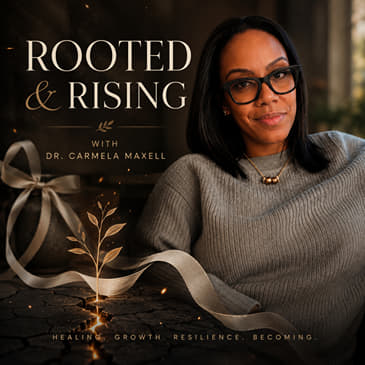
Dr. Carmela Maxell: Hello my friends, and welcome back to Sunday Seeds of Thoughts on Rooted in Rising with Dr. Carmela Maxwell. Today's episode might make a few people feel uncomfortable. Actually, let's be honest, it probably will. And before anybody starts typing an angry comment, sit down, have a sip of water. Because today we're talking about something I jokingly call the Karen syndrome. And no, this is not an episode about women. It's not an episode about white women. It's also not an episode about people actually named Karen. If your name is Karen, you are welcome here. I'm not coming for you personally. What I am coming for is a behavior. And unfortunately, all of us are eligible. The Cairn syndrome is what happens when confidence outruns competence. It's when the certainty in our voice becomes significantly larger than the evidence behind what we're saying. It's when we don't actually know, but somehow we're explaining it to somebody else with authority. And perhaps a PowerPoint. The problem isn't confidence. I want to make something very clear. Confidence is not the problem. We need confidence. Confidence allows us to walk into rooms where we may feel intimidated. It helps us advocate for ourselves. It helps us lead, teach, create, speak, take risks. challenge bad ideas and occasionally hit publish on a podcast called the Karen syndrome and hope LinkedIn doesn't set itself on fire. Confidence is useful. The problem begins when confidence becomes disconnected from curiosity. Because there is an enormous difference between I know this and I think I know this. And even bigger difference between I have experience with this and therefore I'm an expert on everybody's experience with this. Those are not the same thing. But human beings are remarkably good at confusing them. And yes, there's psychology here. There's actually a psychological concept related to what we're talking about. It's called intellectual humility. Intellectual humility doesn't mean thinking you're stupid. It doesn't mean shrinking yourself. And it definitely doesn't mean apologizing every time you have an opinion. It means recognizing something incredibly simple. I can be confident in what I know while remaining aware that there are things I don't know. That's maturity. Because expertise doesn't require omniscience. You can be brilliant in your field and still be wrong. You can have three degrees and still be wrong. You can have thirty years of experience and still be wrong. You can host a podcast and still be wrong. Yes, I put myself in it too. I'm not standing outside the Karen syndrome looking through the window at the rest of you. I have a membership card. We all do. Because our brains love certainty. Part of the problem is that certainty feels good. I don't know is uncomfortable. I need more information is uncomfortable. I misunderstood that is uncomfortable. And Lord have mercy. You were right and I was wrong. That sense has taken out stronger people than us. But psychologically, uncertainty requires us to tolerate not having an immediate answer. And some of us are terrible at that. So instead of sitting with uncertainty, we fill the space. We assume. We generalize. We confidently explained something we learned approximately eleven minutes ago. And social media has made this spectacularly easy. You watch three videos about attachment styles, and suddenly everybody you've dated has narcissistic personality disorder. You read one article about nutrition, and now you're conducting unsolicited consultations in the grocery store. You learn one psychological term, and suddenly that's gaslighting. That's trauma. That's boundaries. That's toxic. That's narcissism. Ma'am, he forgot to text you back. We need additional data. Expertise should make us more curious. Here's something I've learned from teaching. The more deeply you understand a subject, the more you begin to appreciate how complicated it actually is. Beginners sometimes want clean answers. Experts tend to have more questions because learning reveals complexity. You start realizing, ⁓ There are exceptions. There are competing theories. Context matters. Culture matters. History matters. Individual differences matter. The evidence changes. Maybe the answer is not simply yes or no. Maybe it's it depends. Which is perhaps the least satisfying answer in the English language. But sometimes it's the most accurate. And that's why I become a little suspicious when somebody has absolute certainty about an extraordinarily complicated subject. Because sometimes certainty is expertise, but sometimes certainty is just volume. And volume is not evidence. Now like let's make this more uncomfortable because I know what some of you are doing right now. You're thinking of somebody. You already have their face, your coworker, your supervisor, your ex, your cousin. That person in the Facebook comments who has apparently earned six graduate degrees since breakfast, and you're thinking, yes, this is exactly what they do. No, come back. This part is about you and me. Because the most useful question isn't, who do I know who does this? The useful question is, where does this show up in me? Where do I become overly certain? When do I stop listening because I've already decided I understand? When have I dismissed somebody else's expertise because their answer conflicted with what I wanted to believe? When have I spoken about someone else's experience as though I understood it better than they did? When have I confused my education with infallibility? My position with expertise, my age with wisdom, my confidence with correctness. That's the work. And leaders, we need to talk. This becomes particularly important when we have power. Because when you're wrong without power, sometimes you're just wrong. When you're wrong with authority, other people may have to live with the consequences. That's why leadership requires intellectual humility. The higher you move, the easier it becomes to surround yourself with people who stop correcting you. And that can become dangerous. If everybody in the room agrees with you all the time, you may be an extraordinary visionary. Or people may be afraid of you. We should probably investigate. Good leadership isn't knowing everything. Good leadership is creating an environment where somebody can say, I think we're missing something. And you don't punish them for it. Where the newest person in the room can notice something the most experienced person overlooked. Where changing your mind after receiving better information isn't treated as weakness. It's treated as what it is actually learning. We have to stop performing certainty. I think some of us learn that competence means always having the answer, especially leaders, especially educators, especially professionals, especially parents, especially people who have spent years becoming the person everyone goes to. We become afraid to say, I don't know. But those may be three of the healthiest words available to us. I don't know. But I can learn. I don't know. Tell me more. I don't know. I hadn't considered that. I don't know. I may have gotten this wrong. This isn't incompetence. That's intellectual honesty. And strangely enough, the people I trust most aren't the people who always have an answer. They're the people who know when they don't. So here's your seat of thought for this Sunday. Confidence and competence are not the same thing. Confidence tells us we can enter the conversation. Competence gives us something meaningful to contribute. And humility reminds us that we still have something to learn. We need all three. So speak. Take up space. Trust what you've earned. Use your expertise. Challenge ideas. Be confident. But leave a little room in your certainty. Enough room for another perspective. Enough room for new evidence. Enough room to change your mind. Enough room to say, I don't know. Teach me. Because maybe the opposite of the Karen syndrome isn't silence. Maybe it's curiosity. And if you listen to this entire episode thinking about somebody else, I have unfortunate news. You may need to run it back. This has been Sunday Seeds of Thoughts on Rooted in Rising with Dr. Carmela Maxell. If this made you laugh, think, or become mildly concerned about your last staff meeting, send it to somebody. Follow, subscribe, rate the show, and share the episode. You can find Rooted in Rising on Spotify, Apple Podcasts, Amazon Music, YouTube, iHeartRadio, Pandora, Sirius XM, and all major pla ⁓ podcasting platforms. Until next time, stay confident, stay curious, and stay teachable. Remember to stay rooted in who you are and keep rising into who you're becoming. I'll see you next Sunday.