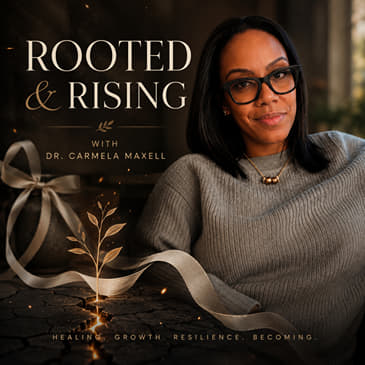
Dr. Carmela Maxell: Welcome back to Rooted in Rising. I'm Dr. Carmela Maxwell. And today I want to talk about something that I think somebody should have told us much earlier in life. Nobody knows what the hell they're doing. There, that's the episode. Thank you for listening. Stay rooted, keep rising. No, I'm kidding. But seriously. I'm becoming increasingly convinced that one of the greatest scams of childhood was the idea that eventually we would become adults and suddenly understand how life works. Remember that? When you were little, adults seemed like they knew things. They knew where the band-aids were. They knew how to get places without GPS. They understood taxes. They knew what temperature the oven was supposed to be. They knew what insurance was. They could call somebody on the telephone without rehearsing the conversation 17 times first. They knew what to do when the toilet started making that weird noise. And you just assume there was some moment in adulthood when all of this information downloaded into your brain. Like congratulations, you are now thirty. Here is your complimentary understanding of escrow. Here is your knowledge of HVAC systems. Here is the ability to meal plan for seven consecutive days. Here is your retirement portfolio. And here is the secret location where everybody has apparently been buying matching Tupperware lids. Except that moment never came. I'm a millennial. I have children. I have degrees. I have a career. I teach other adults. People ask me for advice. People occasionally introduce me with a list of credentials that make me sound like I should absolutely know what I'm doing. And there are still moments when something happens and internally I'm like, should we call an adult? And then I remember. ⁓ shit. I am the adult. That's terrible planning. Who authorized this? Because adulthood is basically an endless series of situations where someone looks at you for an answer and you have approximately 11 seconds to manufacture confidence. And I think one of the reasons so many of us feel anxious, inadequate, behind, or like we're somehow failing adulthood is because we're comparing our internal uncertainty to Everybody else's external presentation. We know how confused we are. We just don't know how confused they are. And that difference matters. Because from the outside, somebody can look incredibly put together. Career, house, marriage, kids, savings, cute little matching containers in the refrigerator. Meanwhile, They're standing in their kitchen at
10:47 at night Googling, can you freeze cheese? And honestly, I respect it. Because we're all just trying to figure this shit out. The adults were winging it too. One of the strangest parts of getting older is realizing that the adults you grew up around were also just people. That's unsettling. Because as children, we don't really understand context. We experience adults as finished products. Mom is mom. Dad is dad. Grandma is grandma. Teacher is teacher. We don't think this woman is 31 years old, has two children, hasn't slept properly in six years, is worried about money, is questioning three major life decisions, and is currently pretending she understands what this school form is asking. No. She's just mom. She knows everything. Then you grow up, and you become the age your parents were in some of your earliest memories. And I remember being so excited to become an adult. Like genuinely excited. Because when you're young, adulthood looks like freedom. Nobody can tell me what time to go to bed. I can eat what I want. I can go where I want. I can spend my own money. I can buy things without asking anybody. This is going to be amazing. And I distinctly remember one of those early moments when I thought, I have arrived. I bought my first car on my own by myself. And I was so proud. I'd gone through the whole process. I picked the car, I handled the financing, I signed the paperwork, I had the keys. And I remember telling my dad, and in my head, I think I expected him to respond like there should have been a parade. Like, my daughter, look at you. Independent, successful, a woman. Sir, perhaps release a dove. Something. Because I had purchased a vehicle. I was an adult. And my dad was basically like, okay, what about insurance? Mmm, excuse me? Insurance? No, Dad. I bought the car. We're celebrating the car. Why are you introducing another bill into this beautiful moment? And then he starts going down the list. Insurance, gas, oil changes, tires, maintenance, registration, wear and tear. All the things that eventually break because apparently purchasing the purchasing the car does not guarantee that the car will simply remain a car indefinitely. And I remember thinking, why are you ruining this for me? Because I thought I had just purchased freedom. My father was explaining that I had actually purchased a subscription service with wheels. You don't just buy a car. You adopt a financially demanding metal dependent. It needs food. It needs healthcare. It needs regular checkups. Sometimes it develops a mysterious noise, and suddenly somebody named Mike is telling you it's going to cost $1,700. And you're standing there like, Mike, the car is still driving. Can we perhaps just let it make the noise? Does the noise have to be treated? Is it suffering? Because nobody tells you this when you're fantasizing about adulthood. As a kid, you're thinking, one day I'm gonna have my own car. Nobody tells you, yes. And one day you'll be sitting in a tire shop at
8:30 in the morning, staring at a laminated chart while a stranger explains tread depth to you. This is freedom. Congratulations. And looking back, I realized my dad wasn't trying to ruin my moment. He was doing what dads do. I was celebrating the purchase. He was thinking about everything required to keep the purchase alive. And that's adulthood in a nutshell. As kids, we think adulthood means finally getting to make our own choices. And it does. Nobody mentions that you also become responsible for the consequences, maintenance, paperwork, payments, scheduling, repairs, and general upkeep associated with every single one of those choices. You want your own place? Absolutely. Here's electricity, water, internet, rent or a mortgage. Something called a deductible. And apparently you need to know where the water shutoff valve is. You want children? Beautiful. Here are 47 school emails. You want a career? Wonderful. Here's Outlook. You wanted freedom? Congratulations. Here's a password you will forget. And that's when you start looking back at the adults who raised you a little differently. Because suddenly you're like, wait, you were how old? You were making decisions for an entire family? At 27? I have leftovers in my refrigerator older than some of the confidence I have in my decisions. And suddenly some of your childhood starts make a little more sense. Not necessarily because everything adults did was okay. It wasn't. Being overwhelmed doesn't excuse hurting people. Being young doesn't erase responsibility. But context changes the picture. You realize that adults aren't granted wisdom simply because a child calls them mom or dad. They're still becoming themselves. They're still carrying whatever happened to them. They're still making choices based on whatever information and emotional resources they have at the time. And sometimes those choices are good. Sometimes they're terrible. Sometimes they're both. The older I get, The more I realize that adulthood isn't an arrival point. It's a continuous process of becoming. Which is annoying. Because I thought we were eventually going to be done. I would like to graduate from personal development. Where is the ceremony? Where is my diploma? Why am I still learning lessons? I have enough degrees. Please stop assigning homework. But life does not care. Life will hand you another lesson on a random Wednesday at two fourteen in the afternoon, and you didn't even enroll in the class. The myth of the fully functioning adult. We have this image of what a successful adult is supposed to look like. They're organized, financially responsible, emotionally regulated, physically healthy. Their home is clean. Their relationships are stable. Their children eat vegetables voluntarily. Their inbox stays at zero. They drink enough water. They exercise. They remember birthdays. They send thank you cards. They have a skincare routine. They change the air filters in their house at whatever mysterious interval you're apparently supposed to change those. And they somehow know what they're having for dinner before 5 47 p.m. Who is this person? Because I would like to meet them. Because I suspect they are three raccoons in a trench coat. The truth is, most functioning adults are functioning selectively. And I mean that lovingly. Somebody can be incredible at work and terrible at keeping their bedroom clean. Someone can manage a multi-million dollar budget and forget to schedule a dentist appointment for two years. Someone can give phenomenal relationship advice and then text the exact person they told themselves they were never speaking to again. Don't look at me. We're talking generally. Someone can understand trauma, attachment, boundaries, human behavior, communication, and still occasionally stare at a text message like it's Rosetta Stone. What does he mean by L-O-L? Ma'am, you have a doctorate. I know, but why did he put two L's? Human beings are not consistent across every domain. Competence is contextual. You can be brilliant and confused. That's me. Strong and overwhelmed. Also me. Successful and uncertain. Did I mention me? You can know exactly what to do professionally and have absolutely no idea what to do personally. Those things can exist at the same time. But because we tend to showcase the areas where we're doing well, everybody else ends up walking around believing everybody else has figured out the parts they're struggling with. And social media made this exponentially worse. Because now we don't just compare ourselves to people we know. We compare ourselves to thousands of curated snapshots. Somebody wakes up at 5 a.m., drinks lemon water, works out. Journals, meditates, makes an aesthetically pleasing breakfast, gets three children dressed in neutral colored linen, and somehow the children are not screaming, already suspicious. Then she cleans the house, runs a business, makes homemade bread, reads forty pages of a book, and goes to bed at nine thirty? And I'm watching this while eating something over the sink, thinking, where did I go wrong? But we're not seeing her entire life. We're seeing content. Even when it's authentic content, it's still a selection. Nobody's Instagram story is a continuous 24-hour surveillance feed. Thank God. Because nobody needs to watch me wandering around my house looking for the phone that is currently in my hand. Why we think we're behind? This creates another problem. We start believing we're behind. Behind whom? Excellent question. We don't know. Just behind. You should own a house by this age. You should be married by this age. You should have children by this age. Or you should have decided not to have children by this age. You should have a certain amount saved. You should have reached a certain point in your career. You should know who you are. You should have healed your childhood. You should have a five-year plan. You should understand investing. You should have traveled. You should have a morning routine. You should have a signature scent. Apparently we're doing that now too. At some point, adulthood became a scavenger hunt. Collect all the items before 40, or you lose. And people absorb these timelines without questioning where they came from. Family, culture, religion, social media, peers, economics from an entirely different generation. Sometimes the life you're comparing yourself to was built under completely different conditions, different housing costs, different childcare costs, different wages, different support systems. Different expectations, different opportunities. And yet we still take somebody else's timeline and use it as evidence against ourselves. Maybe you're not behind. Maybe there isn't a universal track. Maybe you're simply in the part of your life that you're currently in. That doesn't mean you shouldn't have goals. I love goals. Goals give us direction. But there's a difference between I want something different. And I should already have it because everyone else apparently does. The first creates movement. The second creates shame. And shame is a terrible project manager. Confidence is often just experience. Here's something else I've learned. A lot of what looks like confidence is simply familiarity. The first time you do something, you might be terrified. The twentieth time you're answering somebody else's questions about it. You didn't become a fundamentally different person. Your nervous system just gathered evidence. I've been here before. I've survived this before. I know where the bathroom is. I know which form to fill out. I know who to call. I know what happens next. That's experience. And sometimes we're furious with ourselves for not feeling confident in situations where we have absolutely no reason to feel confident yet. New job, new relationship, new diagnosis, new baby, new city. New role, new stage of life, new loss, new responsibility. And you're thinking, why don't I know how to do this? Well, because you've never done it before. Why would you know? We have this strange expectation that intelligence should protect us from being beginners. It doesn't. You can be incredibly intelligent and still suck at something you've never done. You can read every book about swimming ever written. Eventually, somebody has to put your ass in the water. And that's uncomfortable. But beginnerhood isn't evidence of incompetence. It's the price of learning. Expertise doesn't cancel humanity. This one is especially important to me. There is a dangerous assumption that if someone has expertise in an area, they should somehow transcend the human experience associated with it. Therapists should never struggle emotionally. Doctors should never get sick. Financial professionals should never make a questionable purchase. Teachers should never misunderstand something. Relationship experts should have perfect relationships. Parenting experts should have children who behave like tiny diplomats all the time. That's not how humans work. Knowledge gives you tools. It does not make you immune to life. Knowing what grief is doesn't mean grief doesn't hurt. Knowing what anxiety is doesn't mean your body won't experience anxiety. Understanding attachment doesn't mean you'll never get attached to the wrong person. Knowing the importance of boundaries doesn't mean setting them suddenly feels comfortable. Sometimes knowledge actually makes it more annoying. Because now you're in the middle of doing something and there's a tiny informed voice in your head going, You know exactly what this is. Yes, it's Thank you. Very helpful. I would still like to continue making this questionable decision for another four minutes. Please and thank you. Growth is not the elimination of contradiction. It's increasing your ability to notice it. And hopefully, over time, respond differently. Not perfectly. Differently. The invisible labor of keeping a life running. I also think we underestimate how much cognitive labor adulthood requires. Think about everything you're carrying right now, not physically, mentally, appointments, passwords, deadlines, birthdays, bills, school schedules, work schedules, medication refills. Groceries, car maintenance, house maintenance, forms, emails. Who needs new shoes? Who needs a haircut? When is picture day? Did I pay that? When does that subscription renew? When did I get that subscription? What's for dinner? Did I take the chicken out? No, of course I didn't take the chicken out. Now we have frozen chicken at 530. Excellent. Guess we're ordering. And that's before anything unusual happens. A sick parent, a struggling child, a breakup, a death, a job change, a financial emergency, a friend who needs you, a health scare. Suddenly your already full mental dashboard lights up like a Christmas tree. And then you forget something small and think, what is wrong with me? Maybe nothing? Maybe your brain has 17 tabs open and one of them is playing music, but you can't figure out which one. We need to stop interpreting every dropped ball as evidence of personal failure. Sometimes it's simply evidence of capacity. Ask for help before the fire. One of the most adult things you can learn is how to ask for help. I struggled with this. In fact, I still struggle with this. Which is hilarious because many of us associate adulthood with needing less help. Children need help. Adults handle things. Except healthy adults actually rely on one another constantly. We need doctors. Teachers, friends, family, coworkers, mechanics, therapists, accountants, neighbors, childcare, community. The fantasy of complete independence is exactly that. A fantasy. Human beings have always survived through interdependence, and yet some of us wait until we're practically on fire. Fire before we ask anybody to bring water. I didn't want to bother anybody. You are on fire. Bother them. But you don't get a medal for making everything harder than it needed to be. Sometimes competence looks like knowing what you can handle. Sometimes it looks like knowing what you can't. And sometimes it looks like calling somebody who knows more than you. Change your definition of having it together. So maybe we need a different definition of what it means to have your life together. Maybe having it together doesn't mean nothing ever falls apart. Maybe it means you trust yourself to respond when it does. That's different. Because I can't promise myself that nothing bad will happen. Life has thoroughly ruined that illusion. I can't promise that I will always make the correct decision. I won't. I can't promise that I'll never feel overwhelmed. Absolutely not. But I can build trust in myself. I can know. If I don't know, I can learn. If I make a mistake, I can repair. If I need help, I can ask. If something changes, I can adapt. If I fall apart for a minute, I can gather myself again. And if I genuinely have no idea what to do, I can take the next reasonable step. Not the next 20. The next one. That, to me, is much more useful version of adulthood than pretending to have all the answers. So, here are three things to try this week. Because this is rooted in rising. I'm not going to leave you with a philosophical crisis and then disappear. Here's what I want you to try. First, catch one should. Just one. Listen for the moment you tell yourself, I should be further along. I should know this. I should have figured this out already. I should be better at this. And ask, according to whom? And where did that timeline come from? Is it actually mine? You may be surprised how many rules you're following that you never consciously chose. Second, admit one thing you don't know without apologizing. Try saying I don't know. That's it. Not this is probably a stupid question. Not I should know this, but no. I don't know. Can you show me? There's an enormous freedom in not performing competence. And third, give yourself credit for one thing you figured out. Because we're very quick to notice what we don't know and incredibly slow to acknowledge what we've learned. Think about something that once terrified you that is now ordinary. Something you once didn't understand. Something you survived. Something you learned how to navigate. There's probably a version of you from five years ago who would be stunned by what you can handle now. You didn't magically become someone who knows what they're doing. You accumulated experience. You adapted. You learned. You grew. And you're still growing. Maybe that's the real secret. Nobody ever fully knows what they're doing because life keeps changing the assignment. Every time you finally figure out one stage, congratulations, new stage. You figure out elementary school parenting, here comes adolescence. You figure out being single, here comes a relationship. You figure out the relationship? Maybe it changes. You master your job. Here's a promotion. You understand your body? Surprise! Hormones. You think you've got it all figured out in grief? Another anniversary arrives and teaches you that grief has apparently developed downloadable content. There is always something new. And maybe the goal isn't becoming the person who never feels uncertain. Maybe the goal is becoming someone who doesn't interpret uncertainty as danger. Someone who can say I don't know yet. I'll figure it out. That little word matters yet. I don't understand this yet. I don't know what comes next yet. I haven't figured out what I want yet. I don't know how this ends yet. That's not failure. That's an unfinished sentence. So if you've been looking around lately and feeling like everybody else received some adulthood instruction manual that somehow skipped your mailbox, they didn't. Some people have more experience in certain areas. Some people have more resources. Some people have more support. Some people are exceptionally organized. Some people really do meal prep every Sunday. Good for them. But nobody has mastered being human. Nobody. We're all learning ourselves while life is happening. We're all making decisions with incomplete information. We're changing, we're grieving, we're loving. We are royally screwing things up. We're repairing. We're starting over. We're succeeding at things we once thought were impossible. And sometimes we're standing in the kitchen Googling whether chicken is still safe because we can't remember when we put it in the fridge. That is adulthood, not certainty. Adaptation. So maybe you don't need to have everything figured out. Maybe you need enough self-trust to know that when the next thing comes, you'll meet yourself there. And you'll do what you've always done. Learn. Adjust. Ask questions. Call somebody. Google something. Cry if necessary. Laugh when possible. And take the next step. You don't have to know the whole way forward to be moving forward. And you don't have to become some mythical, fully functioning adult before you're allowed to be proud of the life you're building. You're already building it, messy parts included. Before you go, if this episode made you laugh, made you feel a little less alone, or made you think of somebody who is currently pretending they have absolutely everything under control, send this to them. And if you're new to Rooted in Rising with Dr. Carmela Maxell, welcome. I'm glad you found your way here. Make sure to please follow or subscribe wherever you're listening so you don't miss our Tuesday conversations and our Sunday seeds of thought. If you've been listening for a while, One of the biggest ways you can support the show is by leaving a rating or a view. It helps more people discover the podcast and it lets me know what conversations are resonating with you. You can also share the episode, tag me when you listen, and come find me on social media. Thank you for continuing to make space for these conversations. And thank you for growing with me. And if nobody has told you lately, you don't have to have it all figured out to be doing a damn good job. I'll see you next time. Until then, stay rooted in who you are and keep rising into who you're becoming. Take care.