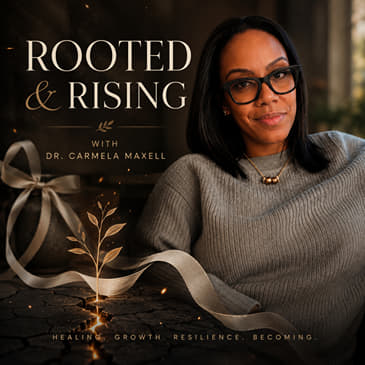
Dr. Carmela Maxell: I can't tell you how many times I've sat and pondered about people and situations where I did not get the closure I felt I deserved. I spent time and energy and resources on people who ultimately did not make the cut because they either prematurely cut ties without explanation or made impulsive decisions to end friendships, relationships, and connections based on some obscure thought process that I could never wrap my head around. And to make matters worse, I continue to hear stories from friends, family, clients, and just people I've conversed with about how this has been their experience, especially as of late. With the new era of dating, social media, and just a more isolating world that looks connected, more and more of us are dealing with a concept that can leave invisible scars with enormous and long-lasting impacts. Ghosting. Welcome back to Rooted in Rising. I'm Dr. Carmilla Maxwell. And I want to broach a subject that far too many of us have had to navigate. Have you ever had someone just disappear? No fight, no explanation, no closure. Maybe they stopped answering your texts. Maybe they unfollowed you. Maybe they slowly became harder and harder to reach until one day you realized they were gone. If you've ever experienced that, you know something interesting happens. The conversation keeps going. Not with them, with yourself. Did I do something? Were they upset? Should I have reached out one more time? What happened? Today I want to talk about why unanswered endings are often harder than painful ones. Because psychologically, our brains don't like unfinished stories. Our brains crave closure. One of the most frustrating things about being human is that our brains love certainty. We want beginnings, middles, endings. That's why movies resolve the story. Books have final chapters. Court cases end with verdicts. Graduations have ceremonies. Funerals have services. Human beings create rituals around endings because endings help us organize our experiences. Ghosting doesn't. Instead, it leaves us holding a question mark. Ghosting isn't always about cruelty. Let's clear something up. Sometimes people disappear because they simply don't care. But not always. Sometimes people disappear because they don't know how to stay. Conflict terrifies them. Disappointing someone feels unbearable. They've never learned how to say, I'm sorry. Or I don't think this relationship is working anymore. Or even I need space. Silence becomes easier than honesty. That doesn't make it healthy. It doesn't make it kind. But it can make it understandable. Avoidance feels good for about five minutes. Here's the tricky part. Avoidance works. At least temporarily. Imagine you have a difficult conversation waiting for you. You don't make the call. Immediately you feel relief. Your brain says, See, we solved the problem. Except You didn't. You postponed it. That relief teaches your brain something dangerous. It teaches avoidance keeps us safe. So next time, you avoid even sooner. Before long, you're not avoiding conversations. You're avoiding intimacy. Let's shift perspectives for a second. If you've been ghosted, please hear this. Your brain will desperately try to fill in the blanks, usually with self-criticism. I wasn't enough. I said something wrong. I should have been different. But here's the truth. When someone refuses communication, they're also refusing to give you accurate information. So your brain starts writing its own story. And unfortunately, our brains tend to make ourselves the villain. I've had my fair share of experiences and relationships and what I thought was the start of relationships that had an end before they even had beginnings. I remember one in particular that was a pretty long-term relationship that I spent countless hours and days on, thinking we were both in a growth mindset. You know the kind. The kind where you spend almost every waking moment connecting in some form of f or fashion. Texting throughout the day, talking about goals, blah, blah, blah. You think it's going somewhere. Maybe there were arguments, misunderstandings. But not enough in your head that you thought it was irreparable. And then suddenly, without notice, all communication ceases. And you scratch your head wondering what the hell happened, and perhaps situate yourself at the center of blame. Or maybe you applied for a job, interviewed for it. It all goes well. It seems promising. You wore your best outfit. You took the time to rehearse your responses to questions that you had no idea were even going to be asked. You showed up early. The room was warm, inviting, and you were left with a feeling that this could be it. The interviewers don't use the typical lines that HR blogs tell you mean that they are not interested. You send your follow-up thank you email. And then nada. You're left wondering if it was something you said or some credential you had or didn't have, or if you had too many credentials and they didn't want to pay you for being a rocket scientist. Hmm. Can I offer a different way to think about ghosting? Sometimes the person we've disappeared from is ourselves. We stop writing, we stop painting, stop exercising, stop singing, stop calling friends, stop applying for jobs, stop dreaming. We slowly disappear from our own lives, not because we don't care, but because somewhere along the way life became overwhelming. Sometimes the hardest relationship to connect with is the one we have with ourselves. So what if you never get closure? Here's the question everyone asks. How do I move on if they never explain? It's one of the hardest questions in psychology. Because closure isn't always something another person gives us. Sometimes it's something we build ourselves. Closure isn't agreement. It isn't understanding. It isn't getting the apology you deserved. Sometimes closure simply means saying, I may never know why, and choosing not to let that uncertainty control the rest of your story. So what we do instead? If you're the person who tends to disappear, ask yourself something. What conversation am I avoiding? Not because you're a bad person, because avoidance usually points towards fear. Fear of hurting someone, fear of disappointing someone, fear of rejection, fear of conflict. Fear isn't weakness. But letting fear make every decision eventually costs us relationships. And if you're the one who was left, remember this someone else's inability to communicate is not evidence that you were unworthy of communication. I'll leave you with this. Sometimes people leave because they stop loving us. Sometimes they leave because they don't know how to love themselves. Sometimes they leave because they're scared. Sometimes we simply never know. And as uncomfortable as uncertainty is, healing doesn't always require answers. Sometimes, healing begins the moment we stop waiting for someone else to finish the story and start writing the next chapter ourselves. Thank you so much for spending a little time with me today. If this episode spoke to you, share it with someone who might need to hear it. Until next time. Be gentle with yourself. Stay rooted in who you are and keep rising into who you're becoming.