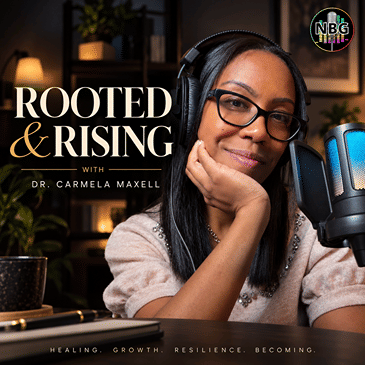
vulnerable: To Rooted in Rising. I'm Dr. Carmela Maxwell. Before we get started, make sure you're following or subscribe to Rooted in Rising wherever you're listening. And if today's episode resonates with you, share it with someone who might need to hear it. Now I've been seeing this trend floating around social media lately. It's kinda chic to it's kind of chic to mind your business. It's kind of chic to stay home. It's kinda chic to protect your peace. It's kinda chic to disappear for a while and come back unbothered. And listen, I love a good trend. Especially one that gives me permission to stay in my house, wear comfortable clothes, and not have to explain why I don't feel like going anywhere. But I've been thinking, what it's kind of chic to be vulnerable? Not performatively vulnerable? Not the Instagram version where you cry for 45 seconds, add a motivational quote, and suddenly everything is beautiful again. I'm talking about the ugly kind. The kind where you're sitting in your car after work, staring at absolutely nothing because you don't have the emotional capacity to go inside your own house yet. The kind where you get into bed at night and suddenly every thought you've been avoiding decides it's time for a fucking staff meeting. The kind where you're functioning. You're working. You're answering emails. You're taking care of everybody. You're smiling at pictures. You're accomplishing things. But emotionally, you don't know what the hell is going on. And maybe the scariest part is that you've gotten so good at functioning through pain that you don't always recognize when you're hurting anymore. So today, we're gonna do something a little different. I'm not gonna hide behind research, statistics, or psychological terminology. I'm gonna talk about me, which makes me a little uncomfortable, and I suppose is the entire point. Because today, it's kinda chic to be vulnerable. Part one When the strong person gets tired. I think one of the most exhausting things about being considered a strong person is that people eventually stop asking whether you're okay. Or maybe they ask, but they already assume they know the answer. Because you're always doing something. You've got a career, you've got children, you've got projects, you've got responsibilities, you've got goals. You've got seventeen things on your calendar, six deadlines coming up, and somehow you're still trying to figure out what everyone is eating for dinner. And from the outside, it looks impressive. It looks like discipline. It looks like ambition. It looks like you have your shit together. And sometimes you do. But sometimes that calendar is full because you cannot stand what happens when it becomes empty. I've had to confront that about myself. There have been periods of my life when I filled every available hour with something productive. Working, teaching, writing, recording, meetings, projects, planning the next thing. And don't misunderstand me. I genuinely love what I do. I'm proud of what I've built. I'm proud of what I've survived. But I've started asking myself a difficult question. Am I doing all these things because they bring me joy? Or am I sometimes doing them because slowing down would force me to acknowledge how much I'm hurting? Because there's a difference. And I think a lot of us confuse being busy with being okay. We confuse productivity with stability. We confuse exhaustion with accomplishment. And sometimes. We even confuse having no time to feel anything with having finally healed from something. I've done that. I've packed my schedule so tightly that there wasn't room for sadness to sit down. And then wondered why I felt so emotionally exhausted when I finally had a quiet moment. Here's the thing rest is not just an empty space on your calendar. And self-care isn't another appointment you're supposed to squeeze into an already overwhelming day. Sometimes rest means allowing yourself to feel something without immediately trying to fix it. Sometimes it means not turning your healing into another project with milestones, deliverables, and a fucking performance evaluation. And if you're anything like me, that is incredibly difficult. Because I know how to work through a problem. I know how to make a plan. I know how to get things done. But you cannot project manage your way out of every emotional wound. Believe me, I've tried. Part two, when someone makes you question yourself. I want to talk about heartbreak. And not just the kind where you miss somebody. I'm talking about the kind that changes how you see yourself. There was someone I trusted, someone I allowed into my life because I believed there was something genuine there. And I don't say that lightly. Trust is something I take very seriously. I've never been interested in being somebody's temporary entertainment, someone's convenient distraction, or someone's option when they're lonely. When I invest in a relationship, I invest sincerely. And I did. I trusted what I was being told. I trusted the connection I thought we were building. I trusted that the person presenting himself to me was the person he actually was. And I eventually had to confront the reality that I hadn't been given the honesty I deserved. There were things that didn't add up. There were moments that left me questioning what was real. And there were things I came to understand as manipulation. But here's what I haven't talked about enough. The hardest part wasn't just losing that relationship. It was what happened to my relationship with myself afterward. Because when you've trusted someone who hasn't been honest with you, sometimes you start questioning your own judgment. How did I not see it? Why did I believe that? Was I naive? Did I miss something obvious? How could I be so perceptive in so many areas of my life and still get this so wrong? And then the questions start becoming more personal. Am I not good enough? Am I asking for too much? Why does this keep happening? What is it about me? And that last question, that's the one that can do some serious damage. Because somewhere along the way, I allowed someone else's behavior to become evidence in a case I was building against myself. Let that sink in. I took another person's choices, their dishonesty, and the way they treated me. And somehow I turn those things into a reflection of my own worth. That's a terrible exchange. And yet so many of us do it. We take rejection and call ourselves unlovable. We take betrayal and call ourselves stupid. We take inconsistency and convince ourselves we're too needy. We take somebody else's inability or unwillingness to show up honestly and turn it into proof that we're asking for something unreasonable. And I had to start asking myself something different. Why was I holding myself responsible for another person's integrity? Why was I punishing myself for trusting? Why had I started believing that the safest version of me was the one who didn't need anybody? I wish I could tell you I worked through all of that and now I'm perfectly secure, completely healed, and immune to disappointment. That would be a lovely ending, wouldn't it? But it wouldn't be honest. The truth is, I'm still working through parts of it. Because when somebody has hurt you deeply, they can leave long before the fear does. And sometimes the next person isn't even doing anything wrong. They're just standing in front of a version of you that remembers what happened the last time you trusted someone. Suddenly you're evaluating everything a delayed text message, a change in tone. An unanswered question, a moment of uncertainty. You're trying to distinguish intuition from fear. You're wondering whether you're recognizing a familiar pattern or anticipating an injury that hasn't happened. And that's exhausting. Because you want to be open. You want to experience love. You want something genuine. But you're also afraid of being made to feel foolish again. I think one of the hardest parts of healing from betrayal is realizing that protecting yourself and closing yourself off are not the same thing. And sometimes we've gotten so good at protecting ourselves that we don't notice we've stopped allowing anything good to reach us. I'm still learning that distinction. Part three, when friendship becomes another kind of heartbreak. Now, romantic relationships aren't the only relationships that can break your heart. Sometimes friendship breakups hurt just as much. And sometimes they hurt in ways that are harder to explain. Because we have an entire cultural script for romantic heartbreak. We have breakup songs, we have romantic comedies. We have friends who come over with wine and tell us that man wasn't shit anyway. But where's the handbook for agrieving a friendship? Where's the breakup song for the person who knew your history, your insecurities, your fears, your family, your dreams? The person you thought would be a part of your life for years. I had a friendship that was deeply important to me. And over time, something changed. One of the things that made this s situation particularly difficult was the way the language of self care became intertwined with the deterioration of our relationship. Now, I want to be careful here. Because I believe in boundaries. I believe in people prioritizing their mental health. I believe in stepping away from relationships that are no longer healthy. I teach these things. But I also believe we've reached a point culturally where sometimes we use the language of healing to avoid having uncomfortable conversations. We call it protecting our peace. We call it choosing ourselves. We call it self-care. And sometimes that's exactly what it is. But sometimes, sometimes we're just avoiding accountability. Sometimes we're refusing to communicate. Sometimes we're treating emotional discomfort as evidence that another person doesn't belong in our life. And those things are not interchangeable. I experienced a friendship where our understanding of self care and what we owed each other as friends seemed to become increasingly different. And ultimately, the friendship did not survive. I can acknowledge that the other person may have experienced the situation differently. I can acknowledge that people have the right to make decisions about their relationships. But I can also acknowledge that the way things unfolded hurt me, that I felt abandoned in ways I didn't expect, and that losing someone I had trusted was painful. What's been especially difficult is that friendship heartbreak can make you question whether all the things you shared actually meant what you thought they did. Were we ever as close as I believed? Did this friendship matter as much to the other person as it did to me? Did I misunderstand the connection? And once again, there I was, taking a relationship's ending and examining myself as though I had defined the defect that explained it. But here's something I'm starting to understand. You can respect someone's boundaries without pretending their decisions didn't hurt you. You can support the concept of self-care without agreeing with every behavior someone justifies in its name. And you can grieve a friendship without needing to turn the other person into a villain. Sometimes you simply have to acknowledge that something meaningful ended, and that it mattered, and that you're sad. That's allowed too. Part four. Silence isn't always healing. Now here's where I need to call myself out. Because if you've listened to this podcast, you know I've talked about silence. I've talked about boundaries. I've talked about knowing when not to respond. And I still believe silence can be powerful. Sometimes the healthiest thing you can do is stop participating in a conversation that is hurting you. Sometimes there's nothing else to say. Sometimes silence really is a complete sentence. But I've learned something else. Silence can protect your peace, but it cannot always process your pain. And I had confused those two things. I thought that because I wasn't talking about certain certain experiences anymore, I must have been moving past them. I thought that because I wasn't crying about them. They must not hurt as much. I thought that because I could tell the story without falling apart, I had healed. But sometimes I wasn't healing. I was containing. I was compartmentalizing. I was putting experiences into neatly labeled boxes and stacking them somewhere in the back of my mind. And then I was going to work, teaching classes, writing books. recording podcast episodes, doing everything I was supposed to be doing, and wondering why I sometimes felt numb. The numbness is something I really want to talk about. Because when we talk about emotional pain, we often focus on sadness. We picture somebody crying, somebody lying in bed, somebody unable to get through the day. But pain doesn't always look like that. Sometimes pain looks like indifference. Sometimes it looks like exhaustion. Sometimes it looks like not being excited about things you know should make you happy. Sometimes it looks like having a wonderful day, getting into bed, and feeling absolutely nothing. Not happy, not sad, just disconnected. And for someone who is used to feeling things deeply, That can be unsettling. Because you start wondering where you went. Where's the part of me that used to get excited? Where's the person who believed good things were coming? Why does everything feel so muted? I started realizing that I'd spent so much time trying not to give certain experiences any more power over me that I hadn't fully acknowledged the impact they had already made. I didn't want to talk about certain people. I didn't want to revisit certain memories. I didn't want to keep explaining why I was hurt. And some of that was healthy. But some of it was avoidance. And there's a difference. Because not every experience needs to be revisited forever. Not every relationship deserves another conversation. Not everyone who hurts you deserves access to your healing. But you still deserve to process what happened, even when the relationship is over. Even when you're not speaking to the person anymore. Even when there's absolutely nothing left to resolve with them. I realized that I needed to let some of these experiences exist outside of my body. I needed to talk. Not necessarily to the people who hurt me, but to people I trusted. I needed to hear myself say what happened, to acknowledge what I had felt, to admit how much certain experiences had changed me. And sometimes I needed to stop trying to extract a lesson from everything. Because my God, can we please acknowledge that not every painful experience needs to become a beautiful fucking metaphor about personal growth? Sometimes something just hurt. Sometimes somebody disappointed you. Sometimes you lost something that mattered. Sometimes you were treated in a way you didn't deserve. You do not have to immediately transform that experience into wisdom. Sometimes you just need to be sad about it. And sometimes you need someone to sit with you while you are. Part five The person I was and the person I'm becoming. One of the strangest things about starting over is that you don't always recognize yourself in the process. I'm not the same person I was a year ago. And I'm certainly not the same person I was five years ago. Some of those things make me proud. I'm grown. I've accomplished things I once dreamed about. I've taken risks. I've built things from nothing. I've kept going through circumstances I genuinely wasn't sure I could navigate. But some of the changes make me sad. I'm more guarded in certain ways. I'm more cautious about who gets access to me. Sometimes I anticipate disappointment before I've even given something the opportunity to work out. And I don't necessarily like that. Because I don't want to become so afraid of being hurt that I stop being the person I actually am. I like being affectionate. I like being thoughtful. I like caring deeply. I like remembering the little things about people. I like believing in love. I like being the kind of person who can genuinely get excited about somebody. I don't want to lose those things. But I've been afraid that maybe those are the very qualities that make me vulnerable to being hurt. And lately, I've been challenging that idea. Because being loving is not a character flaw. Being trusting is not inherently naive. Having hope doesn't make you foolish. Wanting consistency, honesty, affection, and emotional safety doesn't make you demanding. It makes you human. And maybe the answer isn't to become harder. Maybe the answer is to become more discerning without becoming less open. Maybe I can trust people gradually instead of handing them every part of me all at once. Maybe I can pay attention to actions without constantly anticipating betrayal. Maybe I can recognize that some relationships will end without interpreting those endings as proof that I'm somehow deficient. And maybe I can accept that healing doesn't mean returning to who I was before. Because I'm not going backward. I'm learning how to move forward without abandoning the softer parts of myself. Part six, discernment is not the same as distance. And there's something else I've been thinking about lately. The difference between discernment and distance. Because I think sometimes when we've been heard enough, we start confusing the two. We tell ourselves we're being careful, we're protecting our hearts, we're making wiser decisions, we're not allowing people to get too close too quickly. And sometimes that's absolutely true. But other times, we're just scared. And I think we need to be honest enough with ourselves to recognize the difference. Because after you've experienced betrayal, disappointment, or heartbreak, there's something that can feel incredibly empowering about being emotionally guarded. You start telling yourself that nobody is ever going to make you feel that way again. You're not going to get too attached. You're not going to let your guard down. You're not going to believe everything somebody tells you. You're going to remain detached, keep your expectations low, and make sure that nobody has the opportunity to hurt you the way someone else did. And on the surface, that can look like maturity. It can look like you've learned your lesson. It can look like you've finally figured out how to protect your peace. But I've had to ask myself a pretty uncomfortable question. Am I being discerning? Or am I simply keeping everyone at a distance because distance feels safer? Because those are not the same thing. Discernment means paying attention. It means recognizing patterns. It means taking the time to understand someone's character instead of relying exclusively on chemistry, attraction, or what you hope a relationship can become. It means allowing trust to develop through consistency. It means asking questions when something doesn't make sense. It means being willing to acknowledge information that challenges what you want to believe. And sometimes, discernment means walking away. But distance? Distance can mean deciding that nobody gets an opportunity in the first place. It can mean assuming someone's going to disappoint you before they've done anything to suggest that they will. It can mean withholding affection because you're afraid it won't be reciprocated. It can mean pretending you don't care about something that actually matters a great deal to you. And sometimes it means convincing yourself that you don't need meaningful connection because needing someone feels like giving them power over you. And listen, I get it. I really do. But there's a certain comfort in believing that if you never fully open your heart, nobody can break it. If you don't get attached, you can't be abandoned. If you don't get excited, you can't be disappointed. If you don't express what you want, nobody can reject you. And if you never let somebody see the softer parts of yourself, they can't use those parts against you. But here's the problem with that reasoning. We cannot selectively eliminate the possibility of pain without also limiting our capacity to experience connection. You cannot build a meaningful relationship while refusing to participate in the very things that make relationships meaningful. Trust, emotional intimacy, honesty, affection, vulnerability. All of those things involve uncertainty. And uncertainty is uncomfortable, particularly when your previous experiences have taught you that people aren't always who they present themselves to be. But uncertainty is not automatically danger. And vulnerability is not automatically a mistake. Sometimes the very things we're afraid of are the things that create the opportunity for something wonderful to happen. I've been thinking about this in my own life. Because I don't want to spend the rest of my life anticipating disappointment. I don't want to meet someone and immediately begin loo looking for the exit. Part 7. Having faith when you don't have certainty. This brings me to something that's been particularly important to me lately. Faith. Not necessarily in the sense of having every answer. Not in the sense of believing that if I'm patient enough, the universe will eventually reward me with everything I've ever wanted. I don't believe life works that neatly. Good people get hurt. Good relationships end. Beautiful opportunities fall apart. Sometimes you do everything right and things still don't work out. That's life. But I don't want those realities to make me cynical. I don't want to live as though disappointment is inevitable and joy is something I have to prepare to lose. And I definitely don't want to continue punishing future versions of myself for what happened to past versions of me. So I'm trying to have faith. Faith that I can make good decisions even when I don't know how something will turn out. Faith that I can survive disappointment without being consumed by it. Faith that I can be loved without having to perform, achieve, prove, or convince. Faith that I can build a life that feels fulfilling, not simply one that looks impressive from the outside. And faith that there are still good people in this world. People who mean what they say. People who understand that trust is not something you demand from someone. It's something you build with them. People who can have uncomfortable conversations. People who understand that love, friendship, and connection require more than good intentions. They require consistency. They require accountability. They require showing up. And sometimes I have to remind myself that my experiences with a few people are not evidence of what I should expect from everyone. That's hard. Especially when you're scared. Especially when you're beginning to feel something again. Especially when you can sense yourself becoming attached and a little voice in the back of your head starts reminding you of everything that went wrong before. But being afraid doesn't automatically mean something is wrong. Sometimes it means something matters to you. And the challenge is learning how to honor that fear without allowing it to make every decision. I'm working on that. Not perfectly, not gracefully every day, but sincerely. And I think that's worth something. So let's go back to that social media trend. It's kinda chic to you know what? It's chic to admit that your feelings are hurt. It's chic to say that you miss someone without interpreting that feeling as a reason to return to them. It's chic to acknowledge that a friendship ending broke your heart. It's chic to admit that you don't have to have everything figured out. It's kinda chic to cancel something because you're exhausted. It's kinda chic to have an empty Saturday and not immediately fill it with errands, appointments, projects, and obligations. It's chic to stop pretending that you're unbothered when you're very fucking bothered. It's chic to tell somebody you care about them. It's chic to say, that hurt me. It's kinda chic to admit, I'm scared. And it's kinda chic to acknowledge that despite everything you've been through. There's still a part of you that wants to believe things can turn out beautifully. Because I've been thinking about something. We live in a culture that seems obsessed with appearing unaffected. Don't double-text. Don't care too much. Don't let them know you're hurt. Disappear. Detach. Match their energy. Act like you don't give a damn. And look. There are circumstances where disengaging is absolutely the right thing to do. But I don't want to confuse emotional maturity with emotional detachment. And I don't want to spend the rest of my life pretending that being indifferent is somehow more sophisticated than being sincere. I care. I care deeply. I get my feelings hurt. I overthink sometimes. I miss people. I have moments of insecurity. I get lonely. I get exhausted. I want to be loved. I want to be understood. I want people in my life who choose me as deliberately as I choose them. And I don't think any of that is embarrassing. Actually, I think it's beautiful. And I'm tired of treating my humanity like something I need to apologize for. So if you've been listening today and recognizing yourself in any of this, I want you to consider something. What have you been carrying that you've convinced yourself you've already put down? What have you refused to talk about because you thought talking about it would mean you hadn't moved on? What relationships have changed the way you see yourself? And perhaps more importantly, who would you be if you stopped treating other people's failures as evidence of your own inadequacy? I don't have a neat conclusion for everything I've shared today. Some things I'm still grieving, some things I'm still making sense of. Some things I'm still learning to trust myself through. And some days I'm much better at this than others. But I'm beginning to realize that I don't need to arrive at some perfectly healed version of myself before I can enjoy my life again. I can be a work in progress and still be worthy of love. I can have unresolved feelings and still experience joy. I can be cautious and still remain open. I can be tired and still have dreams. And I can have been hurt without allowing hurt to become the defining characteristic of who I am. Because the people who hurt me don't get to write the rest of my story. Neither do the friendships that ended. Neither do the relationships that didn't become what I hoped they would. And neither does the fear that sometimes follows me into new chapters. I do. And I still believe there's something beautiful ahead. I don't know exactly what it looks like. I don't know who will be a part of it, and I definitely don't know how long it will take. But for the first time in a while, I'm trying not to demand certainty before giving myself permission to hope. Maybe things will work out differently than I imagined. Maybe I'll discover that some of what I thought I needed was actually never meant for me. Maybe I'll get hurt again. That's possible. But maybe I'll be happy in ways I hadn't even considered yet. And I'd really like to leave room for that possibility. Don't let the people who mishandled your vulnerability convince you that vulnerability itself was the mistake. You weren't wrong for wanting connection. You weren't wrong for believing someone. You weren't wrong for caring about a friendship. And you don't have to become emotionally unavailable to prove you've learned something. You can develop boundaries and still have a soft heart. You can know your worth and still have moments when you question it. You can choose yourself without pretending you never wanted someone else to choose you too. And you can keep the faith, even when you're still figuring out what healing looks like. Maybe that's the most vulnerable thing of all. Continuing to believe in something good when life has given you plenty of reasons to be afraid. So yeah, it's kinda chic to be vulnerable. It's chic to be human. And it's definitely chic to stop acting like you have to get your shit together every single day. Thank you for allowing me to share a little more of myself with you today. If this episode resonated with you, I'd really love for you to share it with someone who needs permission to stop pretending they're okay. And if you feel comfortable, tell me. What is something you've been carrying that you're finally ready to put into words? Until next time, stay rooted in who you are. Keep rising until you hear becoming. And remember, Being vulnerable doesn't make you weak. It means you're still willing to live with your heart open. Take care.