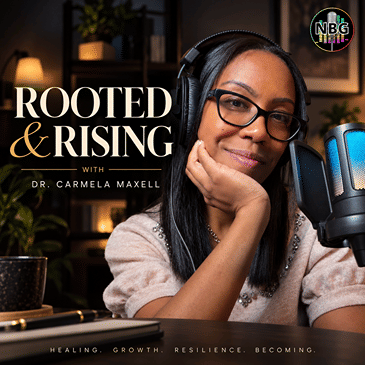
Dr. Carmela Maxell: Welcome back to another episode of Rooted in Rising with Dr. Carmela Maxwell. Today we are having a conversation about what it means to be black and a black woman in America. Beauty, the challenges, the expectations, the sacrifices, and the joy. Black women are so often celebrated for their strength. Sometimes that celebration comes at the expense of recognizing our humanity. We are mothers, daughters, sisters, friends, professionals, partners, and so much more. But before any of those titles, we are women who deserve to be seen, heard, valued, and loved. And today I have two of my most wonderful friends joining me for this conversation: the lovely Kristen Matthews and the lovely Chloe Simone. To rooted and rising, ladies.
Chloe Simone: Thank you for having
Kristen: Thank you.
Chloe Simone: us.
Dr. Carmela Maxell: Yes, yes. Well, Kristen, we'll start with you. Tell us a little bit about yourself, where you're hailing from, your background, what you do.
Kristen: Well let's see, first I'm a beautiful mellow skin woman. But my name is Kristen
Chloe Simone: Yes.
Kristen: Matthews. My name is Kristen Matthews and I'm a mother, I'm a woman, I'm a friend, I'm a sister, I'm a sorrow, and I'm a certified choice resolution life coach. I'm passionate about working with individuals for personal growth, self awareness, also making sure that they have the power that they need to make intentional choices in their life. my my focus is encouraging them and others or anybody where you want to be able to have clarity when you're making these decisions and you're, you know, because we get so overwhelmed and life is life thing for everyone right now. It is to support individuals in everything that they do. And I am from or well, I'm from many places, but I'm currently in Las Vegas, Nevada. in the Sin City. So my disclaimer,
Chloe Simone: Mm.
Kristen: I am an Oakland Raider fan, not Las Vegas Raiders. Just letting it be known. Let's get it correct. It is Oakland. You're not a true Raider fan.
Dr. Carmela Maxell: my god, okay.
Chloe Simone: Hehehehe
Kristen: It is not Oakland. So that's
Dr. Carmela Maxell: Here we go.
Kristen: a little bit about me. It's a little bit about me. I'm also a mother and every day just living life to the fullest.
Dr. Carmela Maxell: Yes, yes. Thank you for being
Chloe Simone: Love that.
Dr. Carmela Maxell: we'll we'll talk about this Raiders stuff. Sorry, Raiders Nation.
Kristen: Hey, kickoff is coming very shortly, like, I'm just saying.
Chloe Simone: she's trying to start some fights before the show even starts.
Dr. Carmela Maxell: a moment tell us where you're hailing from, a little bit about your background, what you do.
Chloe Simone: Well, I am Chloe Simone. I hail from Georgia. Everybody that
Dr. Carmela Maxell: Yeah.
Chloe Simone: knows me knows that that good good old southern hospitality is gonna show up one way or another. And it's usually with food. If I'm if I'm around you, I'm gonna feed you. So if you need a little extra extra packing, we we got you. We got you.
Dr. Carmela Maxell: Get you a plane.
Chloe Simone: I'm telling you, I'm aspiring to be the big mama in my family. But like I'm not I'm not I'm gonna be a little, you know, a little bit different shape than what we might be used to with that. a little bit about me. my gosh. I am literally just becoming myself and finding out everything that I love about myself, revisiting all the things that I thought I knew and just going for it, which is why I like even my name even on social media now is completely Simone. It is just about me understanding all the wonderful contradictions and symmetry that make up Simone. So I am a mom, but I am also out here in the street with y'all. Like I'm in my dream. I'm an author, I'm a poet, I have my consulting agency now. Yay. And literally I
Kristen: Right.
Chloe Simone: just want to help people who are visionaries become themselves and take their visions into a reality across any platform that you can imagine.
Dr. Carmela Maxell: Yes. Well, all of you guys know
Kristen: Mm-hmm.
Dr. Carmela Maxell: about currently in, the great state of Washington, Pacific Northwest, Seahawks fan. One, yep. Mohawks. Michigan,
Chloe Simone: Hehehehehe
Dr. Carmela Maxell: raised in Jersey, now here in the y on the left coast. And I love conversations like this that bring women from just across the way together. for
Kristen: Yeah.
Dr. Carmela Maxell: those of you in the audience who, you know, the friendship stumbled between us and I just love the commitment. I just love the the womanhood, the the vulnerability, lots that we have. And so we're bringing our lively selves to be used to just give this a very transmerically, emotional, very empowering conversation. so here we go. This you know, this question is for all of us. whoever w would like to go, when did you first recognize that the world might treat you differently because you were Black girl.
Kristen: Hmm, good question.
Chloe Simone: Think I was ever unaware that it was that we were going to be treated differently. like I said, we were raised in the South. there's a lot of ways we're very advanced, and there's some ways that we still have a little bit of growing to do. And there was a clear separation in just basic nuances, basic dialects, you know, basic food. And, you know, there were certain areas that we knew that we came together in, but there were certain areas that was very clear that you just kind of saw that. the people that looked the most alike tend to stay together. but then also
Kristen: Mm-hmm.
Chloe Simone: I was raised by my grandmother and I was blessed to see my great grandparents still alive for a little while before they transitioned and they grew up with stories and they gave us warnings like they gave their children and their grandchildren warnings. So I I was not afforded the ability to be unaware that, hey, there's a clear difference between you and maybe someone else.
Kristen: I I have to agree. gr growing up in South Carolina and Narla, just being in those places, you you didn't have the opportunity to not be unaware because even I mean, in my age I'm a lot older than I look, but I was still in South Carolina and when it was still segregated. We could not go into stores if you were black. my mother actually has a newspaper article where we were the first black people to enter a store that
Chloe Simone: Hmm.
Kristen: chose to no longer be segregated. And they had a newspaper article
Chloe Simone: Yeah.
Kristen: and everything. And so to grow up in that and see that in kids now they see racism, but they don't see what we experienced during that time. And for individuals of color, when we first wake up in the morning before we even get out of bed, our minds are racing about how our day's gonna go and what are we going to do to stay safe. So I don't think there was ever
Chloe Simone: Mm.
Kristen: a time really for me to not be unaware.
Dr. Carmela Maxell: Yeah. I think I said with the two of you with a little bit of a twist, growing up in the north,
Chloe Simone: Mm-hmm.
Dr. Carmela Maxell: you know, the I think the temperature is a little different.
Chloe Simone: Mm-hmm.
Dr. Carmela Maxell: there and and particularly on the east coast, there were a lot of different backgrounds, right? I grew up with folks who were Irish and were Jewish and
Kristen: Mm-hmm.
Dr. Carmela Maxell: Spanish backgrounds and there were a lot of people from different countries, like Diana.
Chloe Simone: A lot of diversity.
Dr. Carmela Maxell: A lot of diversity and yet there was still this sense of siloing, right? And
Kristen: Okay.
Dr. Carmela Maxell: and for me, I I put it out there, I'm I am black and Filipino, so coming from two collectivistic backgrounds, I think I struggled with my blackness or you know, just this idea that I'm mixed because I guess I was also mix right it was
Chloe Simone: Mm.
Dr. Carmela Maxell: people would look at me very differently so there was an I guess there was a an acknowledgement that something was different awareness came in waves for me because I saw people that looked like me and there were people that were treated with there was some equitability there and at the same time just this pulse right this feeling that you were different and I think I saw it in school I saw it in school I definitely saw it in interactions with people who were not who didn't look like me. my mother is an immigrant, so speaking a very a different language was also I got a lot of questions, Well do you speak that too? And do you what kind of foods do you eat? Things that I would wear. but there was always this this sort of policing, right? My parents were always like you gotta be careful because you're you're you're black presenting, so they'll look at you
Chloe Simone: Mm. Okay.
Dr. Carmela Maxell: differently. And I think I carried that. my dad is from Georgia and so there's a lot of those, those those southern etiqu southern etiquette and and
Chloe Simone: Yeah. Yes.
Kristen: Yeah.
Dr. Carmela Maxell: And my mother being an immigrant, there's there's a lot of that, just that home you take care of everybody, which people were so fiercely independent. And I think it was it was interesting. It was interesting. 'cause it's like I I always knew I was black and then there were times where people would say, But yeah, but that's not what we're judging you based on. But you knew. you
Kristen: Yeah.
Dr. Carmela Maxell: Yeah, you knew different.
Chloe Simone: that's that's such an interesting dynamic because especially when you're a kid when you're so young you know people tend to try to force you to fit in a group you can't really be an outlier too long without having some discomfort with it and what we noticed growing up with children that were biracial specifically it was almost as if they were sometimes forced to be black and forced to identify to be black. And then I saw a lot of internal conflict as they got older to say, but hey, but my dad's white or my mom's Hispanic or something. And it it was very unsettling and kinda traumatizing for them to be
Dr. Carmela Maxell: yeah.
Chloe Simone: grouped in in the community that they didn't necessarily feel like fully represented themselves. Was that similar to you? Like were you kind of forced to mhm. Yeah.
Dr. Carmela Maxell: But think, you I struggled with identity for for so long. and even now I still have those those tidbits where you know there are people that was kinda mutter under their breath, Yeah, I mean you're blackish And you know now I I I kinda chuckle at it because I know it I know what you mean and people don't realize there's a lot of deep deep seated, deep rooted I think there's hatred. you know,
Chloe Simone: Mm.
Kristen: Yeah.
Dr. Carmela Maxell: think back to like the loving versus Virginia case, right?
Chloe Simone: Yeah, yeah.
Kristen: Mm.
Dr. Carmela Maxell: was not that was what was that? Right after I mean civil rights. So it's not
Chloe Simone: Yeah.
Dr. Carmela Maxell: like this was that long ago where I wouldn't even say it was necessarily accepted. Now we just start to see more folks that look like me. but it for the longest time it's been like the black or white experience. It's been this or
Chloe Simone: Right.
Dr. Carmela Maxell: that. And I think even as just black women, right, it's we are forced into
Kristen: Yeah.
Dr. Carmela Maxell: from how we wear our hair to the clothes that we we we wear, the brands that we choose and the foods
Chloe Simone: Yeah.
Dr. Carmela Maxell: we eat. There's always this Yeah, you're black, you look black, and some of your mannerisms don't quite fit black culture. And it's just it's very interesting. But you're not black. You're black but you're not
Kristen: you're not black. You you lose that black card. Yeah.
Chloe Simone: Yeah. Yeah. Yeah.
Kristen: Yeah.
Chloe Simone: you gotta you have to so did you feel like you had to constantly prove you were black enough?
Dr. Carmela Maxell: Always. Always. Always, always, always, always. Which made it rough, right? Made it rough. I think, you know, there's a lot more security now. but it's something I grapple with. It's something I grapple with. because there are still people that are not as accepting. Not accepting of my blackness, not accepting of me being Filipino, or the fact that sometimes yeah, you know, I like to eat lumpiet egg rolls and I also like to have Call agree. It's like, sometimes both of those things sound good at the same time. It's like, it doesn't make me any less, but I think people's perceptions of just our experience
Kristen: Mm-hmm.
Dr. Carmela Maxell: is just so interesting. So interesting. You know.
Chloe Simone: think that's very interesting and I I don't wanna stay on this too long just because for me being so yellow as I've been told so many times Yes.
Kristen: Red Bull.
Dr. Carmela Maxell: Has no right.
Chloe Simone: so my aesthetic, people were assuming I was biracial more so than saying that I was black. And so I would have I had it a little bit of resentment growing up of saying like hold on, hold on. Don't I I'm not saying there's anything wrong with being something different, but don't try to make me something that I'm not. And then they started trying
Kristen: Yeah.
Chloe Simone: to group me in a different category and to a certain extent they wanted me to almost perform black in a way
Dr. Carmela Maxell: Mm-hmm.
Chloe Simone: that I thought was highly offensive. Mm-hmm. Mm-hmm. Mm-hmm.
Dr. Carmela Maxell: Right, right. you're especially I think being light skinned, like all of us, right? Light skinned, black, we we may we must not experience some of the same struggles.
Chloe Simone: Wha well I was told that I was different than even the traditional light skinned black woman. Yeah, so
Dr. Carmela Maxell: Hmm. Ooh, tell more about
Chloe Simone: yeah. No, seriously, I d I literally they would say no, the the light skinned the traditional light skinned woman is the red bone or your yellow or your
Kristen: Yeah.
Chloe Simone: hair is this or your eyes are this or you know, so more so I I think people didn't mean it to be offensive, but the most confirmation I got is I was wondering what you were mixed with, and then you opened your mouth and then
Dr. Carmela Maxell: yeah.
Chloe Simone: we knew you were a black woman. And
Kristen: yeah.
Chloe Simone: they definitely got a lot more of whatever they were trying to get as a response to that. But I I asked that because it was such a different reality to me because with you, you would have to merge your identities together. You're a sum of different things. And then for me, it was
Kristen: Yeah.
Chloe Simone: always very clear and I was raised and I knew myself to be a black woman. So even regardless of how I was presenting, I knew myself. So I that's why I thought your experience was really like eye opening for me to hear. So thanks for sharing that.
Dr. Carmela Maxell: Yeah. It's interesting when we actually sit down and and talk, right?
Kristen: Mm.
Chloe Simone: Yeah. Mm-hmm.
Dr. Carmela Maxell: I don't know, Kristen, have you experienced anything like this? 'Cause I know I I don't even know what we would call a typical black woman. I think it's Yeah.
Chloe Simone: Right.
Kristen: W there's just so many so many colors. we are ebony skinned women and we come in all shades. Soft, light, dark, cream. We we come with so many. for me experiences actually I don't know. My experiences are different. Of course I look black, but I also will get foreigners arguing with me, telling me I'm Ethiopian. And I'm I mm no, I'm American. I'm I'm I'm Native American and Jamaican, but I'm not Ethiopian. And so I would get
Chloe Simone: Mm-hmm.
Kristen: that where individuals would say, You are you sure you're not Ethiopian? Are you sure you're not from your your culture? I said, No, I'm not Ethiopian.
Dr. Carmela Maxell: Come on.
Kristen: last time I checked, no. So, you you get that too. And so when Chloe talks about she's having to she's being put into a box of the category and then you Carmelo, you're having to decide which category you fall into because you look this way but you might not act that way. You you you might have a black card, but they're not sure, but you gotta prove yourself. And so for me it was like, okay, well, I'm proving trying to prove that I'm not what you say I am. So ever everybody's
Chloe Simone: Right.
Dr. Carmela Maxell: Right, right. Right.
Kristen: had their different different aspects. And and being growing
Chloe Simone: Yeah.
Kristen: up military, what I did love about growing up military
Chloe Simone: Mm.
Kristen: is I had the opportunity to be in a group, especially in high school. Our group was of all ethnicities. All the girls we hung out with, we didn't hang out with one just one race. So to be able to be
Chloe Simone: Yeah.
Kristen: in that diversity, be in those different personalities, backgrounds, cultures, generations, it was nice for me. And so I just saw myself as a human being. I didn't see myself as being black
Chloe Simone: Yeah.
Kristen: because I was a in a group of women of all shades and ethnicities and we didn't we didn't care about race. And so it was it was a little
Dr. Carmela Maxell: Yeah.
Kristen: different.
Dr. Carmela Maxell: Yeah. Gosh, it's it's it's so
Chloe Simone: Yeah.
Dr. Carmela Maxell: eye opening and it's lovely to hear just all of our experiences and I
Chloe Simone: Yeah.
Dr. Carmela Maxell: think if for you know, for anyone that's listening to this episode, I think the the the big point is whatever it is that you're experiencing, you're not alone. And
Kristen: Mm.
Chloe Simone: Yes.
Dr. Carmela Maxell: if if you if there are some disparities in what I don't even know what the norm, you know, would be,
Chloe Simone: Yeah.
Dr. Carmela Maxell: but we're here. We're here to validate And verify we're all going through different things. We've all had different upbrings,
Chloe Simone: Yeah.
Dr. Carmela Maxell: with
Chloe Simone: Absolutely.
Dr. Carmela Maxell: with all of that. Let's talk about just the the one thing that I think is the undisputed stereotype, and I don't mean that we that we we can't cancel this one out, but why is confidence in black women sometimes interpreted or many times interpreted as aggression?
Kristen: Because it's intimidation.
Dr. Carmela Maxell: Mm.
Kristen: It's an intimidation. When black women are confident because we are in society not to be confident, we're supposed to be less than, we don't have power, whatever it may be. When we walk in confidence, it becomes an inner intimidation because if you really look and and this is just my observation, but if you really look at other ethnicities, what are things, including in culture, you see it in TV, you see it in movies, you see it in music. What is it that they mimic of the black woman? Plus the black woman is considered to be the strongest out of the women races when it comes to having it all, handling it all, doing it all, surviving it all. And so
Chloe Simone: Mm-hmm.
Kristen: individuals envy that. Sometimes they they want to look up to that or they want to be like that. They want to feel like that. I mean it's so much so that women can to get to a woman of colors skin tone. You know, whether it it's Chloe's skin tone where they're a little bit darker, whether it's my skin tone. I know someone who actually tans to get as dark as me. And I'm just like, okay. And and it's it's
Chloe Simone: What?
Kristen: it's an intimidation, just says that Lord forgive me, I forget her name right now, but she went through life saying that she was a black woman and she was a professional. She went through the whole history of of I did this and that and not once was she ever black. And her story came out,
Chloe Simone: Rachel Dovazal?
Dr. Carmela Maxell: I was gonna say that's very Yeah, I was like that's over here.
Kristen: Yeah. Yeah. Yeah. And her story came out me it was like years later and I was like, okay, how
Chloe Simone: Yeah.
Kristen: is this okay? And then you you deal with you deal with the the blackface, the Halloween stuff, whatever it may be. It's just black women are strong. Black women carry a lot, they can handle a lot. A lot of that comes back From slavery, of having to do that when your family's being taken from you and you were separated and you're going through all the things that you go through, being whether you're a house slave or you're a a field slave, whatever it may be, it's just intimidation and it's qualities that we have that other people wish they have.
Dr. Carmela Maxell: Yeah, yeah. I agree. I think our strength, I think we're we're strong to begin with. I
Kristen: Okay.
Dr. Carmela Maxell: I think that much of that is also rooted in faith. which, you know, for many people that don't know, you know, Christianity was not something that black people brought here. That was something that had to get indoctrinated into through, you know, through slavery and and the divisiveness here. Yeah, it's something I think that we we clung to and and my thoughts about strength are, in order to know strength you have to know what it is to be in the pit as well. And I think many of us we've had to carry our families, you know, as black women. we've had to there there are things that made us step outside of what we thought we could do. We we've had to rely so much on faith and community and and just
Kristen: Mm-hmm.
Dr. Carmela Maxell: own inner that you know inner desire and motivation to kind of persevere through through things and so I agree I think
Kristen: Yeah.
Dr. Carmela Maxell: too you know black women have our our cultures are so beautiful, right? 'Cause there's such a diversity when it comes to black culture. And even black culture here in America is, you Coley's talking about the both of you w with with the southern roots. And I have southern ties just because, my father and then, people in my family, but food and how we gather to how we dance, how we comfort and support one another, there's there's there's a beauty there. and
Kristen: Yeah.
Dr. Carmela Maxell: not to say that this negates, you know, other re other ethnicities and backgrounds, but th there's something about our own preservation that I I think is just I don't know, it's magnificent.
Chloe Simone: Absolutely.
Kristen: Yeah.
Chloe Simone: Yeah, that was you guys both touched on the majority of what I was gonna say. the main answer that I have is that we are powerful. we are, you know, I go back to the mitochondria Eve, you know, a lot of life and a lot of genetics and everything that you see can come from a black woman. We're capable of producing anything. We
Kristen: Yeah.
Chloe Simone: are capable of like being spiritually gifted in different ways. We are capable of maintaining and for some reason we adapted the role of of holding families together in different ways and then people began to trust in that role and then then we
Kristen: Yeah.
Chloe Simone: are required to perform that role which which like you both hinted to, we have to defend that role. We have to protect that role. And there may be some some power that's coming out that everybody doesn't know how to handle. It's not necessarily intended to even be aggressive, but it just might be powerful. But I will say this too, what I've noticed when we talk about people who are are confident. we run into a lot of people that are appearing and seeming to be confident because they're really masking something that they themselves lack. And I imagine that if you then encounter a person who is confident but them themselves actually embody what they're proud about, it might come
Kristen: Mm-hmm.
Dr. Carmela Maxell: lot of muchness. I know, I've that's definitely been an experience at night,
Chloe Simone: Mm.
Dr. Carmela Maxell: this and it's a it's a it's a huge conflict, right? I think especially if you don't have those supports or if you're not quite sure of yourself,
Chloe Simone: Mm-hmm.
Dr. Carmela Maxell: you can be made to feel small or or feel as if you have to silence that confidence or that that you know, I I've got you've got a big ego. I'm like, Woo ego. It's I I I know what my skill set is. I know what I'm good at. And if you were to do that as a as a as a as a man, as a you know
Chloe Simone: Mm-hmm.
Dr. Carmela Maxell: white woman, which white man black man. You know, if if you were to do that, people would not battle ash. But as a black
Kristen: Yeah.
Dr. Carmela Maxell: woman if like there's I've been I've been I've definitely been told you you are a lot. You're doing too much. I don't know what to tell you at this point. Make it a movie.
Chloe Simone: I'm definitely team too much. I'm definitely on that team.
Dr. Carmela Maxell: Right, right. Until you need me or something. And then
Chloe Simone: Until you need me. Can we just end the show right there? Yeah.
Dr. Carmela Maxell: It got touched a source, but just hit a source.
Kristen: Until you need me. Wait, wait, wait. Until I need you. How about that?
Dr. Carmela Maxell: Whoa
Kristen: What happens there? Well it's everything is great
Chloe Simone: Oof.
Kristen: and you're doing amazing until I need you and mm well where you disappear too.
Chloe Simone: No not where you disappeared.
Kristen: Yeah.
Chloe Simone: Yeah. But I mean and I I still I feel like we can't have that discussion without also referencing how we talk about frequently black women will be unprotected in ways that other people have a different kind of support. So there are some ways where we're we're interpreted as being aggressive and we're not. We're just powerful. But there are some ways that you can interpret aggression because it's aggression. Because we have to stand up
Kristen: Yeah.
Chloe Simone: for ourselves, we have to defend ourselves, we have to protect ourselves. We're That there's no one else but us to stand up for us. So sometimes we have to show up in those spaces or we can't exist in those spaces.
Dr. Carmela Maxell: Yeah. That
Kristen: Exactly. Yeah.
Dr. Carmela Maxell: just right in the heart because I mean that that leads to sort of the next thing I'd wanted to touch on. Where we have to navigate predominantly white spaces. And or and I usually and we are called to be both directly and inadvertently representation for like the whole community.
Kristen: Yeah.
Dr. Carmela Maxell: Tired. I'm tired. Exhausted.
Chloe Simone: Yeah.
Dr. Carmela Maxell: I'm exhausted. I've I've gotten well, you know, Carmela, you're black. I'm like, ooh, hey, now, hey.
Kristen: wait, you started it out like that? Okay.
Dr. Carmela Maxell: That's political. I
Kristen: Noted statement.
Dr. Carmela Maxell: didn't you know what? I didn't even clock up.
Chloe Simone: I I love how you're clearly black now when it's convenient, but okay.
Dr. Carmela Maxell: It's
Chloe Simone: We will we won't go there. Let's let's continue.
Dr. Carmela Maxell: Yeah. Yeah. but I think those pressures, you know, and I will say being in the north, I have had to kn navigate many and predominantly white spaces. I went to predominantly white institutions, you know, for schools and I don't think that there's you know, necessarily anything wrong with that. you know, I got challenged for not going to HBCUs and it's like, you know There were things that I really liked about certain universities and I don't think that the every little thing that I do strips me of of my blackness. that's completely different conversation. But navigating particular
Kristen: It doesn't have to be afraid.
Dr. Carmela Maxell: ways. Yeah, it doesn't have to be Afrocentric, right? I think that's something that we need to talk about.
Kristen: Everything. Yeah.
Dr. Carmela Maxell: Yeah, you know, but that's that's rough. That's been rough, especially when you look around and you don't see anybody that looks like you and then people
Chloe Simone: Yeah.
Dr. Carmela Maxell: You're like the culture vote, right? So hey
Chloe Simone: Ha ha ha.
Dr. Carmela Maxell: So, you know, could you show me how to do that dance? I'm like, I too cannot do that
Chloe Simone: He
Dr. Carmela Maxell: What's gonna do with that? I I can't I can't it's just not in my spill.
Chloe Simone: Right. I I kinda love that you think that I automatically can though. I love how there's the assumption that there's this black toolkit that we get at birth and we automatically all have an understanding of all of our wonderful talents.
Dr. Carmela Maxell: Yeah. We just look at each other and we're like Yeah.
Kristen: Yeah. Yeah you you
Chloe Simone: Yeah. Right. Right. Now there's there's some ways we do that though. Yeah.
Dr. Carmela Maxell: Yep, yep, yeah.
Kristen: Well that's the that's those when you see somebody and we ignore each other, we get a little nod or you get that that look, Yeah, we we got that
Chloe Simone: Yeah.
Kristen: conversation. But that's something that's that
Chloe Simone: Right.
Kristen: comes subconsciously. You don't even have to even see that and it's just built in you. That is embraided in you.
Dr. Carmela Maxell: Yeah. I agree.
Chloe Simone: Yes. I love it.
Dr. Carmela Maxell: I agree. Yeah. But what has your experience been? I mean, when you have been in spaces I mean it doesn't necessarily have to be predominantly white spaces, but when you have been tokenized. I see a storm
Kristen: Well yeah.
Dr. Carmela Maxell: for me. Gee, let me get out of the frame.
Chloe Simone: Hehehehe
Kristen: long time going to school and being the only black person in my class for many, many schools and many years of lifetimes, even in college, in your life. Okay, well we just gonna make it work. And so you being tokenized and people are looking at you and they wanna come talk to you, they wanna touch your hair and it's so pretty. please don't touch me, among other things. And or they wanna be your friend because there's a motive behind it, you know, though those those things that happen because of being a person of color. It's like Where's the generosity in people? Where are the those with real hearts and and so forth and so to be tokenized and to be put in a specific space and that even even when you're tokenized, you're still categorized, you're still you still have a glass ceiling, you're still limited on things that you can do and say even when you're like the center of attention.
Chloe Simone: I think this this is your platform. I'm gonna be I'm gonna be conscious of your audience.
Dr. Carmela Maxell: You what you do what you do, you do it.
Kristen: Just come on with it.
Chloe Simone: So I I think I'm I am I am a full blooded Gemini. I don't pretend that I'm not and I I feel like those spaces are when the other Gemini
Dr. Carmela Maxell: Capia
Chloe Simone: comes out because like play with it if you want to. Like I don't like to play those kind of games. So like in if you try to tokenize me, then now I'm more black than ever. I didn't know I was that black this morning. I don't know. Let's see where we are today. But no, it it reminds because listen, and I I say this with love, but Audacity is so cheap. It is so cheap. I I'll tell you when
Kristen: Very nice of
Chloe Simone: I was I remember I was at a job one day and there was a Caucasian woman who walked up to me and we were having a conversation about work and a lovely African American woman black by with all her flair and style. And then the Caucasian woman tried to talk to me and tried to see how I feel about, you know, why it was like so much or so, you know, this and and I just kinda gave her a look. 'Cause I like I just wanted to give you a chance to I wanna make sure you know what you just said. Maybe I didn't hear it right. And then she looked at me in shock as being offended. And she I said, let me clarify first. Do you know I'm black? Because maybe you don't. Let me let me just make sure. I don't know how I look to you. And
Kristen: You passing, you're passing, that's why.
Chloe Simone: and I and I love we have these kind of experiences. She told me, she was like, no, of course I know that you're black. She's like, but but you're mixed, you're something else too. Like you're white too, right? So you understand.
Dr. Carmela Maxell: Can we go again? no. I'm tired for you, babe. I'm tired for
Chloe Simone: I get so
Dr. Carmela Maxell: you.
Chloe Simone: so we had a few words. We never had that kind of conversation ever again. I don't think me and her were ever alone in a situation ever again. But
Kristen: Ever yet.
Chloe Simone: yeah. But no. No, listen, I if I'll I'll give you what you came here to get. You want me to be the talking black person, you want me to represent us, I'm gonna show up to us to the fullest, which means I'm gonna have our best interest in in my conversation that I have with you. So if you wanna ask me what black people would think about this, I'm gonna tell you what I feel. That's offensive, that's inconsiderate, that's inappropriate, that's tone deaf. I'm not even sure why you think that that's okay. That lacks enough flavor to even try. Like why are we doing this? So just be prepared. If however you want me to show up, that's how I can absolutely show up. And I've
Kristen: Yeah.
Chloe Simone: learned to I learned to love being in those spaces. I love some of the responsibility of being the only black person in the room. I hated being in advanced classes growing up and often being the only black person in the class. And then when we had black type questions, they would ask me. And then my question was like, Well, why am I the only one?
Dr. Carmela Maxell: Yeah, yeah.
Chloe Simone: What's going on? Are we are we
Kristen: Yeah.
Chloe Simone: all just like 'cause if I came from the same environment, neighborhood, upbringing, and primary education, why am I the only one here then? We can't have those kind of conversations then.
Dr. Carmela Maxell: don't think that there was ever a
Kristen: Yeah.
Dr. Carmela Maxell: fe response to those questions either. No. I
Chloe Simone: It wasn't.
Dr. Carmela Maxell: I I can't even tell you. gosh. I
Chloe Simone: Mm-hmm.
Dr. Carmela Maxell: chuckle in solidarity because there's my mind is doing like the role it's like the role of like all the different experiences, right? And and so
Chloe Simone: Right. Right. Right. Mm-hmm.
Kristen: Well
Dr. Carmela Maxell: I don't know if this is necessarily just that the the representation part, but two of my children are are half white.
Chloe Simone: Mm.
Dr. Carmela Maxell: has been a point of contention with with with many black people, people in general. People in general. And
Chloe Simone: I can imagine, yeah.
Dr. Carmela Maxell: and it's hard, right? I mean, my kids,
Chloe Simone: Mm-hmm.
Dr. Carmela Maxell: mommy, they look just like me. Stop it. They look just like you know. but it's hard for people I think to conceive that these are my children that I actually gave birth to. And funny enough, here in
Chloe Simone: Okay.
Dr. Carmela Maxell: you know here in Washington, I just had never experienced anything like I've gotten looks before but I've got the
Chloe Simone: Mm.
Dr. Carmela Maxell: I remember I was at the grocery store with my two youngest babies because my eldest is is much darker skinned
Chloe Simone: Mm.
Dr. Carmela Maxell: and this woman walked up to me this white woman walked up to me and she said how much how much do you charge? Now that's hard about because we met it
Kristen: That's that question alone or what are you asking if we're are showing it? What are we
Chloe Simone: I'm sorry.
Dr. Carmela Maxell: What are we asking for here? Because I I'm letting
Chloe Simone: Wait, wait. Ha ha.
Dr. Carmela Maxell: the audience take what they
Chloe Simone: that swell up in my chest when you said that. my god, okay. Where's the mute button? Can I put myself on mute while you finish the story?
Dr. Carmela Maxell: I was sitting there like, whoa, whoa. I had I had to zip my jacket up. I was feeling a little wet. I was feeling like I need I'm you know what? I'm what
Chloe Simone: Ha ha
Dr. Carmela Maxell: And so I said you know I tried to bring my best self and was like what charge for what? you know, to to babysit. And let me tell you how my best friend says, and I know she'll be listened to this episode. so if you're listening, girl, she says, black people live on a wish. Wish a motherfucker would
Chloe Simone: huh.
Dr. Carmela Maxell: wish you would, right?
Chloe Simone: Yeah.
Dr. Carmela Maxell: I just was stunned. And I'm not surprised by much. People say some pretty off the wall stuff to me that I just have to tuck into the the annals of my memory. But I was just like, these are my biological children.
Kristen: Yeah.
Dr. Carmela Maxell: And I guess what is so interesting is that people have like that cheap audacity that you talk about, Chloe. people
Chloe Simone: Yeah.
Dr. Carmela Maxell: have that audacity to just ask that question, not even starting with, hey, are those your children? Is how much do you how much do you charge?
Chloe Simone: Yeah, I I got trauma. I'm I'm very triggered by the the color difference already, but I'm very triggered by the immediate like purchasing of something that has to do with
Dr. Carmela Maxell: It's visceral.
Chloe Simone: us too.
Kristen: Yeah.
Chloe Simone: Like that just it it takes it to a different
Kristen: Yeah.
Chloe Simone: level for me that I'm a service provider automatically for your discretion. I'm I'm a little yeah, I'm triggered.
Dr. Carmela Maxell: Or that, you guys have seen
Kristen: when you're in the store and then somebody comes to and S ma'am, do you do you know where the so and so is? I'm sorry, I don't work here. Do you not see my purse?
Dr. Carmela Maxell: I
Chloe Simone: Mm-hmm.
Dr. Carmela Maxell: can't even tell you people will come up with the utmost I I just start cracking up, just the utmost confidence. I literally
Chloe Simone: Mm-hmm.
Dr. Carmela Maxell: have the same for those of you in whatever states, y'all say buggy, it is a cart. I said it. It's a shopping cart.
Kristen: Is it a c yes.
Dr. Carmela Maxell: It's a shopping cart. fight you. Shopping
Chloe Simone: Hehehehe
Dr. Carmela Maxell: cart, right? But I have a shopping cart with items and said shopping cart and children attached to me. What what in Sam name makes you think? that I am not too a patron of this prime establishment. Right. But the stupid
Chloe Simone: See it. I don't I don't want to go off the rails here. I wanna I'm gonna say this and I'm gonna I'll
Dr. Carmela Maxell: shit.
Chloe Simone: reel it back in. But I don't particularly have a problem with racism in a sense of if you don't like me, I wanna know that. I wanna
Dr. Carmela Maxell: Mm-hmm.
Chloe Simone: know you don't support me, I need to know I don't need to be in spaces with you. I'm fine with that. I don't like the little nuances of racism that people try to pretend that are not rooted in racism. Because
Dr. Carmela Maxell: yeah, we'll put the program. Mm-hmm.
Chloe Simone: you looking at me
Kristen: Mm.
Chloe Simone: as a service provider. instead of on the same level as a shopper with you is a nuance that you're trying to I didn't mean anything. No. Yes you did. Yes you did. Yeah. Yes you did. Because you had
Dr. Carmela Maxell: Maybe you you didn't understand bias, right? And that's what we tell
Kristen: Yes it is, yeah.
Chloe Simone: to walk past a few people to to ask me. Mm-hmm.
Dr. Carmela Maxell: Mm-hmm, uh-huh.
Chloe Simone: And and my outfit looks better than yours. I don't know where we're getting this from. I don't know where this is coming from.
Kristen: Yeah, you don't see me in a uniform?
Chloe Simone: Yeah, you're
Dr. Carmela Maxell: Yeah.
Chloe Simone: in you're in the red polo shirt. I'm in the silk blouse. Why are you asking me? What's going on? Yeah, but
Dr. Carmela Maxell: Yeah. Yeah. Those
Chloe Simone: yeah.
Dr. Carmela Maxell: preconceived ideas but implicit bias, I the tangent I was gonna go off on this freshly showered hair. And usually I I keep my hair straight and people are like, is it because you wanna be white? No. It is quite literally, you know, hormonal changes after having kids, right? I'm a mother and so y you get this like straight curl thing going on because I have mixed hair. But I've been asked, Not even by our people, not by black people, by people of every other kind of race and creed and whatever. So
Kristen: Mm.
Dr. Carmela Maxell: how much did you pay for your hair? Like what? or you know, is it real? Can I touch it? What kind of glue do you use? I'm like, genetic. Can I get that on Amazon? No. It's like actual like it just yeah. Wow.
Chloe Simone: No. Kristen, we were just having this conversation. I told you when I got my hair locked, that was the first time I had ever heard in my life that my natural hair in its natural state was perfect for something. never heard that before. When I grew up, I not had a good amount of hair on my head, but I grew up and usually I heard, your hair is so beautiful, you should let me straighten it. You should let me curl it. You should let me do this or you can do that. Or
Kristen: Mm-hmm.
Chloe Simone: it was always those types of styles. it was but it was always but it's so thick and we need to charge you for double heads and it's gonna take this and we need to do the sh pressing they
Kristen: Mm, mm-hmm.
Chloe Simone: I grew up with the old school hairstylist that had to put the relaxer in your hair and do a a pressing comb. afterwards and then get the Marcel curling irons to style it and and whatever. my god. Yes.
Dr. Carmela Maxell: your hair and you sit there's like that
Kristen: And you like that press
Chloe Simone: Man. Yes.
Kristen: and comb, you feel that heat right there.
Dr. Carmela Maxell: Whoa
Chloe Simone: Yeah, don't don't move, don't move. but nothing got
Dr. Carmela Maxell: You hope.
Kristen: Okay.
Chloe Simone: your hairs nothing got your hair straight like that. But I I never heard that. I cried after I got my hair locked. I cried because I realized I have never heard that before in my life. your hair's perfect for this. Your hair is beautiful. people will come in and wish they had your hair. What?
Kristen: Yeah.
Chloe Simone: Okay.
Dr. Carmela Maxell: those those stereotypes and beauty standards for black women that don't apply or don't seem to apply for other women across the board.
Chloe Simone: Even though we become the standard of beauty, but okay.
Dr. Carmela Maxell: And that's so funny. Like we're the we're the standard not standard, right? We walk this bifurcated I think line because I you know, I I'm a curvy girl. did
Chloe Simone: Mm-hmm.
Dr. Carmela Maxell: I always have those? No. No. but you know, I'm I'm a curvy girl, a a naturally curvy girl, and you know, I think the United States has gone through and maybe i across the world, right? We've gone through these standards of of of being thin without you know, without like being well endowed or, having big behinds and all that stuff where those weren't seen as attractive, in certain time frames. And then, you know, you look at parts of the South where culturally being more endowed was considered healthy and was considered very attractive and and very sexy. And I feel like
Chloe Simone: Issues with that statement, but I agree with what you're saying culturally and what
Dr. Carmela Maxell: Good.
Chloe Simone: is presented commercially. But I've never heard of a time in history where black women were not desired and sexualized. And so
Dr. Carmela Maxell: Mm. Yeah.
Chloe Simone: you cannot also say that we're not
Kristen: Any level, yeah.
Chloe Simone: right. You cannot say, you're not the standard of beauty, and yet you are always viewed as that object of sexual desire. I have issue with that. But yes, I agree with what you're saying.
Kristen: Yeah.
Dr. Carmela Maxell: Yeah. Yeah. I feel like you know, there there's there's a lot of that. I I call it reverse monopoly, right?
Kristen: Yeah.
Dr. Carmela Maxell: or what's the game? Perimetopause is kicking in, y'all. reverse Uno. It's coming, it's coming. But it's okay for for the curly curves, right? The natural curls and stuff that we have or or the bronzer and the tanning and and all that. And and here's the thing, I'm not here to to squash anyone's preference for what they want for their body. I think a woman's body is a woman's body, do what you want with it. And also understand some of the appropriation that comes with some of those standards. And I say on all
Kristen: Yep. Yep.
Dr. Carmela Maxell: sides, 'cause I I I could be accused of appropriation for straightening my hair. And genetically, you know, that's sort of also where I'm at. But if we're just looking at the pervasiveness of this, Well, I think what I'm seeing in the media, what many of us are seeing in the media is there's there's been a lot of like Ploty said, the over sexualization of black women and and now some of us I think are using that as spotlights of endearment. Right? We're taking back that, which I think is the wonderful thing about what black people and black women do. We take these very negative connotations and experiences and we just own own them and recreate them into something beautiful.
Kristen: Yeah.
Chloe Simone: Mm-hmm.
Dr. Carmela Maxell: Our culture. It does not make it easy though. And I think the standards of beauty for us, I I still don't think that they're widely accepted.
Kristen: For the b standard of beauty for us.
Dr. Carmela Maxell: Mm-hmm. what we like for ourselves, what we find to be attractive and gorgeous. I don't know that that that they're fully accepted for us, not by us, but for us.
Chloe Simone: In for what way? Can you clarify that a little bit more?
Dr. Carmela Maxell: Yeah, yeah, yeah. But try my best post caffeine. it is I I overheard a conversation several a conversation about you know, even like little kids talking, my gosh, mommy, look, she's got a really big butt.
Chloe Simone: huh.
Dr. Carmela Maxell: But if that was seen on someone who is not black, it really wouldn't be a conversation like, wow, she's got curves, right? It's even in the way that we're talked about. Or her hair is straight, so that must be weave. Or it could be that she just got her hair got soap press, right? It c it even like getting our nails done. It you know, if they're too long, they're seen as claws or inappropriate. Or let's do this. Let's make something that's that's that's been making headlines. Wearing our natural hair to work. Why is this
Chloe Simone: Hmm. Yeah.
Kristen: Hmm. I don't know. I when you say that it's still not acceptable for us, but well part of it is is that for women of color, for black women, ebony skin women of all shades specifically, it is it is not okay for us to be overly sexualized. Because remember, you have to look at how we came to this country. We came in this country as slaves. Even before then, we were queens. We ran our own countries. We we we carried our people. So when we talked about earlier about how that confidence is considered to be anger, but we're strong overall. And then so you look at it, I'll give an example. And so I'm not hating on them, I'm just giving an example before I say what I'm gonna say. What that means is for
Chloe Simone: Yeah.
Kristen: instance, if a black woman was married in divorce, therefore she If she ends up with somebody else, she trifling, she's a gold digger, she's just trying to do this, or because she got these looks, that's all all why he wanted her. It's not okay for her to move on. But then you look at the Kardashians. Some of them have been married how many times? They've been with multiple black men at that. And it's okay. They're not seen as a hoe or a gold digger or whatever the case may be. Yes, that particular family comes from money. Okay. But they're not seen as that. And they're still considered marriage material. Whereas for the black
Dr. Carmela Maxell: Yeah.
Kristen: woman, after she's been married and divorced, she's no longer considered marriage material. And so the way that we look, the way that we carry ourselves, the things that we do, it is not accepted because it doesn't fit what somebody else says we're supposed to fit, because we choose not to be a part of that category that they want to put us in.
Dr. Carmela Maxell: I love that you said that. Don't quote me on the year, but I think it was a two thousand and eight study or an article that I read way back when that where I had a an extremely visceral reaction. Black women are the now the highest educated in terms of baccalaureate degrees in in the United States and are still
Chloe Simone: Mm-hmm.
Dr. Carmela Maxell: considered the least valued in terms of beauty standards. And that just I think this is this is where I'm going with it, right? I think we have accepted our beauties of our our standards of beauty. And I think they're lovely, everything that we bring to the table, but I think the world still has an issue with how we show up. And
Kristen: Mm-hmm. Mm-hmm.
Dr. Carmela Maxell: you're absolutely right. We don't fit a particular aesthetic where it's constantly a moving goalpost, right? And yet we're doing all the things that society says is is supposed to be added value.
Chloe Simone: And can I bring in we excuse me, even coming back from even slavery times, we are kind of bred to be more competitive with each other sometimes than
Dr. Carmela Maxell: Mm-hmm. Ooh.
Chloe Simone: we are to be collaborative with each other. So some of black women's criticism is from other black women to be fair.
Kristen: From our own.
Chloe Simone: And and not because I don't even think that black women want to talk to other women that way. It reminds me of a show I started watching, I didn't finish, but I think it was called The Other Black Girl. And I I know people that have been in situations where there's kind of like one black person that can be in a certain spot, one black person can be in upper management, one black person can be this. And then it starts to kind of breed a little bit competition, like, hey, there's only two or three of us here i you are my competition more than the others part of it. And I I think that that has to be acknowledged too. That but that a lot of that because I do think the greatest deconstructing of trying to break down the black community, trying to, 'cause you still haven't done it, is the the separating and the division of the families and the communities and of the villages. so once you started having us look at each other as competition instead of collaboration because collaboration will cause us to go to create our own avenues so that we're we're we don't it doesn't matter. There's no one only of anything. Right? Because even the last the last I don't even know what to call it, but the story that I saw of a black woman that was not able to wear her hair naturally at work was from a black company. And her black manager told her her hairstyle was inappropriate. She went to either the owner or HR. I I don't remember, please, if I'm misquoting the story. And they agreed with the manager and said, No, we we you've you've worn wigs, you've done, you get hairstyles every week. You we don't like that hairstyle. We can go to a different hairstyle. And then the framing they said was that it was an immature, it made her look like a a young girl, because I think she just had her hair and loose braids. And they thought that it looked childlike and immature. But I also saw her pull it back too. I didn't see an issue with that. But I didn't like the fact that they referenced you wear wigs, you wear braids, you wear this, you cher you change your hair every week. There's nothing for you to change it now.
Dr. Carmela Maxell: Yeah. Yeah. I think
Chloe Simone: Yeah.
Dr. Carmela Maxell: that that that brings up,
Chloe Simone: Yeah, so if you're receiving that kind of feedback internally,
Dr. Carmela Maxell: Yeah.
Chloe Simone: I I hate to say it, it doesn't really matter what everybody else outside of us does if if
Kristen: Yeah, thank you
Chloe Simone: within our own community we're shutting each other's down. We're saying you're too dark, you're too light, your hair's too this, your hair's too that. We have to understand how
Kristen: You're confused.
Chloe Simone: we need to talk to yeah. How how do you show up black like black is this one thing? Like the black card is just like this one l composite list of of it. I I do think that it is something that needs to be talked about more in-house and something we definitely want to work on. But I I can't fairly say that that's also not affecting our reality. Because if you don't even feel self-love and love
Dr. Carmela Maxell: It it I think it definitely is.
Chloe Simone: in your home, you're gonna come out a little differently in the world too.
Dr. Carmela Maxell: think you're you're spot on, which brings me to, when we talk about accountability and sisterhood, right? The way I conceptualize this is probably different and the same. Sisterhood within the black community is is much desired and some of the most challenging, right? It's
Kristen: Yeah.
Dr. Carmela Maxell: it's it's super challenging, I think, to find someone who not not even as just values aligned, not even that. But someone that
Chloe Simone: Mm-hmm.
Dr. Carmela Maxell: allows you to s to have space for
Kristen: Yes.
Dr. Carmela Maxell: your
Chloe Simone: Yeah.
Dr. Carmela Maxell: own experiences at the table. And I say this within our w As black sisters, right?
Chloe Simone: Right.
Dr. Carmela Maxell: as you're absolutely right, and it's very painful to think about how divisive
Chloe Simone: Yeah.
Dr. Carmela Maxell: we can be. Competitive, I can deal with, but divisive, that part
Kristen: Yeah.
Chloe Simone: Yeah.
Dr. Carmela Maxell: I think hurts the absolute most. And so what are your thoughts on how we can navigate the Maiek knock stuff over. How we can navigate that? How we can squash some of these misunderstandings. How we can stop with this, you know, this this rule that we have to show up a certain way, or that we have to earn our blackness or prove our blackness to be part of the sisterhood. I think we are inherently part of the sisterhood because we are. We showed up, we breathe air, we were born. But How do we mend this sisterhood? How do we come to that place of collaborativeness? Because I'm stopped. I'm stubborn.
Kristen: Well, this is a gener for generation. The generations are so different now, the way that kids are, the way that it's taught. Right now life is life for the world. So parents are working. Parents
Chloe Simone: Yes.
Kristen: aren't being parents. Or parents are too busy being friends. it kinda goes back where Chloe said how the system has taught us to compete against each other because of being separated, because of being put in different roles and if you're a house slave, then you are you have more power, more status than being a field slave or whatever the case may be, just from those things. I think that it it goes back to building that foundation and and actually teaching our children, teaching grandchildren. You know, back in the day you could talk to anybody's kid about anything. Now you talk to somebody's kid, the parents like, Who are you? And why are you speaking to my child? You know, that that discipline, them aunties and cousins can't be aunties and cousins like that. like you used to be. So for us to bridge and rebuild that, it starts with those who still have those home values, whether it's southern values, home values, manners, tradition, and passing that on to the women that you're around, it I I think there's so much insecurity within black women. Black women are very powerful, black women are strong, but we still still have so much insecurity in making it. We're doing everything we can that we want to try to make it in this world and it's still not good enough. We're still looked down upon, we're still frowned on, we're still overlooked by our own black men. All of that is
Dr. Carmela Maxell: Well
Kristen: many factors of why it is not easy to come out of of that aspect and that field of where things are and how women are with each other.
Dr. Carmela Maxell: Well said.
Chloe Simone: Absolutely absolutely agree. and I feel like I'm saying essentially the same thing, but definitely a lot more minimized. we need to mend our relationship with black men. And black men need to mend their relationship with us.
Dr. Carmela Maxell: Mm-hmm. Mm-hmm.
Chloe Simone: 'Cause I I hate to say it, but that's some of the things we're competing on too, is the black men.
Dr. Carmela Maxell: Mm-hmm.
Chloe Simone: Mm-hmm. So we mend our relationship and our
Dr. Carmela Maxell: We are all seeing
Chloe Simone: respect with the black men, they mend their relationship, their love and real respect with the black woman. Then we have different conversations.
Kristen: Yes.
Chloe Simone: Then we form different relationships. We form different families. We form different communities. And then the community is having the kind of dialogue and raising our children, like you said. So a hundred percent agree.
Dr. Carmela Maxell: as we talk about raising children, I've been in the mental health field for a long time and I've worked with with families and and all different, you know, dynamics. And I think as I think about the relationships we we have or don't have with black men, or you know, with partners in general, how we're seen as I think the black community, especially here in
Kristen: Yeah.
Dr. Carmela Maxell: America, is is one of the few, not to say that we're the only, but one of the few where I I think we revere the mother more as like the head of the household.
Kristen: Mm-hmm.
Dr. Carmela Maxell: that did the the foundation of the household. And it's not a lot a lot of times it's not really by choice, because we we gotta step in and be there. Knowing that, knowing our histories, do you think that black mothers are afforded the same grace for mistakes in motherhood or for when our black men are absent. yeah, talk to me about that for me. Because I yeah. Sure.
Chloe Simone: Can can I clarify the question? I want to make sure I clarify. Are you saying that black women are not afforded the same grace when they make mistakes in parenthood that black men are afforded a certain kind of a grace when they make mistakes in their parenthood?
Dr. Carmela Maxell: Let's go with both. Let's go with both actually. Others being you know, you just like added
Chloe Simone: Or are we talking about mothers being mothers and fathers? Are we talking single mothers versus single fathers? Or
Dr. Carmela Maxell: onto it. Let's talk about both, honestly. Let's talk about both. I mean, I think in comparison
Chloe Simone: Okay.
Dr. Carmela Maxell: to black men, I don't I I actually think that's I don't know when I look at both scenarios, I think both are they're equal equally different the same.
Kristen: Mm-hmm.
Chloe Simone: I think that black women are harder on themselves. I think mothers
Dr. Carmela Maxell: Yeah.
Chloe Simone: are harder on themselves. first of all, we can't talk about somebody else extending us grace. We don't even give ourselves grace. We could
Dr. Carmela Maxell: Grace. Yeah.
Chloe Simone: come home from work and make the kids a grilled cheese sandwich and we think we're the worst mom in the world. The single dad coming home making the kids a grilled cheese sandwich feels like, man, I got everything done today. so first let's afford some grace to ourselves, first of all. Second of all, I don't know is a
Kristen: Agree.
Chloe Simone: fair question that I can answer that in comparison because to me black fathers, single black fathers are not promoted the way single black mothers are. We we there commercially we like to present this image that there are no black fathers present and that black fathers are the lesser role in the house and that black women are the demonic aggressors in the house that are taking and robbing them of their masculinity. That's not the case at all. I don't have enough.
Kristen: And sons are products of their moms,
Chloe Simone: Ex Exactly, exactly. and then when we hear a lot about men behaving badly, it typically is blamed on they had a single mom. There actually is some pretty
Kristen: Mm-hmm.
Chloe Simone: good data of single fathers being very good parents. And part of that is they tend to have a village differently than single mothers do. But I think once again, the single mother won't give herself grace, thinks she should handle it, and won't ask for help in a way that I've seen single fathers willingly, yes, please come help me if you can do it. so it's it's very hard for me to answer
Kristen: But it's also a
Chloe Simone: that truthfully.
Kristen: Well, I think for men too, when you say how men are not commercialized and publicized in the same, I think social media actually is allowing us to be afforded that visibility where single fathers are
Chloe Simone: Mm-hmm.
Kristen: good fathers and doing what they need to do. Social media is allowed that, whereas before social media, yeah, you wouldn't see you wouldn't know it unless you word of mouth of knowing those people, those individuals, those men. but at the same time too, it's Even if it's a single father, it's it's not like almost almost like it's saying it's not okay for you to be a single father. Why you're raising your kids or whatever, but the mom should be doing that. So you still s they still get that. And so even for a man, even if they are doing it, they still get put down for doing it. So it's like where's the grace overall?
Chloe Simone: Mm.
Kristen: So when we talk about how is it for women and how's it for men, it's always been the expectation for women because you even just going from way back when to now. Women took care of the children no matter what type of household you were in, no matter what type of circumstances you were in. The man was considered always
Chloe Simone: Mm-hmm.
Kristen: to be the breadwinner. That is the societal view of how
Chloe Simone: Yeah.
Kristen: men and women fit into this world and what we are supposed to do in America. whereas
Chloe Simone: Mm-hmm.
Kristen: in in in whereas now all of that is changing, it it is evolving. And
Chloe Simone: Yes.
Kristen: with like you said, with women not giving themselves grace for what they are doing, what they can do. But that's because they're not afforded the opportunity to be realize that. And so when it like if you're in therapy and counseling, you your therapist will tell you, remind yourself, look what you're doing, look what you've done, where look where you're going. Women don't get
Chloe Simone: Mm-hmm.
Kristen: that unless they have that girlfriend, that sister girl or that bestie that actually sees
Chloe Simone: Yes.
Kristen: it and acknowledge that for them. So they don't even see it in themselves.
Chloe Simone: Yes.
Kristen: And that's why women are so hard on themselves. Whereas men
Chloe Simone: Yes.
Kristen: you're raising your daughter. my gosh, you're doing such a great job. I'm so proud of you. look at this. That's a good man
Chloe Simone: Mm.
Kristen: right there. the different praise that's given when
Chloe Simone: Mm-hmm.
Kristen: it comes to that. And that's why women are so much harder on themselves because it's not there.
Chloe Simone: So we're ranked differently. What you're saying is we're ranked differently, even doing the same thing from a single father to a single mother. So yes, I I can subscribe to that. I definitely can see how that is part of the conversation. I got I got mixed feelings. I got mixed
Dr. Carmela Maxell: Yeah. Yeah.
Chloe Simone: feelings because
Kristen: Okay.
Chloe Simone: I Being a woman and and being looked at as being the more responsible one. I know how heavy that is. Like you will look at me
Kristen: Mm-hmm. Very. It's it's draining.
Dr. Carmela Maxell: Yeah.
Chloe Simone: like I I understand. Like you you get I could be sitting here next to a whole husband. So if that kid got snot running down their nose and and crumbs on their shirt, they're not gonna ask the dad why your kid looked like that. They're gonna ask, Did your kid eat did you kid did you wipe your kid's face? I yes, I agree. There's a societal expectation of leaning towards the mother being more responsible in terms of raising the children. Yes, I agree.
Kristen: Mm-hmm. Mm-hmm.
Chloe Simone: I the only thing that I have mixed feelings about with that is I also see that there are instances of parenting where women and men are being compared and the woman might not necessarily be the best or the stable or or even the most healthy choice in parenting, and then society
Dr. Carmela Maxell: Right.
Chloe Simone: will also lean on her just because she is the mother. So I agree
Dr. Carmela Maxell: Right. Yeah.
Chloe Simone: that the parenting stigma in general should be less biased altogether.
Dr. Carmela Maxell: Yeah. Yeah. Man,
Chloe Simone: Yes. So I agree.
Dr. Carmela Maxell: this would be like a ninety five part series 'cause I love this. I just love
Kristen: 95 criteria is on my word.
Dr. Carmela Maxell: Yes. we just just start a new podcast. Just the nick.
Chloe Simone: Ha ha ha.
Dr. Carmela Maxell: That's what we'll that's what we'll call it.
Chloe Simone: I don't even know have we made it through the first set of questions?
Dr. Carmela Maxell: You know what? I just was bopping around because this is just so organically
Chloe Simone: He
Dr. Carmela Maxell: amazing. it is it's Yes.
Chloe Simone: It's amazing. These are conversations I love to have and I could have every day.
Dr. Carmela Maxell: Every day. And and folks, we do. So we actually do.
Kristen: We actually do.
Chloe Simone: We absolutely do.
Dr. Carmela Maxell: Which is awesome.
Chloe Simone: Mm.
Dr. Carmela Maxell: okay. Because we could be here for ten years, I wanna I wanna wind down with two statements. from each of us reflecting on just our own experiences as mothers, as professionals, as black women, and you know helping the world understand we're we're not your superheroes, right? We're not the ones here to save you. We're we're still trying to save ourselves. We're still trying to figure ourselves out. So Mike two statements. The first one, I would like for you to to fill in the blank I'm no longer willing to carry what?
Kristen: People's trauma and pain.
Chloe Simone: That was it. I literally was gonna say anybody else's shit. Yeah.
Dr. Carmela Maxell: Anybody else's shit. That's right.
Kristen: Yeah, you have.
Chloe Simone: I I'm refusing to carry things that are not my own or don't actually belong to me.
Kristen: And stop putting shit on me because look, I got my own.
Dr. Carmela Maxell: Mm-hmm. I got my own stuff, right? I think
Chloe Simone: Right.
Dr. Carmela Maxell: I am no longer willing to carry versions of myself that solely pleased others.
Kristen: That's good.
Chloe Simone: That's the one. That's the one. Yeah.
Dr. Carmela Maxell: That's it. That's it. Like, you know, I'm gonna just
Kristen: I don't know.
Dr. Carmela Maxell: I'm not here. I'm not here to please you, sorry.
Chloe Simone: That's the t shirt.
Dr. Carmela Maxell: t-shirt Lord merch guys merch rooted in rising merchant on there for part two we're coming back we're bringing more to this journey
Kristen: Let's go. Let's go. We just start getting our s slogans out there.
Chloe Simone: Yes. Yes. We'll we'll be on our we'll have our shirts on for part two. We'll be there.
Kristen: Yeah, see. Yeah.
Dr. Carmela Maxell: and the last one I am giving myself permission to
Chloe Simone: I am giving myself permission to grieve.
Kristen: Mm. I'm giving myself permission to just be.
Dr. Carmela Maxell: I am giving myself permission. to walk that fine line. And I say that as, the very beginning of this discussion, we get so wrapped up in our our ethnic backgrounds and all that. I'm giving myself permission to be all of it. Or none of it. And I think you were done.
Kristen: Yay. Just let it
Chloe Simone: Yes. Yes.
Dr. Carmela Maxell: man.
Chloe Simone: Perfectly imperfect.
Dr. Carmela Maxell: Perfectly imperfect, right?
Kristen: That's right.
Dr. Carmela Maxell: Ugh Well, I can't thank you both enough, you know, for being here, for for having this conversation with with me, for sharing your time, your space, your energy, your wisdom, your love, your pain, your grief. I think we need more conversations like this. We need more understandings. We need more
Kristen: We do.
Dr. Carmela Maxell: airtime. Gosh, we need more airtime. And for those of you in the audience who started, with us on this journey today, I hope that you learned something, felt something, moved something. and you know, we just want folks to continue to to love and grow and celebrate who they are. you know, today we looked at black womanhood, sisterhood, our own self-worth, and and looking at futures where black women are not only celebrated but revered for their strength and their humanity. We do more than just survive. And I would like to see us do more than serve. I'd like to see us live. We deserve peace and we deserve joy and opportunity and the freedom to be whoever we choose to be. And so on that note, thank you everybody for joining in with us today. Thank you to the lovely Kristen Matthews and the lovely Chloe Simone. As always, stay rooted in who you are, keep rising, continue becoming. Take care.
Kristen: Thank you.